Get your free personalized podcast brief
We scan new podcasts and send you the top 5 insights daily.
While type inference makes code more concise by removing explicit type annotations, its trade-off is often cryptic error reporting. When the system makes a wrong deduction based on a bug, the resulting error message may point to a location far from the actual source of the problem, frustrating developers.

Related Insights
Advanced AI coding tools rarely make basic syntax errors. Their mistakes have evolved to be more subtle and conceptual, akin to those a hasty junior developer might make. They often make incorrect assumptions on the user's behalf and proceed without verification, requiring careful human oversight.

While an AI agent can find and propose a fix for a specific line of code, it often lacks the context to identify and solve the problem class architecturally across the entire codebase. Expert human engineers remain vital for this higher-level reasoning and pattern recognition.

An LLM generating code can use a static type checker as a rapid verifier. This allows the model to iterate and correct its own type errors internally before presenting the final code. This dramatically constrains the problem space and improves the quality of the generated output, making static typing a boon for LLMs.

Don't let LLMs make raw HTTP calls. Instead, provide a code execution tool with a statically typed SDK. This environment can run a type-checker, instantly catching errors when the model hallucinates a non-existent endpoint or parameter, then provide helpful, in-context documentation to correct its mistake.

Beyond catching compile-time errors, a strong static type system's main benefit is making large, aging codebases maintainable. Dynamically typed programs can become immutable as original authors leave. With static types, a developer can fearlessly refactor a 35-year-old codebase by letting the compiler guide them to all necessary changes.
A formal proof doesn't make a system "perfect"; it only answers the specific properties you asked it to prove. Thinking of it as a perfect query engine, a system can be proven against 5,000 properties, but a critical flaw might exist in the 5,001st property you never thought to ask about.

'Vibe coding' describes using AI to generate code for tasks outside one's expertise. While it accelerates development and enables non-specialists, it relies on a 'vibe' that the code is correct, potentially introducing subtle bugs or bad practices that an expert would spot.

AI can generate code that passes initial tests and QA but contains subtle, critical flaws like inverted boolean checks. This creates 'trust debt,' where the system seems reliable but harbors hidden failures. These latent bugs are costly and time-consuming to debug post-launch, eroding confidence in the codebase.

While 'chain of thought' provides some transparency, advanced inference techniques like speculative decoding are making AI systems less observable. These methods operate on abstract 'hidden states' rather than human-readable text, creating a new challenge for monitoring and debugging that requires specialized tooling.
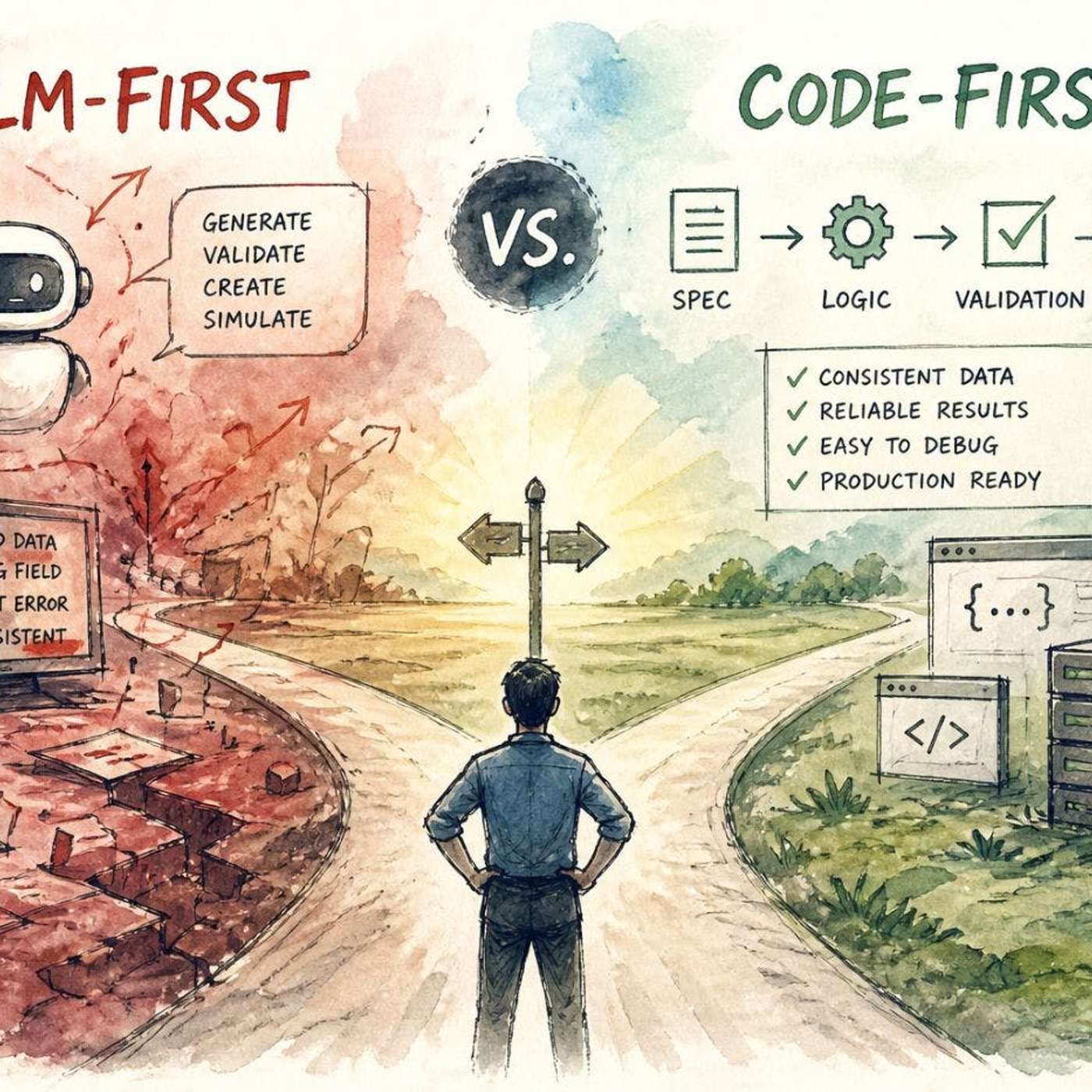
LLMs in production don't often crash spectacularly. Instead, they introduce subtle, probabilistic errors—like incorrect enum values or missing fields—that are hard to debug because they lack clear error patterns, unlike deterministic code failures.