Get your free personalized podcast brief
We scan new podcasts and send you the top 5 insights daily.
Instead of pursuing broad, shallow integrations, Practice by Numbers focused its engineering on the five largest Practice Management Systems. This strategic decision provided access to 70-80k dental offices, maximizing market penetration with minimal wasted effort and creating a significant moat.

Related Insights
Instead of only selling to individual dental offices, Flossy leverages its deep relationships with private equity firms. By selling directly to the PE firms that own large dental service organizations (DSOs), they create an efficient top-down channel to sign deals covering hundreds of locations at once.

Product stickiness in health systems is achieved through deep workflow integration. By embedding a solution into the daily processes of every stakeholder—from medical assistants to billing coordinators—it becomes entrenched and difficult to replace, mirroring the zero-churn model of EMR giant Epic.

A powerful, non-obvious moat for software is deep integration with hardware. DJ software Serato partnered with hardware makers like Pioneer, becoming the industry standard. This makes switching extremely costly for users who have invested thousands in hardware, creating a durable competitive advantage.

Practice by Numbers began as an analytics layer on top of core dental PMS. They strategically expanded by building solutions for all adjacent needs (payments, phones, booking), creating a comprehensive "practice in a box" that simplifies the tech stack and dramatically increases customer value.
Two dominant strategies are winning. Companies can either be the absolute best at one specific thing (e.g., musculoskeletal care, women's health) or build a platform that aggregates these best-in-class solutions into a seamless 'digital front door' for insurers and corporations.

For AI companies like Talent Sprout, a key differentiator isn't the model itself. True defensibility comes from creating a streamlined user experience for a specific workflow (like candidate screening) and building deep integrations into the existing ecosystem (e.g., 50+ applicant tracking systems). This creates value beyond the core AI functionality.

Practice by Numbers competes with incumbents like Dentrix because they are owned by large supply companies, not tech companies. This fundamental difference in DNA means incumbents lack the technical skills and agility to innovate at the same speed, creating a durable competitive advantage.
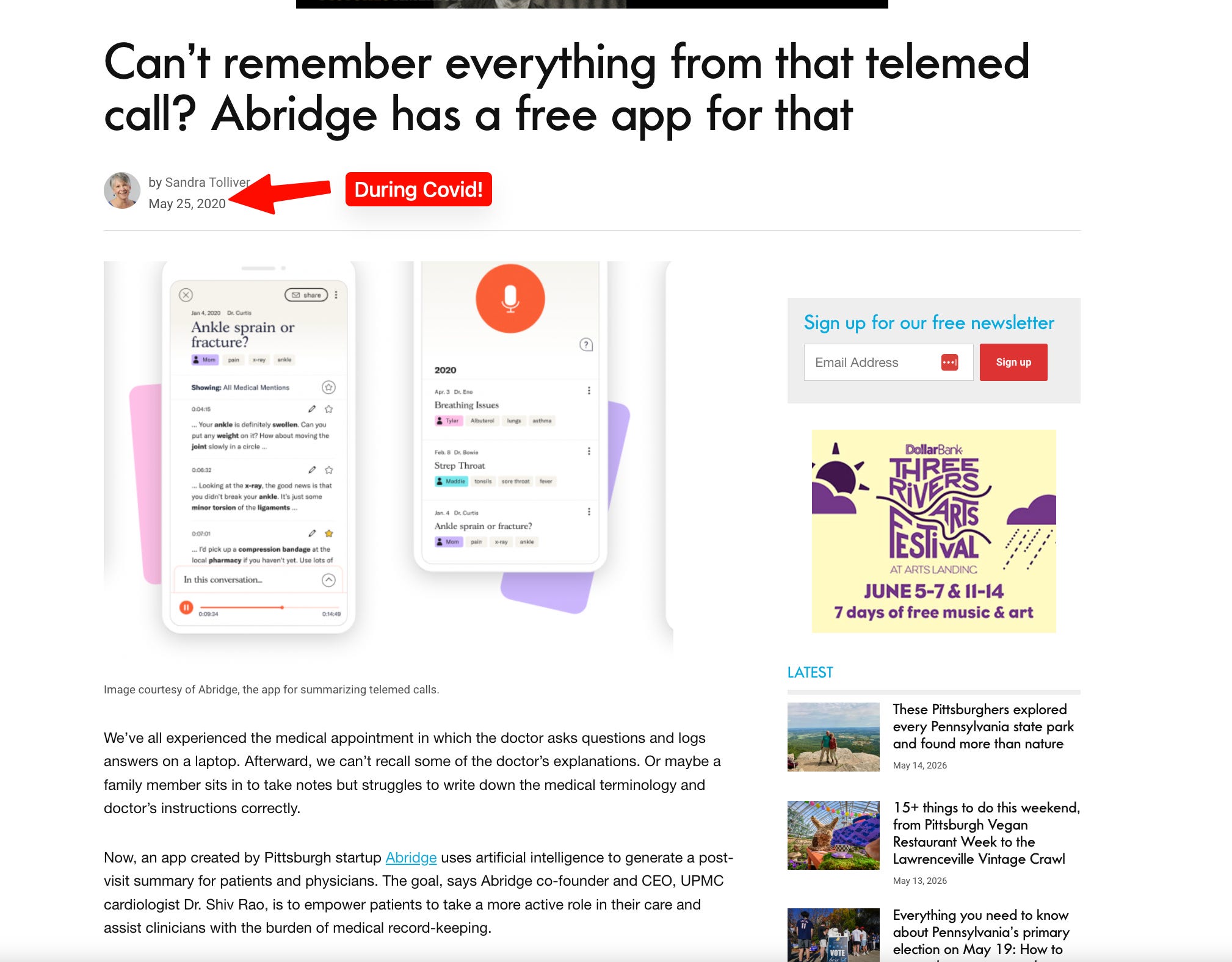
While proprietary data and high-quality models are important, Abridge's true moat lies in its deep integration into the clinical workflow. By solving problems like prior authorization in real-time while the patient is still in the room, it collapses weeks of administrative latency into minutes, creating value that is hard to replicate.
Flossy's AI receptionist beats general tools like Intercom by focusing on the dental industry's primary revenue-generating action: scheduling patients. While horizontal tools are built for conveying information, Flossy's value is in driving bookings, demonstrating a key vertical SaaS strategy of owning the customer's core workflow.
Instead of chasing a larger Total Addressable Market (TAM), Sensei's exclusive focus on the Microsoft ecosystem signals long-term commitment. This assures channel partners like MSPs that Sensei won't pivot, simplifying the partnership and building trust because the strategy is predictable and stable.
