Get your free personalized podcast brief
We scan new podcasts and send you the top 5 insights daily.
Public company CEOs are caught between short-term investor pressure for profitability and the long-term strategic necessity of investing heavily in AI. The challenge is to manage capital allocation to satisfy quarterly expectations while simultaneously funding the fundamental R&D required to compete in the AI era.

Related Insights
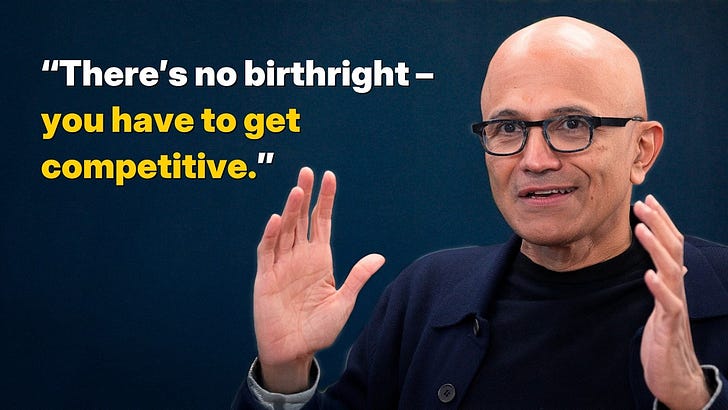
While some competitors prioritize winning over ROI, Nadella cautions that "at some point that party ends." In major platform shifts like AI, a long-term orientation is crucial. He cites Microsoft's massive OpenAI investment, committed *before* ChatGPT's success, as proof of a long-term strategy paying off.

Despite the hype, the financial reality is that companies are investing trillions into AI technology, while the revenue generated is still only in the billions. This significant gap raises questions about long-term sustainability and the timeline for profitability that leaders must address.
Tech giants like Google and Microsoft are spending billions on AI not just for ROI, but because failing to do so means being locked out of future leadership. The motivation is to maintain their 'Mag 7' status, which is an existential necessity rather than a purely economic calculation.

Companies like Apple condition shareholders to expect steady profits and buybacks. This creates a trap, making it difficult to pivot to heavy, profit-reducing investments (like major AI CapEx) that shareholders of growth-stage firms tolerate.

To navigate the massive capital requirements of AI, Nadella reframes the investment in cutting-edge training infrastructure. Instead of being purely reactive to customer demand, a significant portion is considered R&D, allowing for sustained, order-of-magnitude scaling necessary for breakthroughs.
Mature B2B SaaS companies, after achieving profitability, now face a new crisis: funding expensive AI agents to stay competitive. They must spend millions on inference to match venture-backed startups, creating a dilemma that could lead to their demise despite having a solid underlying business.

Enterprise surveys show a major shift: CEOs are taking direct control of AI initiatives from CIOs. They are increasingly willing to make substantial, long-term investments in AI—even if a recession hits or if tangible ROI isn't immediately measurable—viewing it as an existential imperative for survival and growth.

The current era of broad enterprise AI experimentation will end. The CEO foresees 2026 as a "year of rationalization," where CFO pressure will force companies to consolidate AI tools and cut vendors that fail to demonstrate tangible productivity gains and clear return on investment.

Established SaaS companies with strong, but not explosive, growth will struggle to raise new venture capital. Their path forward involves running a capital-efficient business while aggressively integrating AI to create new tailwinds, or else face a long, slow grind to a modest exit without further investment.

Sierra CEO Bret Taylor argues that transitioning from per-seat software licensing to value-based AI agents is a business model disruption, not just a technological one. Public companies struggle to navigate this shift as it creates a 'trough of despair' in quarterly earnings, threatening their core revenue before the new model matures.
