Get your free personalized podcast brief
We scan new podcasts and send you the top 5 insights daily.
Contrary to assumption, Toast discovered its least tech-savvy customers were quickest to adopt its AI assistant. Natural language interfaces allowed them to bypass learning complex software workflows, making them power users simply by asking questions in plain English.

Related Insights
Traditionally, business users must queue up requests with data science teams for insights, causing delays. AI changes this by enabling non-technical users to query enterprise data directly using natural language, receiving answers in seconds and empowering faster, data-driven decisions.
The narrative that AI agents are only for power users appears wrong. High engagement from non-technical people with complex tools suggests a massive, underestimated consumer appetite for agentic AI beyond simple work tasks, indicating the total market is far larger than assumed.

Instead of relying solely on top-down, consultant-led workflow automation, enterprises should empower individual employees with AI tools. This builds user fluency and intuition, allowing them to pull AI into their own workflows, resulting in greater overall impact and less disempowerment.
While advanced AI agents like Hermes and OpenClaw cater to power users with increasing complexity, Instinct wins the mass market by focusing on radical simplicity. Its 'agent for everyone' approach proves that accessibility trumps feature-richness for broad adoption by non-technical users.

Advanced AI agent platforms are no longer just for developers. Companies like Adaptive are explicitly targeting non-technical small business owners, indicating a strategic push for mass-market adoption and a focus on practical, real-world business automation away from tech-savvy early adopters.
New users hesitate with open-ended AI prompts. Successful products overcome this by offering constrained, guided entry points like slash commands, templates, or contextual suggestions. This reduces user uncertainty and boosts consistent use, making adoption easier.
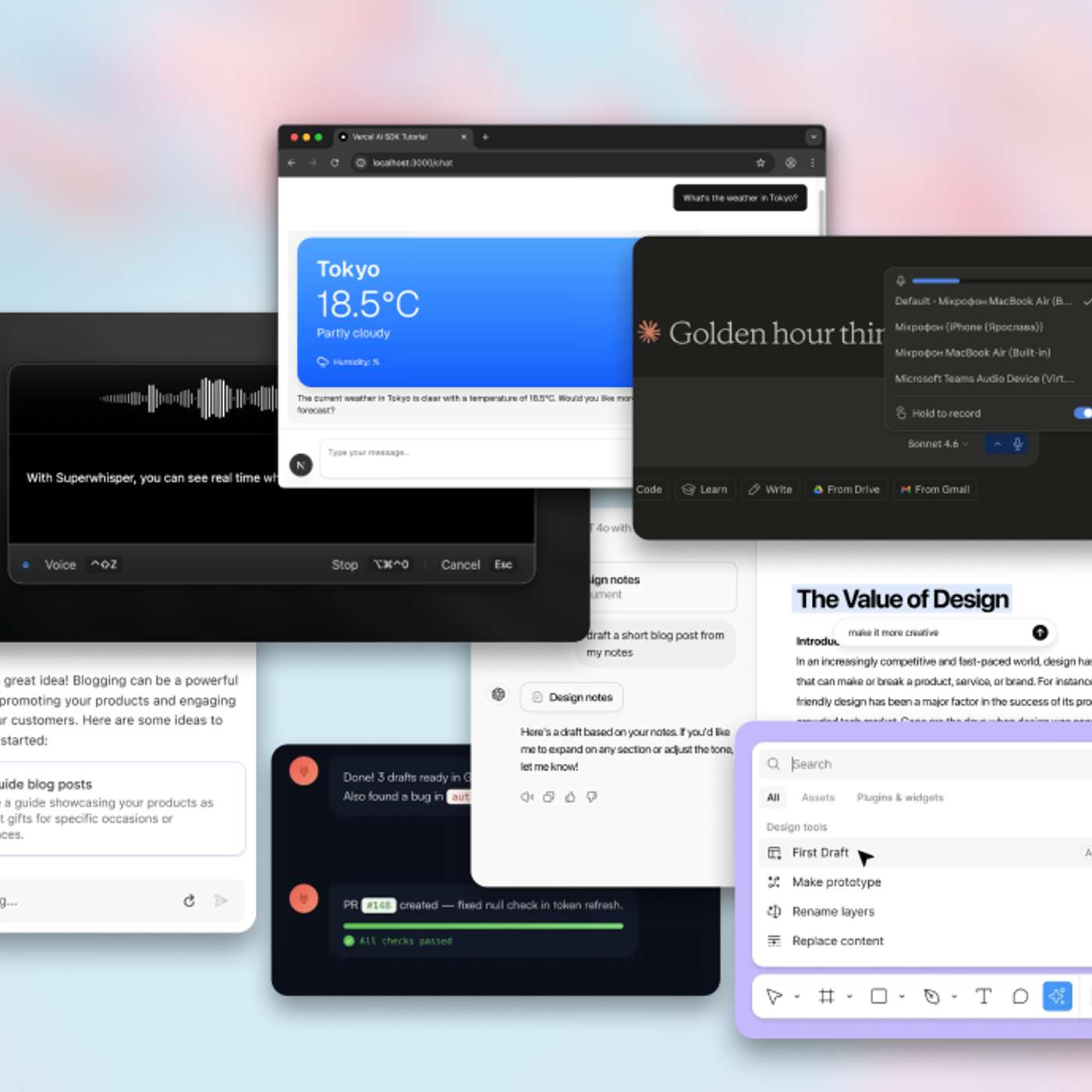
Anthropic's Cowork isn't a technological leap over Claude Code; it's a UI and marketing shift. This demonstrates that the primary barrier to mass AI adoption isn't model power, but productization. An intuitive UI is critical to unlock powerful tools for the 99% of users who won't use a command line.
A truly "AI-native" product isn't one with AI features tacked on. Its core user experience originates from an AI interaction, like a natural language prompt that generates a structured output. The product is fundamentally built around the capabilities of the underlying models, making AI the primary value driver.

Filevine discovered that customers prefer to ask its AI assistant, Lois, questions even when the answer is displayed directly on the screen in front of them. This indicates a fundamental shift in user behavior toward conversational interfaces, making them faster and more intuitive to train and use.

Instead of setup menus, users onboard Lindy through conversation, just as they would with a human. Telling it "after my meetings, I want you to update my CRM" is the entire configuration process, drastically lowering the adoption barrier for non-technical users.