Get your free personalized podcast brief
We scan new podcasts and send you the top 5 insights daily.
Parameter size alone fails to measure real-world performance when smaller models solve identical reasoning problems using significantly fewer tokens. Dense reasoning models reduce token consumption by three to four times, translating directly into faster inference and reduced operating expenses.

Related Insights
Instead of using massive, expensive LLMs for every task, companies can solve the "tokenpocalypse" (runaway token costs) by pairing smaller models with high-quality retrieval systems. This allows cheap models to act like large ones, saving significant costs.

Recent AI model releases are not just cheaper on a per-token basis. They are also engineered to use significantly fewer tokens to generate responses, creating a compound cost-saving effect for users. This signals a strategic shift from raw capability to practical, everyday efficiency.

As enterprise usage ramps up, LLM token bills threaten corporate budgets, creating intense pressure on CIOs and CFOs to reduce costs. Enterprises do not need frontier-grade intelligence for every workflow; near-frontier open-weight models that trail frontier models by 6 to 12 months can handle 90% of reasoning, coding, and agentic tasks at a third of the cost. This dynamic will force enterprises to downgrade non-critical workloads away from expensive closed models.

Reflection achieved high token efficiency on its 500-billion-parameter Beam model by scaling reinforcement learning across 10,500 GPUs and 100 million rollouts. Rather than rewarding only task completion, the training pipeline explicitly rewarded the model for solving tasks using the fewest possible tokens. Combining compute-efficient token generation with token-saving problem solving creates a specialized reasoner that prevents enterprise inference costs from ballooning.
When designing smaller models, it's inefficient to use limited parameters for memorizing facts that can be looked up. Jeff Dean advocates for focusing a model's capacity on core reasoning abilities and pairing it with a retrieval system. This makes the model more generally useful, as it can access a vast external knowledge base when needed.
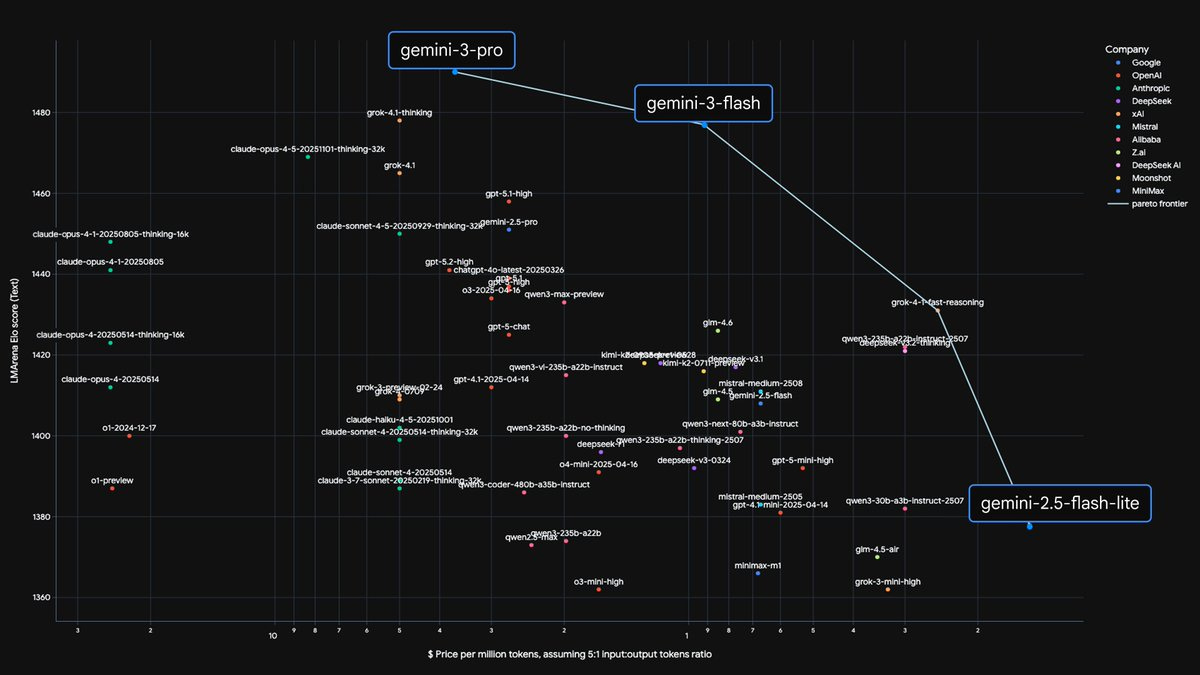
Classifying a model as "reasoning" based on a chain-of-thought step is no longer useful. With massive differences in token efficiency, a so-called "reasoning" model can be faster and cheaper than a "non-reasoning" one for a given task. The focus is shifting to a continuous spectrum of capability versus overall cost.

Allocating substantial compute budgets to reinforcement learning rather than pure pre-training trains models to prune unproductive search paths. This produces models that reach correct conclusions in a fraction of the inference time, cutting token latency and infrastructure costs for production workloads.

The massive 2.8 trillion parameter count of Kimi K3 is misleading for cost analysis. Its Mixture of Experts (MOE) architecture activates only 16 of its 896 expert submodules per token. This makes the model computationally efficient and affordable for inference despite its enormous total capacity.

The binary distinction between "reasoning" and "non-reasoning" models is becoming obsolete. The more critical metric is now "token efficiency"—a model's ability to use more tokens only when a task's difficulty requires it. This dynamic token usage is a key differentiator for cost and performance.
Focusing on token pricing is misleading. A more powerful model may be more expensive per token but significantly cheaper per task because its higher efficiency requires fewer prompts and iterations to achieve a final result. The correct way to measure cost-effectiveness is by the total cost to complete a job, not the price of the raw material.
