Get your free personalized podcast brief
We scan new podcasts and send you the top 5 insights daily.
The first TPU's breakthrough performance came from radical design choices. It eliminated hardware caches, which are less useful for predictable AI memory access, and introduced bfloat16, a floating-point format prioritizing range (exponent) over precision (fraction), perfectly suited for neural networks.

Related Insights
The AI hardware market is fragmenting. Google is now producing two distinct eighth-generation TPUs: one for training (8t) and one for inference (8i). This move away from one-size-fits-all GPUs shows that optimizing for specific AI workloads is the next competitive frontier.

The competitive landscape for AI chips is not a crowded field but a battle between two primary forces: NVIDIA’s integrated system (hardware, software, networking) and Google's TPU. Other players like AMD and Broadcom are effectively a combined secondary challenger offering an open alternative.

As performance gains from general-purpose CPUs stalled, the industry shifted to domain-specific architectures (DSAs). By designing hardware like GPUs and TPUs for narrow tasks like AI, architects can achieve dramatic performance improvements that are no longer possible with traditional CPUs.
Google isn't betting on a single chip design. It's actively developing three distinct TPU architectures with different partners to avoid being trapped in a "local minima." This hedges against future breakthroughs in model architecture that could render one design obsolete.

Designing custom AI hardware is a long-term bet. Google's TPU team co-designs chips with ML researchers to anticipate future needs. They aim to build hardware for the models that will be prominent 2-6 years from now, sometimes embedding speculative features that could provide massive speedups if research trends evolve as predicted.
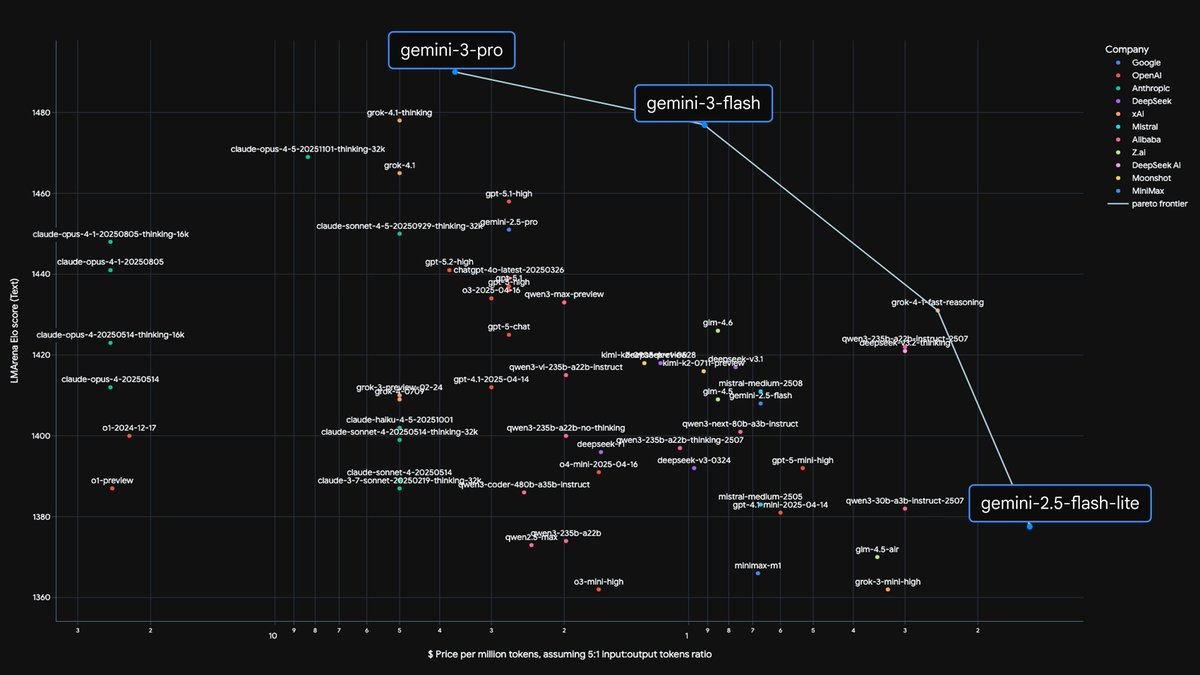
Google successfully trained its top model, Gemini 3 Pro, on its own TPUs, proving a viable alternative to NVIDIA's chips. However, because Google doesn't sell these TPUs, NVIDIA retains its monopoly pricing power over every other company in the market.

Google created its custom TPU chip not as a long-term strategy, but from an internal crisis. Engineer Jeff Dean calculated that scaling a new speech recognition feature to all Android phones would require doubling Google's entire data center footprint, forcing the company to design a more efficient, custom chip to avoid existential costs.

Unlike CPUs that use hardware-managed caches leading to unpredictable latency, AI accelerators like TPUs often use software-managed scratchpads. This gives the programmer explicit control over data placement, ensuring deterministic memory access times critical for synchronizing large parallel computations.

The narrative of NVIDIA's untouchable dominance is undermined by a critical fact: the world's leading models, including Google's Gemini 3 and Anthropic's Claude 4.5, are primarily trained on Google's TPUs and Amazon's Tranium chips. This proves that viable, high-performance alternatives already exist at the highest level of AI development.

While competitors like OpenAI must buy GPUs from NVIDIA, Google trains its frontier AI models (like Gemini) on its own custom Tensor Processing Units (TPUs). This vertical integration gives Google a significant, often overlooked, strategic advantage in cost, efficiency, and long-term innovation in the AI race.
