Get your free personalized podcast brief
We scan new podcasts and send you the top 5 insights daily.
Unlike deterministic SaaS software that works consistently, AI is probabilistic and doesn't work perfectly out of the box. Achieving 'human-grade' performance (e.g., 99.9% reliability) requires continuous tuning and expert guidance, countering the hype that AI is an immediate, hands-off solution.

Related Insights
While AI can attempt complex, hour-long tasks with 50% success, its reliability plummets for longer operations. For mission-critical enterprise use requiring 99.9% success, current AI can only reliably complete tasks taking about three seconds. This necessitates breaking large problems into many small, reliable micro-tasks.
While consumer AI tolerates some inaccuracy, enterprise systems like customer service chatbots require near-perfect reliability. Teams get frustrated because out-of-the-box RAG templates don't meet this high bar. Achieving business-acceptable accuracy requires deep, iterative engineering, not just a vanilla implementation.
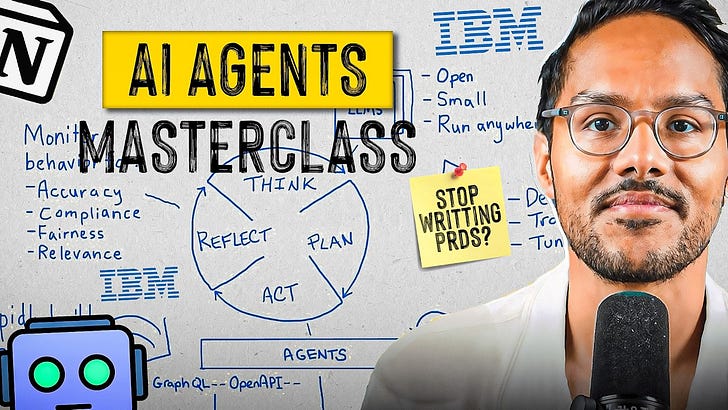
Effective enterprise AI deployment involves running human and AI workflows in parallel. When the AI fails, it generates a data point for fine-tuning. When the human fails, it becomes a training moment for the employee. This "tandem system" creates a continuous feedback loop for both the model and the workforce.
Instead of waiting for AI models to be perfect, design your application from the start to allow for human correction. This pragmatic approach acknowledges AI's inherent uncertainty and allows you to deliver value sooner by leveraging human oversight to handle edge cases.

AI is not a 'set and forget' solution. An agent's effectiveness directly correlates with the amount of time humans invest in training, iteration, and providing fresh context. Performance will ebb and flow with human oversight, with the best results coming from consistent, hands-on management.
Enterprises struggle to get value from AI due to a lack of iterative, data-science expertise. The winning model for AI companies isn't just selling APIs, but embedding "forward deployment" teams of engineers and scientists to co-create solutions, closing the gap between prototype and production value.

AI evaluation shouldn't be confined to engineering silos. Subject matter experts (SMEs) and business users hold the critical domain knowledge to assess what's "good." Providing them with GUI-based tools, like an "eval studio," is crucial for continuous improvement and building trustworthy enterprise AI.
Off-the-shelf AI models can only go so far. The true bottleneck for enterprise adoption is "digitizing judgment"—capturing the unique, context-specific expertise of employees within that company. A document's meaning can change entirely from one company to another, requiring internal labeling.

The evolution of Tesla's Full Self-Driving offers a clear parallel for enterprise AI adoption. Initially, human oversight and frequent "disengagements" (interventions) will be necessary. As AI agents learn, the rate of disengagement will drop, signaling a shift from a co-pilot tool to a fully autonomous worker in specific professional domains.
The most fundamental challenge in AI today is not scale or architecture, but the fact that models generalize dramatically worse than humans. Solving this sample efficiency and robustness problem is the true key to unlocking the next level of AI capabilities and real-world impact.