Get your free personalized podcast brief
We scan new podcasts and send you the top 5 insights daily.
Elicit built a Domain-Specific Language (DSL) defining reasoning primitives as microservices. Frontier models orchestrate these primitives to create structured workflows, ensuring complex processes run exactly as defined and overcoming the inherent unreliability of standard LLMs for high-stakes tasks.

Related Insights
Contrary to the vision of free-wheeling autonomous agents, most business automation relies on strict Standard Operating Procedures (SOPs). Products like OpenAI's Agent Builder succeed by providing deterministic, node-based workflows that enforce business logic, which is more valuable than pure autonomy.

Don't give LLMs full control. Use deterministic code for core logic, validation, and enforcing rules. Delegate only tasks requiring flexibility or understanding of unstructured input to the LLM, treating it as a specialized component, not the entire system.
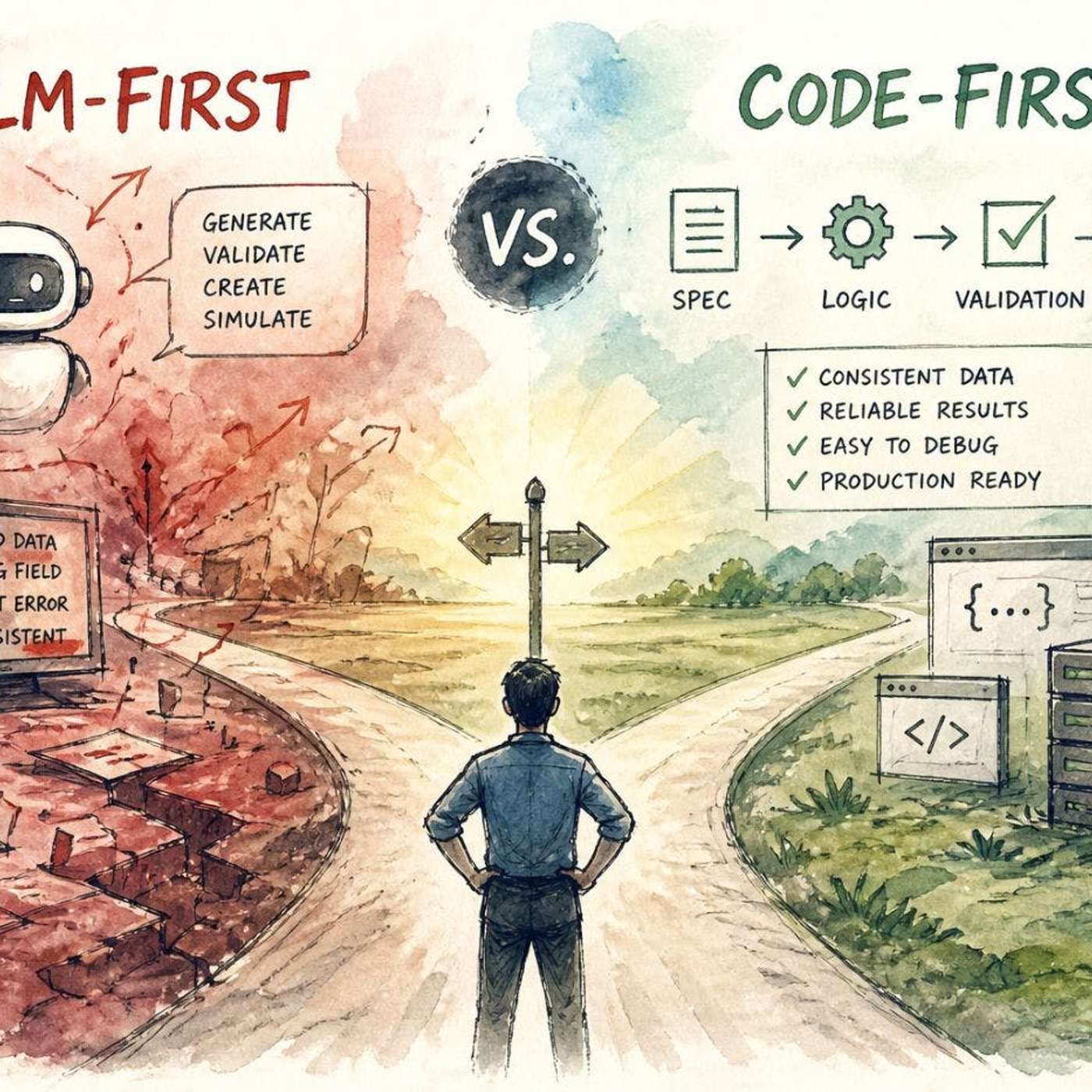
To ensure reliability in healthcare, ZocDoc doesn't give LLMs free rein. It wraps them in a hybrid system where traditional, deterministic code orchestrates the AI's tasks, sets firm boundaries, and knows when to hand off to a human, preventing the 'praying for the best' approach common with direct LLM use.

The Qwopus model is distinguished by its perfect scores on both tool calling and agentic reasoning benchmarks. This high degree of reliability in planning, error recovery, and tool selection makes it an ideal foundation for building sophisticated, multi-step AI agents and automated workflows.

For critical enterprise functions like financial modeling, 99.9% accuracy from a probabilistic LLM is unacceptable. Platforms like Salesforce's Agent Force 360 solve this by layering deterministic logic and guardrails on top of the AI, ensuring compliance and preventing costly errors where even a 0.1% failure rate is too high.

Building reliable AI agents for finance, where accuracy is critical, requires moving beyond pure LLMs. Xero uses a hybrid system combining LLM-driven workflows with programmatic code and deep domain knowledge to ensure control and reliability that LLMs inherently lack.

Relying solely on natural language prompts like 'always do this' is unreliable for enterprise AI. LLMs struggle with deterministic logic. Salesforce developed 'AgentForce Script,' a dedicated language to enforce rules and ensure consistent, repeatable performance for critical business workflows, blending it with LLM reasoning.

Purely probabilistic LLMs are unreliable for critical business processes. GetVocal's architecture uses a deterministic "context graph" based on user intentions as the core decision-making engine. This provides traceability and reliability, while selectively calling generative models for conversational nuance.

As AI models execute tasks via function calling, their internal state is insufficient for reliable, repeatable business outcomes. They must integrate with external systems (like BPMS) to become predictable "runtimes," ensuring consistent results despite prompt failures or hallucinations.

For users in life sciences, an AI tool's value lies not just in its power but its ability to apply the exact same reasoning process consistently over thousands of data points. Elicit guarantees the 9,999th item is analyzed identically to the 5th, providing trust at scale.