Get your free personalized podcast brief
We scan new podcasts and send you the top 5 insights daily.
As AI models reach sufficient intelligence for tasks like coding, the critical bottleneck becomes speed. Ultra-fast models enable interactive, real-time collaboration, allowing a developer to build software with an AI assistant without breaking their creative 'flow' state.

Related Insights
Altman argues that AI model speed is as critical as intelligence for creative work. Using extremely fast models creates an immediate connection between a creator and their creation, shortens the iterative thinking loop, and makes a 'wild difference' in problem-solving. Latency is not just a performance metric; it's a constraint on creativity.

For vertical AI applications, foundation models are now sufficiently intelligent. The primary challenge is no longer model capability but building the surrounding software infrastructure—tools, UIs, and workflows—that lets models perform useful work reliably and trustworthily.

The goal for computer use agents has shifted beyond mimicking human actions to exceeding them in speed. The primary bottleneck is no longer the AI's reasoning but the real-world latency of the software it operates, like website loading times. This changes how developers must think about agent performance optimization.

Previously, implementing a new algorithm could take weeks, leaving compute idle. With advanced coding assistants, ideas can be prototyped in hours, making the availability of compute resources to run experiments the primary limiting factor for progress again.

As frontier AI models reach a plateau of perceived intelligence, the key differentiator is shifting to user experience. Low-latency, reliable performance is becoming more critical than marginal gains on benchmarks, making speed the next major competitive vector for AI products like ChatGPT.

Historically, the 'build' phase was the primary bottleneck in software development. With AI making building nearly instantaneous, the critical path to success has shifted. Mastery of the 'define' (scoping) and 'feedback' (learning) stages is now what separates winning teams from the rest.

The focus in AI engineering is shifting from making a single agent faster (latency) to running many agents in parallel (throughput). This "wider pipe" approach gets more total work done but will stress-test existing infrastructure like CI/CD, which wasn't built for this volume.
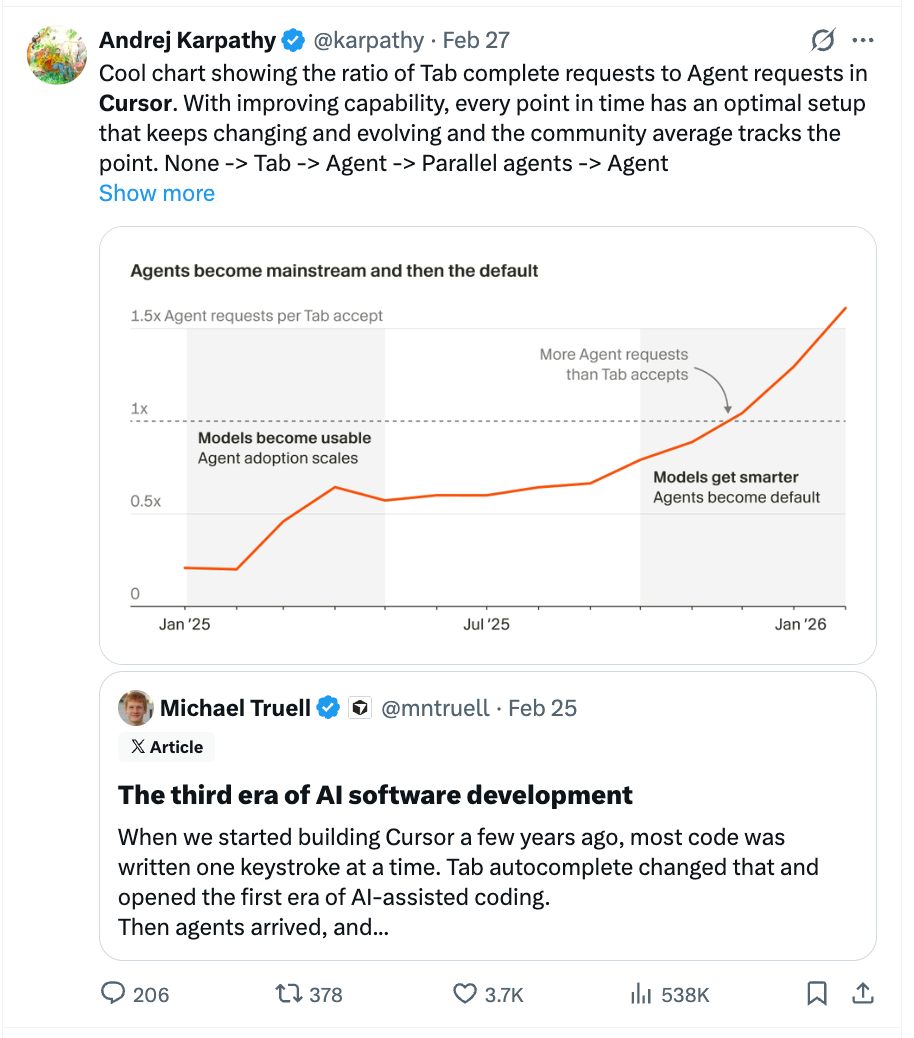
AI tools dramatically speed up code implementation, making engineering velocity less of a constraint. The new challenge becomes the slower, more considered process of deciding *what* to build, placing a premium on strategic design thinking and choosing when to be deliberate.

OpenAI is exploring how extremely fast models can replace deterministic scripts for tasks like Git operations. A model can handle errors and complex states more intelligently than a rigid script, and when latency is low enough, it becomes a viable alternative for UI button-click actions.

Cursor's founder predicts AI developer tools will bifurcate into two modes: a fast, "in-the-loop" copilot for pair programming, and a slower, asynchronous "agent" that completes entire tasks with perfect accuracy. This requires building products optimized for both speed and correctness.