Get your free personalized podcast brief
We scan new podcasts and send you the top 5 insights daily.
Significant advances in AI models around February 2024 created a new dividing line in software. Any company with a pre-dating codebase now has substantial technical debt. However, these same new AI tools also make refactoring and paying down that debt faster than ever before.

Related Insights
The rapid pace of development enabled by AI doesn't eliminate technical debt; it accelerates its creation. More code shipped faster means more potential bugs, maintenance overhead, and architectural risk that must be managed proactively, not just reactively.

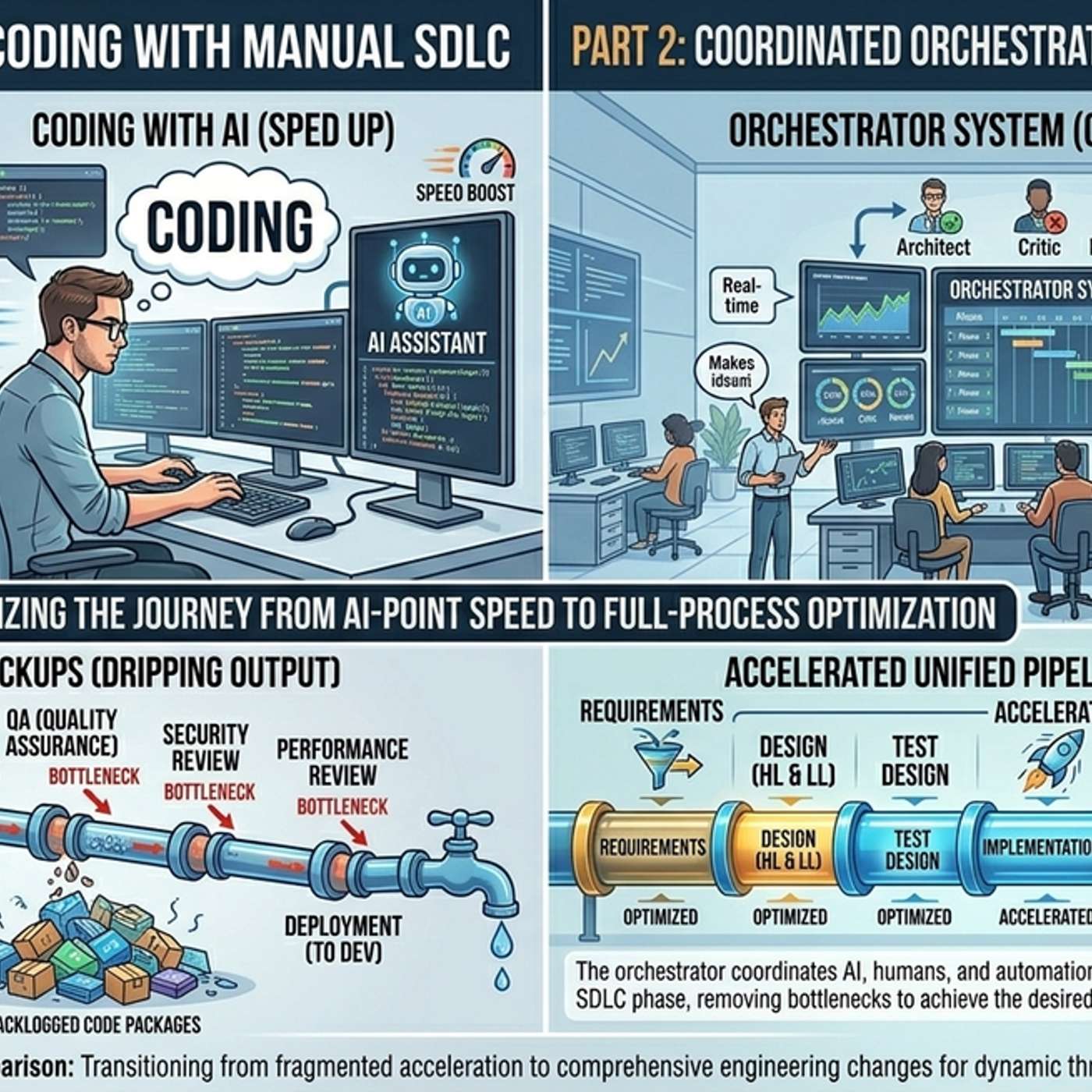
Unlike AI tools that just accelerate coding (and thus tech debt), an AI-orchestrated SDLC enforces consistency in documentation and testing. This creates a compounding benefit where the codebase becomes stronger and easier to maintain with each new feature, actively reversing the typical trend of system fragility over time.
The narrative that AI coding decreases quality is outdated. Advanced models like GPT-5.5 excel at complex, systemic tasks that humans often avoid, such as resolving security vulnerabilities or refactoring legacy code, allowing teams to proactively raise their quality bar.

Unlike normal technical debt, 'agentic technical debt' compounds rapidly. Without persistent, written architectural constraints, AI coding tools re-derive foundational decisions in each session, causing the codebase to drift incoherently. The solution is to document architectural principles before building to give the AI context and prevent entropy.

Classic software engineering warns against full rewrites due to risk and time ("second-system syndrome"). However, AI's ability to rebuild an entire product in days, not years, makes rewriting a powerful and low-cost tool for correcting over-complicated early versions or flawed core assumptions.

AI makes achieving a zero-item backlog a feasible reality. The ability to quickly resolve tech debt, perform migrations, and tackle long-standing "wish list" items means teams no longer have to choose between maintenance and new features.

AI-driven approaches dramatically reduce the time and cost of modernizing legacy systems. What was once a multi-year, multi-million dollar mainframe project can now be completed in as little as 90 days, fundamentally altering the ROI for tackling technology debt.

AI coding tools dramatically accelerate development, but this speed amplifies technical debt creation exponentially. A small team can now generate a massive, fragile codebase with inconsistent patterns and sparse documentation, creating maintenance burdens previously seen only in large, legacy organizations.

In the AI era, technical debt isn't 'ugly' code but anything that slows an AI agent's feedback loop. This includes slow tests, messy system boundaries that the AI will replicate, and poor runtime performance. The focus shifts from human readability to machine-drivable efficiency and safety.

AI coding assistants have recently crossed a critical threshold. They are no longer just for building new features but are now highly effective at refactoring legacy code. This dramatically changes the economics of modernizing established software companies by accelerating the notoriously slow process of paying down technical debt.