Get your free personalized podcast brief
We scan new podcasts and send you the top 5 insights daily.
Unlike normal technical debt, 'agentic technical debt' compounds rapidly. Without persistent, written architectural constraints, AI coding tools re-derive foundational decisions in each session, causing the codebase to drift incoherently. The solution is to document architectural principles before building to give the AI context and prevent entropy.

Related Insights
The rapid pace of development enabled by AI doesn't eliminate technical debt; it accelerates its creation. More code shipped faster means more potential bugs, maintenance overhead, and architectural risk that must be managed proactively, not just reactively.

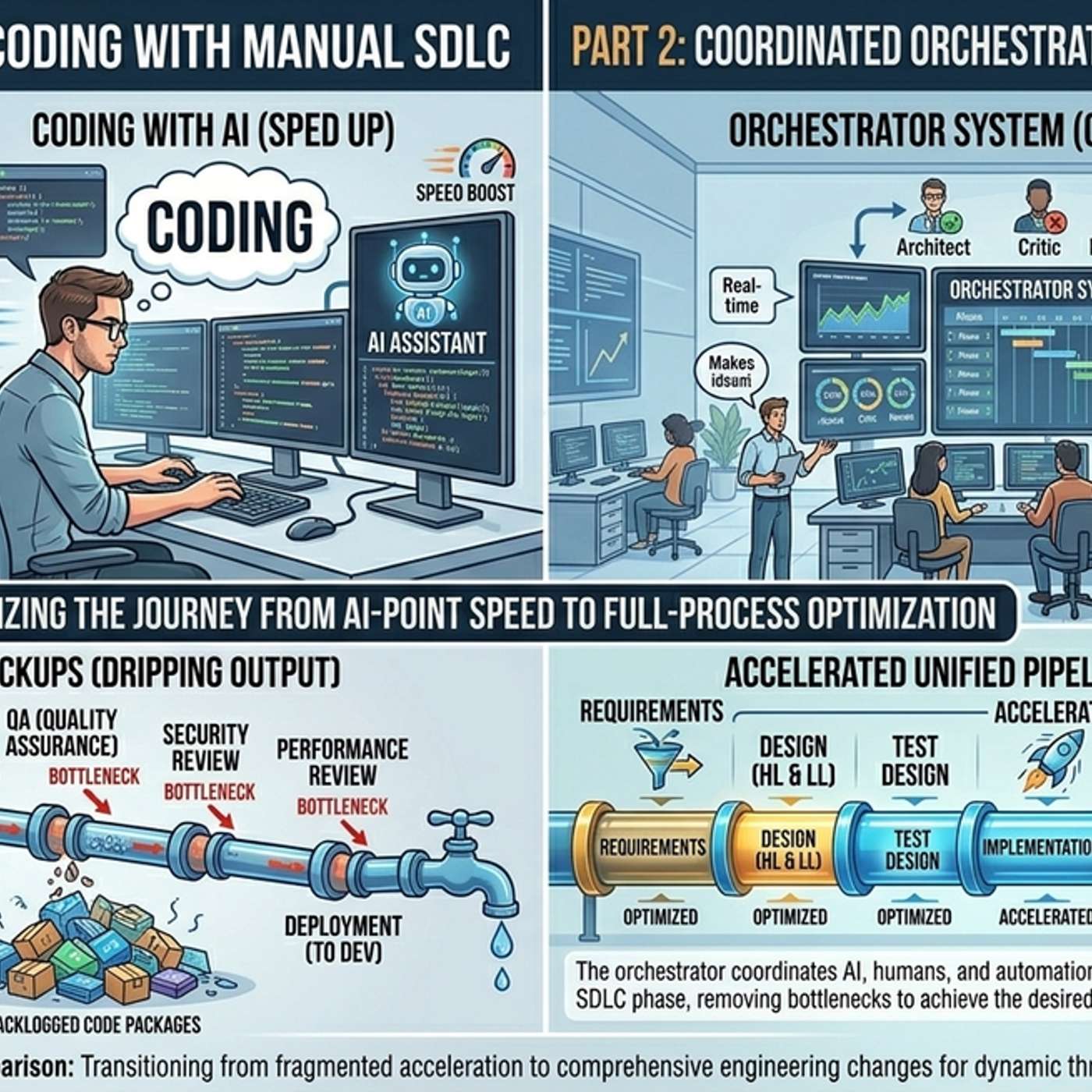
Unlike AI tools that just accelerate coding (and thus tech debt), an AI-orchestrated SDLC enforces consistency in documentation and testing. This creates a compounding benefit where the codebase becomes stronger and easier to maintain with each new feature, actively reversing the typical trend of system fragility over time.
Similar to technical debt in software, "agent debt" arises from quickly hacking together agent workflows without refinement. Over time, this leads to polluted memory, conflicting system prompts, and overlapping tools, causing the agent to behave erratically and become difficult to debug or maintain.

When teams adopt AI-first coding without proper auditing, a negative feedback loop emerges. The AI learns from existing code, adopting and exponentially propagating poor patterns introduced by any engineer. This leads to a rapid decline in overall code quality, as the codebase regresses to its lowest common denominator.

AI coding tools dramatically accelerate development, but this speed amplifies technical debt creation exponentially. A small team can now generate a massive, fragile codebase with inconsistent patterns and sparse documentation, creating maintenance burdens previously seen only in large, legacy organizations.

Meredith Whittaker warns that while AI coding agents can boost productivity, they may create massive technical debt. Systems built by AI but not fully understood by human developers will be brittle and difficult to maintain, as engineers struggle to fix code they didn't write and don't comprehend.

As AI handles code generation, the most durable asset engineers create will shift from the code itself to the documentation that guides the AI. This documentation captures the 'why'—the intention, PRD, and customer problem—making it the essential input for future AI-driven development and iteration.

The productivity boost from AI is not 'free time.' Successful senior developers reallocate minutes saved on code generation towards more rigorous structuring of commits, critical review of AI output, and thoughtful documentation. This discipline prevents the rapid accumulation of AI-generated technical debt.

While developers leverage multiple AI agents to achieve massive productivity gains, this velocity can create incomprehensible and tightly coupled software architectures. The antidote is not less AI but more human-led structure, including modularity, rapid feedback loops, and clear specifications.

After achieving broad adoption of agentic coding, the new challenge becomes managing the downsides. Increased code generation leads to lower quality, rushed reviews, and a knowledge gap as team members struggle to keep up with the rapidly changing codebase.
