Get your free personalized podcast brief
We scan new podcasts and send you the top 5 insights daily.
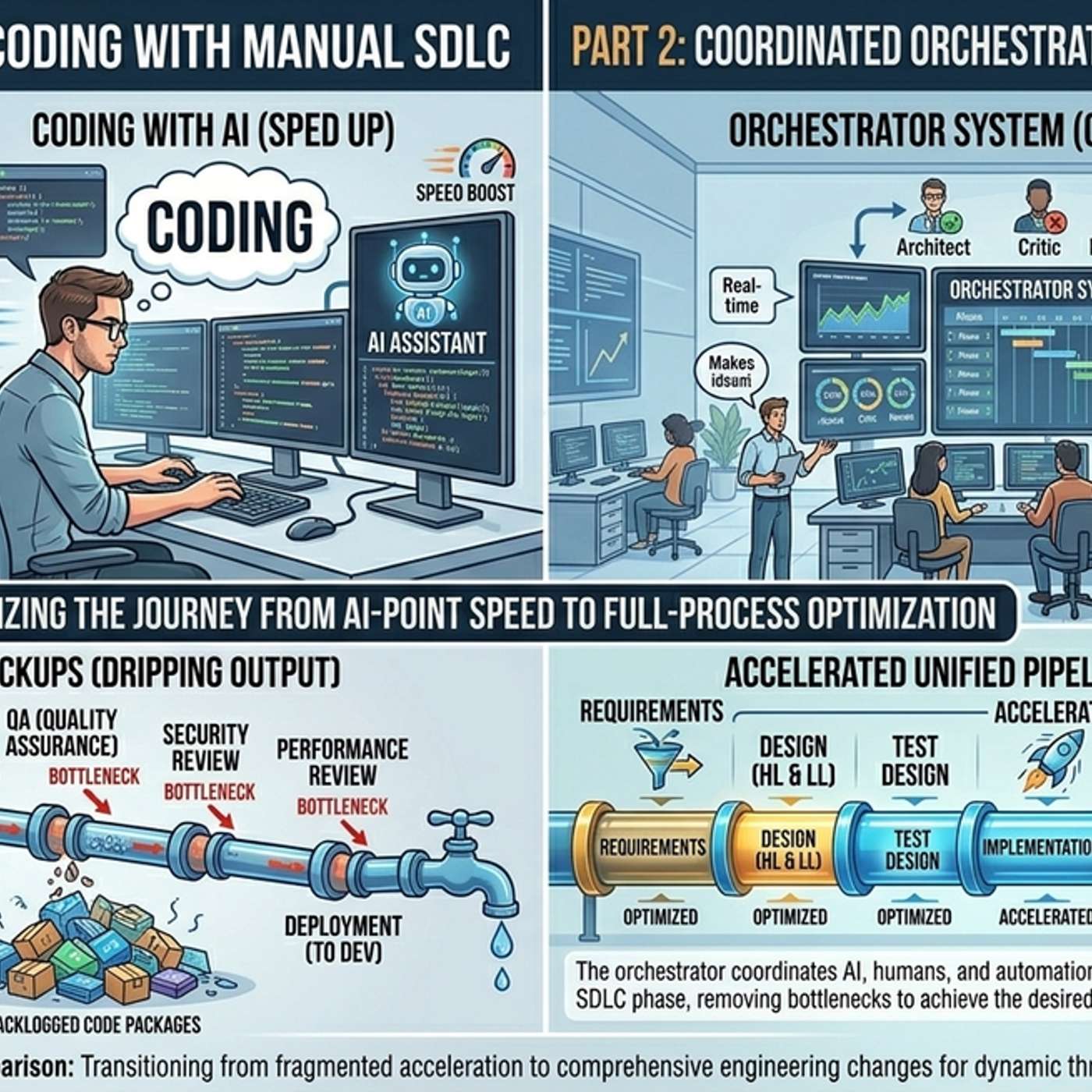
Unlike AI tools that just accelerate coding (and thus tech debt), an AI-orchestrated SDLC enforces consistency in documentation and testing. This creates a compounding benefit where the codebase becomes stronger and easier to maintain with each new feature, actively reversing the typical trend of system fragility over time.
Related Insights
Beyond code generation, Patrick Collison sees a huge opportunity for AI in automated refactoring. He imagines an AI that continuously improves a codebase's architecture, turning the 'detritus' from rapid development into elegant, maintainable systems, thus solving the classic speed-versus-quality tradeoff.

The rapid pace of development enabled by AI doesn't eliminate technical debt; it accelerates its creation. More code shipped faster means more potential bugs, maintenance overhead, and architectural risk that must be managed proactively, not just reactively.

The narrative that AI coding decreases quality is outdated. Advanced models like GPT-5.5 excel at complex, systemic tasks that humans often avoid, such as resolving security vulnerabilities or refactoring legacy code, allowing teams to proactively raise their quality bar.

For AI to manage the software development process from idea to completion, the entire SDLC cannot be an unspoken or abstract set of habits. It must be explicitly documented with defined inputs, tasks, outputs, and quality gates that an AI agent can interpret and execute against.
Instead of codebases becoming harder to manage over time, use an AI agent to create a "compounding engineering" system. Codify learnings from each feature build—successful plans, bug fixes, tests—back into the agent's prompts and tools, making future development faster and easier.

Contrary to fears that AI creates low-quality "slop," Intercom found their code quality improved. AI compresses the cost of fixing tech debt, flaky tests, and other internal projects, making it easier for the business to invest in them.

As AI handles code generation, the most durable asset engineers create will shift from the code itself to the documentation that guides the AI. This documentation captures the 'why'—the intention, PRD, and customer problem—making it the essential input for future AI-driven development and iteration.

Instead of fighting for perfect code upfront, accept that AI assistants can generate verbose code. Build a dedicated "refactoring" phase into your process, using AI with specific rules to clean up and restructure the initial output. This allows you to actively manage technical debt created by AI-powered speed.

When an AI-generated app becomes hard to maintain ("vibe coding debt"), the answer isn't manual fixes, but using the AI again. Users should explain the maintenance problems to the tool and prompt it to rethink the solution from a deeper level, effectively using AI to solve AI-created tech debt.

AI coding assistants have recently crossed a critical threshold. They are no longer just for building new features but are now highly effective at refactoring legacy code. This dramatically changes the economics of modernizing established software companies by accelerating the notoriously slow process of paying down technical debt.
