Get your free personalized podcast brief
We scan new podcasts and send you the top 5 insights daily.
Current language models operate by optimizing statistical patterns without possessing explanatory creativity. Unlike human grandmasters who generate qualitative reasons and novel theories, computers scaling raw calculations cannot produce genuinely new knowledge or solve open-ended problem situations.

Related Insights
Observed AI mathematical breakthroughs operate largely within the convex hull of existing knowledge, recombining recognized results rather than creating novel frameworks. Generating genuinely surprising hypotheses or proposing the next foundational open question remains an unresolved challenge for automated systems.

LLMs shine when acting as a 'knowledge extruder'—shaping well-documented, 'in-distribution' concepts into specific code. They fail when the core task is novel problem-solving where deep thinking, not code generation, is the bottleneck. In these cases, the code is the easy part.

According to Demis Hassabis, LLMs feel uncreative because they only perform pattern matching. To achieve true, extrapolative creativity like AlphaGo's famous 'Move 37,' models must be paired with a search component that actively explores new parts of the knowledge space beyond the training data.

Recursive self-improvement won't trigger a rapid intelligence explosion because AIs currently lack the ability for genuine strategic decision-making and open-ended research. These skills, crucial for major breakthroughs, are far more than just coding, which is what current AIs excel at.
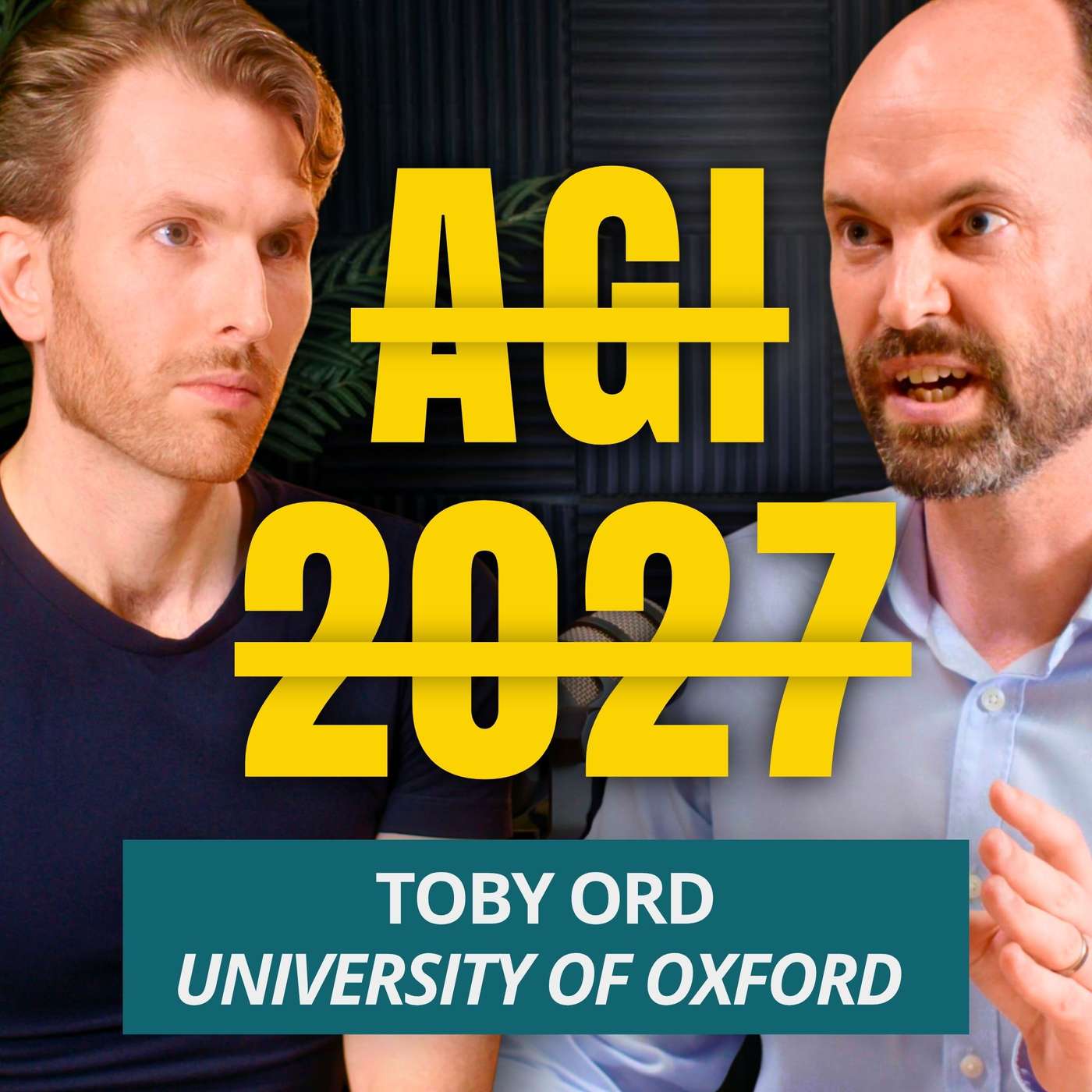
Judea Pearl, a foundational figure in AI, argues that Large Language Models (LLMs) are not on a path to Artificial General Intelligence (AGI). He states they merely summarize human-generated world models rather than discovering causality from raw data. He believes scaling up current methods will not overcome this fundamental mathematical limitation.

Simply making LLMs larger will not lead to AGI. True advancement requires solving two distinct problems: 1) Plasticity, the ability to continually learn without "catastrophic forgetting," and 2) moving from correlation-based pattern matching to building causal models of the world.

According to pioneer Jürgen Schmidhuber, Large Language Models by themselves are insufficient for AGI. True general intelligence requires two components: a predictive "world model" and a separate "controller" network that uses the model to plan and execute actions, like a baby learning through experiments.
Google DeepMind CEO Demis Hassabis argues that today's large models are insufficient for AGI. He believes progress requires reintroducing algorithmic techniques from systems like AlphaGo, specifically planning and search, to enable more robust reasoning and problem-solving capabilities beyond simple pattern matching.
Contrary to popular belief, generative AI like LLMs may not get significantly more accurate. As statistical engines that predict the next most likely word, they lack true reasoning or an understanding of "accuracy." This fundamental limitation means they will always be prone to making unfixable mistakes.

Replit's CEO argues that today's LLMs are asymptoting on general reasoning tasks. Progress continues only in domains with binary outcomes, like coding, where synthetic data can be generated infinitely. This indicates a fundamental limitation of the current 'ingest the internet' approach for achieving AGI.
