Get your free personalized podcast brief
We scan new podcasts and send you the top 5 insights daily.
The AI's power stems from creating a holistic knowledge graph. It integrates deep codebase analysis—including regressions and fixes—with contextual data from project management and support tools like Jira and Zendesk. This mimics how a top-tier human engineer synthesizes disparate information to solve problems.
Related Insights
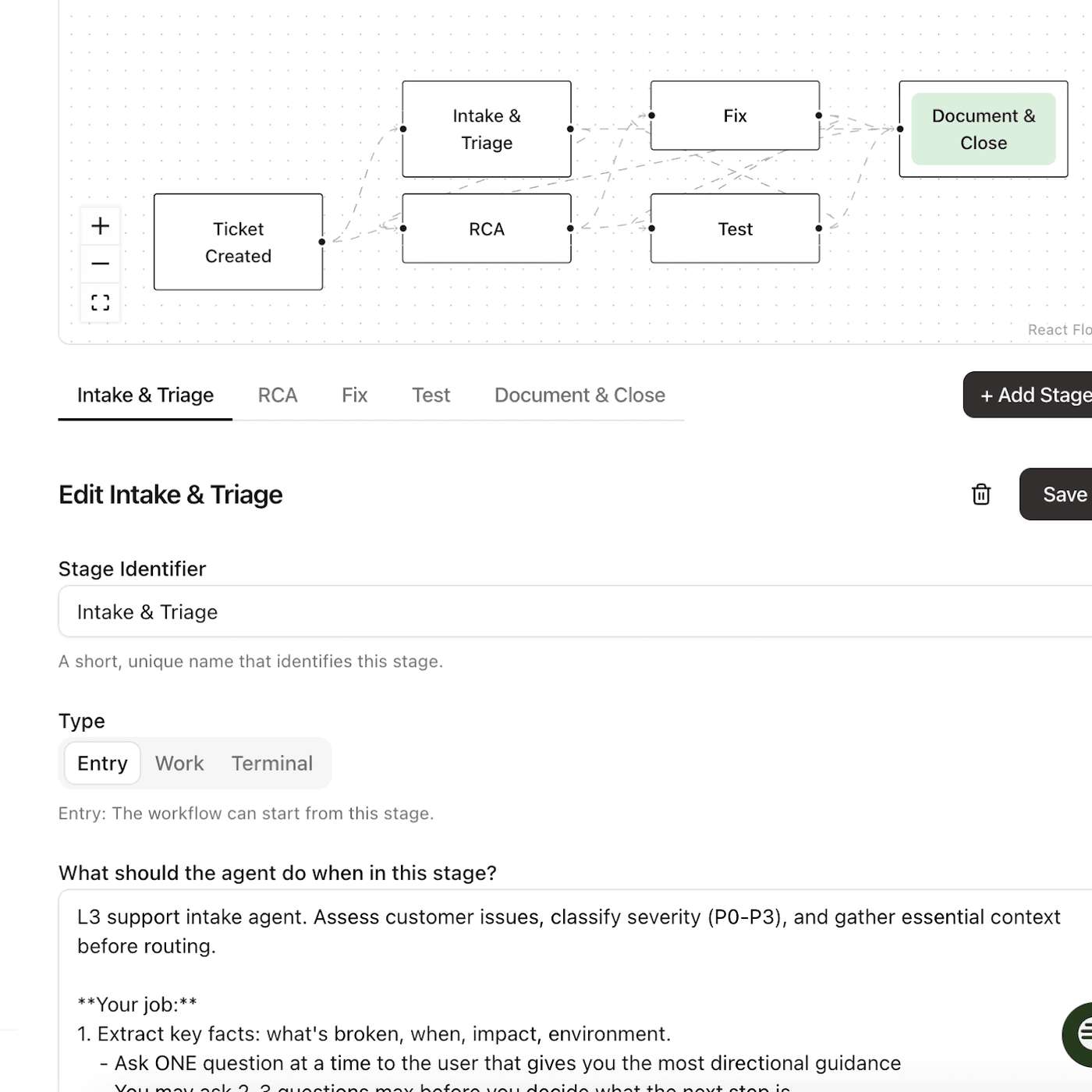
An AI agent monitors a support inbox, identifies a bug report, cross-references it with the GitHub codebase to find the issue, suggests probable causes, and then passes the task to another AI to write the fix. This automates the entire debugging lifecycle.
Company lore and the 'why' behind technical decisions often disappear when employees leave. An AI agent can analyze the entire codebase and its commit history to answer questions and reconstruct narratives, effectively turning your repo into a searchable archive.

The secret to effective enterprise agents is a "living context graph" that continuously crawls and maps all of an organization's data assets—code, databases, APIs, documents. This graph provides the essential, often undocumented, context agents need to reason and execute complex tasks accurately.

AI coding assistants rapidly conduct complex technical research that would take a human engineer hours. They can synthesize information from disparate sources like GitHub issues, two-year-old developer forum posts, and source code to find solutions to obscure problems in minutes.
Off-the-shelf AI support tools lack the deepest context for accurate answers, which is often found only in a company's proprietary source code (e.g., how interest is calculated). Klarna built its own system so its AI could directly access this 'source of truth,' making support a core part of its tech stack.

The evolution of software from human-written code to AI-driven systems requires a new platform. This platform will manage development as a "system graph" or "knowledge graph," a higher abstraction than GitHub's file-based model. OpenAI's internal tool signals this shift away from traditional source control.

The next major advance for AI in software development is not just completing tasks, but deeply understanding entire codebases. This capability aims to "mind meld" the human with the AI, enabling them to collaboratively tackle problems that neither could solve alone.
![[State of Code Evals] After SWE-bench, Code Clash & SOTA Coding Benchmarks recap — John Yang thumbnail](https://assets.flightcast.com/V2Uploads/nvaja2542wefzb8rjg5f519m/01K4D8FB4MNA071BM5ZDSMH34N/square.jpg)
The primary barrier for useful AI agents is not the underlying model but the complex task of 'data wiring'—connecting to a user's real-world context like emails, local files, and support tickets. Products that solve this difficult integration challenge, where most agents currently fail, will gain a significant competitive advantage.

AI agents are simply 'context and actions.' To prevent hallucination and failure, they must be grounded in rich context. This is best provided by a knowledge graph built from the unique data and metadata collected across a platform, creating a powerful, defensible moat.

Mike Cannon-Brookes posits that business acceleration from AI equals `intelligence * context`. Instead of relying solely on large context windows, Atlassian's strategy is to create a rich, pre-indexed "Teamwork Graph." This graph connects code, org charts, and skills, providing cheaper, faster, and more relevant answers from AI agents.