Get your free personalized podcast brief
We scan new podcasts and send you the top 5 insights daily.
A "maximalist" is someone who rejects conventional limitations and believes they can "have it all, right now." While not entirely achievable, this mindset dramatically expands the scope of what one can accomplish by refusing to accept trade-offs that normal people see as necessary.

Related Insights
The barrier to executing complex ideas is lowering thanks to AI. Individuals who were previously just "idea guys" can now handle design, product management, and engineering themselves, turning concepts into reality with unprecedented speed and capability, as noted by OpenAI's CEO.

The conventional wisdom of 'focus on less to achieve more' is inverted by AI. With powerful new tools, the strategic advantage lies in taking on more ambitious projects and exploring ideas that were previously infeasible. AI shaves down the learning curve, making it possible to tackle a wider range of challenges.

OpenAI's CEO believes the term "AGI" is ill-defined and its milestone may have passed without fanfare. He proposes focusing on "superintelligence" instead, defining it as an AI that can outperform the best human at complex roles like CEO or president, creating a clearer, more impactful threshold.

Sam Altman suggests the most successful founders are not just creating companies but are on a mission to build something closer to a religion. This is especially apparent in the AI space, where the technology is developing qualities traditionally associated with God, like omniscience and omnipresence.

Sam Altman believes incumbents who just add AI features to existing products (like search or messaging) will lose to new, AI-native products. He argues true value comes not from summarizing messages, but from creating proactive agents that fundamentally change user workflows from the ground up.
Sam Altman argues there is a massive "capability overhang" where models are far more powerful than current tools allow users to leverage. He believes the biggest gains will come from improving user interfaces and workflows, not just from increasing raw AI intelligence.
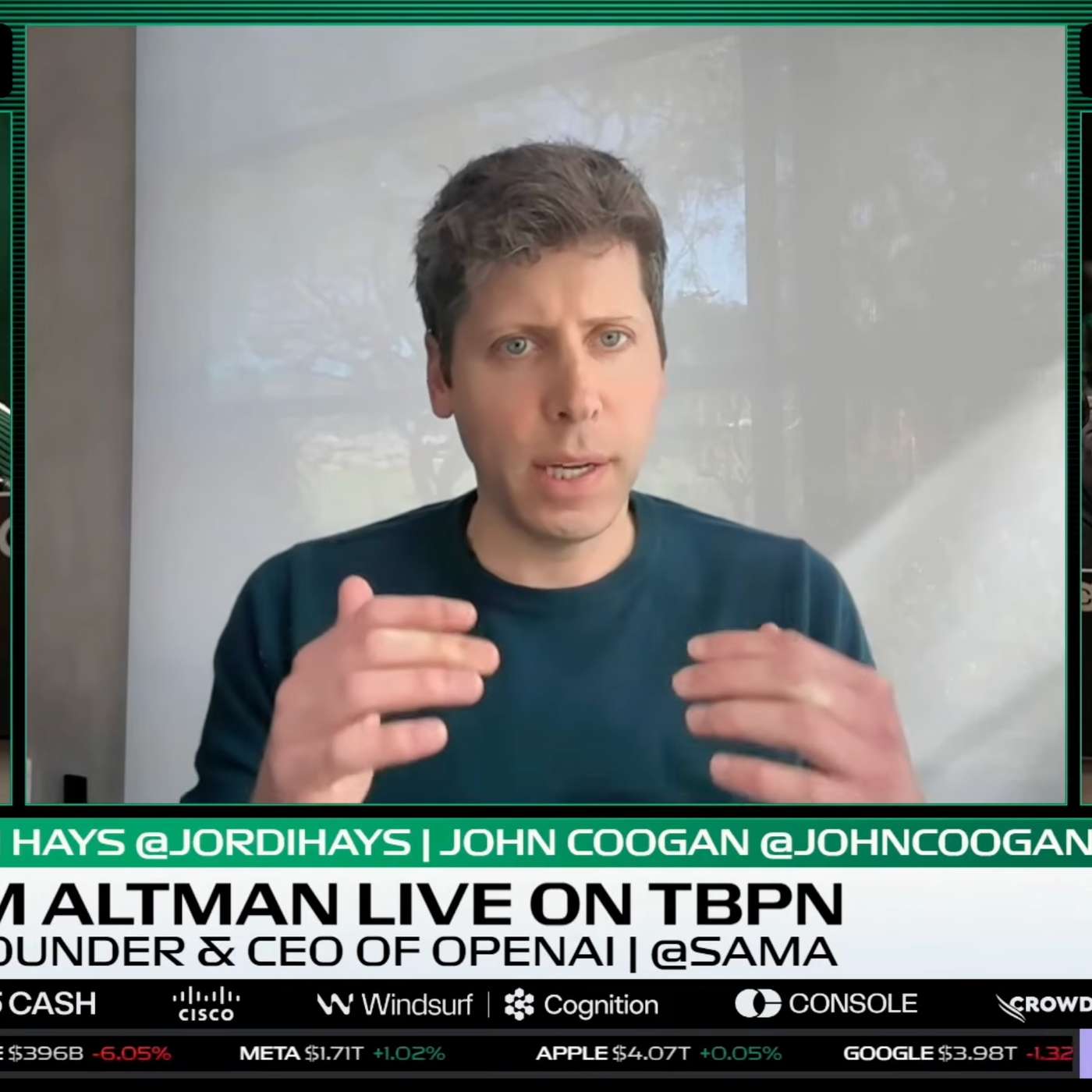
The ultimate goal for companies like OpenAI and Anthropic is not just creating useful products like chatbots, but developing superintelligence—an AI that surpasses human cognitive ability in every domain, akin to the gap between a human and a mouse.

Product teams at OpenAI are guided by three core questions: "Is this maximally accelerated?" for speed, "Are you mainlining it yet?" for intense dogfooding, and pushing for maximum ambition for scope.

Setting exceptionally high goals is critical for outlier success. Even falling short of a massive ambition will produce a better outcome than succeeding at a modest one. The process of striving for greatness generates significant value, regardless of the final result.

Sam Altman believes the transition to AGI will be less dramatic than people expect. He argues that, like self-driving cars, society will adapt quickly to the new capabilities. The "big switch" moment will feel muted, even as it ushers in a new era of abundance.