Get your free personalized podcast brief
We scan new podcasts and send you the top 5 insights daily.
The "Software Factory" maintains a persistent, bi-directional link between requirements docs (PRDs) and production code. A hotfix in production auto-updates the PRD, and a PRD change propagates to code. This "binding" solves documentation drift, a massive pain point for engineering organizations.

Related Insights
Most auto-documentation tools fail because they become outdated after the first code change. Code Wiki's key innovation is its ability to regenerate explanations and diagrams with each commit. This "living documentation" approach ensures the map of the codebase always reflects the current territory, breaking the cycle of stale docs.

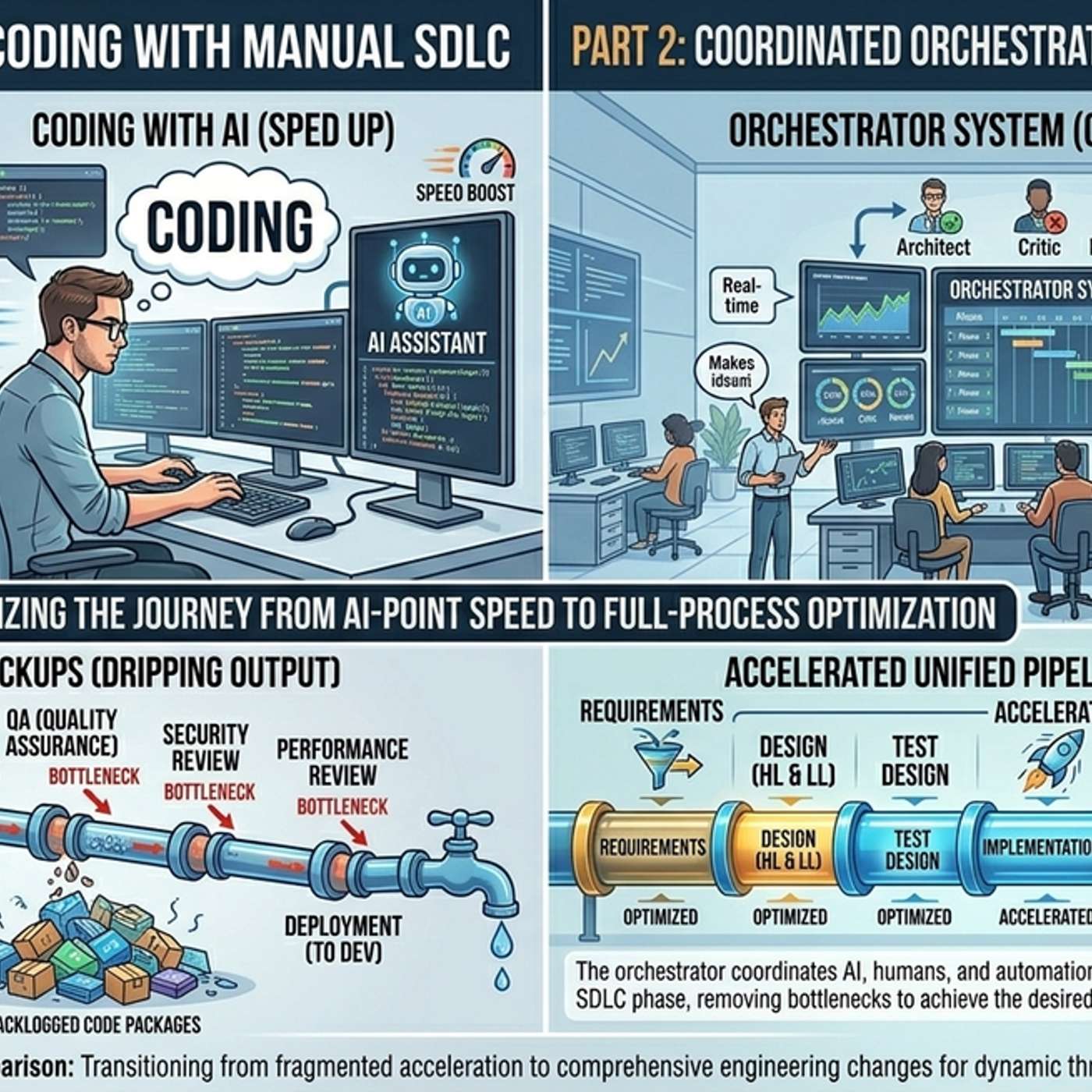
Unlike AI tools that just accelerate coding (and thus tech debt), an AI-orchestrated SDLC enforces consistency in documentation and testing. This creates a compounding benefit where the codebase becomes stronger and easier to maintain with each new feature, actively reversing the typical trend of system fragility over time.
Production code often evolves past design files, creating workflow friction. Figma's MCP tool uses AI to pull live application states directly into design files and push updates back to code, creating a synchronized source of truth.

Moving PRDs and other product artifacts from Confluence or Notion directly into the codebase's repository gives AI coding assistants persistent, local context. This adjacency means the AI doesn't need external tool access (like an MCP) to understand the 'why' behind the code, leading to better suggestions and iterations.

The current model of separate design files and codebases is inefficient. Future tools will enable designers to directly manipulate production code through a visual canvas, eliminating the handoff process and creating a single, shared source of truth for the entire team.

As AI handles code generation, the most durable asset engineers create will shift from the code itself to the documentation that guides the AI. This documentation captures the 'why'—the intention, PRD, and customer problem—making it the essential input for future AI-driven development and iteration.
Snowflake's CEO describes a shift to "spec-driven development," where engineers write English-language requirements and AI automates the coding, testing, and deployment. This transforms the entire software creation process, moving beyond simple code completion to full workflow automation.

Engineering AI tools understand markdown better than complex PRDs in other formats. Product leaders can translate critical user workflows into simple markdown files, providing context to the AI to help it analyze the impact of code changes and identify potential issues.

Documentation is no longer just for humans. AI agents now read it directly as operational input, making its accuracy critical for system function. Outdated docs, once a nuisance, now cause system failures, elevating documentation to the level of essential infrastructure.

Bypass the common problem where team members agree but envision different outcomes. A product leader can use an AI tool like Claude to turn a PRD into a working prototype. This visual artifact provides perfect clarity, ensuring the entire team is aligned on the exact same vision from day one.
