Get your free personalized podcast brief
We scan new podcasts and send you the top 5 insights daily.
Testing on low-grip surfaces like frozen lakes is not just for cold-weather durability. It provides the optimal conditions for refining power and torque delivery with extreme precision. This allows engineers to fine-tune handling characteristics in a way that is impossible on normal surfaces, ensuring control in all conditions.

Related Insights
Contrary to the "floor it the longest" perception, NASCAR is about managing the grip of four tires. Drivers execute perfect arcs while braking at the limit, modulating the throttle, and providing real-time feedback to a team of up to 100 people, turning each lap into a complex, high-speed puzzle.

Competitors often have feature parity for standard use cases. To stand out, focus the conversation on how your product performs in the worst-case scenarios—like a dashcam operating at -20 degrees. This shifts the evaluation from a simple feature checklist to a discussion of reliability and premium quality.

In the late 1970s, the Lotus team revolutionized F1 aerodynamics with the "ground effect" car. By shaping the car's underside like an inverted airplane wing, it created a low-pressure zone that effectively sucked the car to the road. This generated immense downforce for cornering without the drag of large wings, a principle that defines modern car design.

Jaguar's EV platform is the key enabler of ideal performance, not a compromise for environmental reasons. The architecture allows for perfect 50/50 weight distribution, an extremely low center of gravity with the driver at its heart, and instantaneous torque vectoring—advantages nearly impossible to achieve with a combustion engine.
While using advanced digital modeling, Jet Zero gets crucial, rapid feedback by mounting scale models on a truck and driving down a runway. This "cheapest wind tunnel on the planet" demonstrates the irreplaceable value of physical, iterative testing for complex hardware development.

To define the new car's driving essence, Jaguar instructed its engineering team to immerse themselves in its heritage vehicles. The goal wasn't to replicate features but to distill the intangible "feeling" of a Jaguar—power in reserve, control, and refinement—and translate that essence into a modern EV platform.
A key design proportion, the "premium gap" (distance from driver's foot to the front wheel's center), is identical to the iconic E-Type. This seemingly aesthetic choice serves a critical engineering function: the space is used to house extra batteries, a solution made possible by re-engineering the car's crash structure.
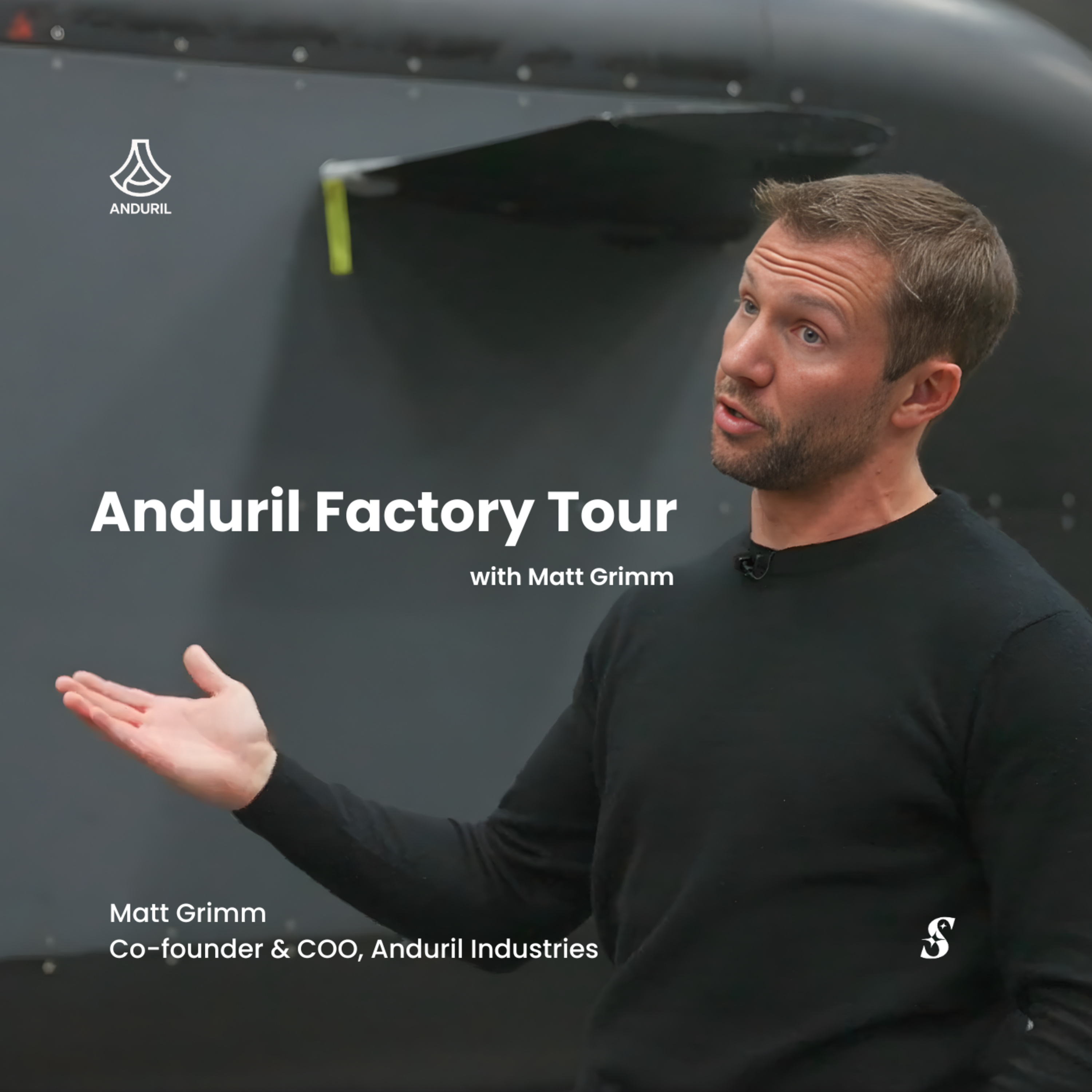
Anduril's R&D building houses machine shops, labs, and a 'dev test area' designed specifically to break products. By putting engineers across the parking lot from facilities that can rapidly prototype and test for failures (e.g., saltwater corrosion, vibration), they create an extremely tight feedback loop, speeding up iteration.
Instead of accepting trade-offs, Jaguar's team was challenged to deliver a low-riding design (1.4m tall) AND a 700km range. This forced them to invent novel solutions, like re-engineering the crash structure to place batteries in unconventional locations, ultimately adding 70 miles of range without compromising the design.
Lukas Czinger reveals that the unique, seemingly organic structure of the 21C hypercar's chassis is not a human aesthetic choice. It is the output of proprietary AI software that performs a weighted optimization based on inputs like load forces, crash safety, and material properties to generate the lightest possible design that meets all performance requirements.
