Get your free personalized podcast brief
We scan new podcasts and send you the top 5 insights daily.
Traditional software offers the rigid, deterministic structure ("the bones") needed for reliable systems. AI language models act as the "brain and ligaments," providing the flexibility, intelligence, and adaptability to operate around that structure. Both are required for a fully functional, intelligent system.

Related Insights
For vertical AI applications, foundation models are now sufficiently intelligent. The primary challenge is no longer model capability but building the surrounding software infrastructure—tools, UIs, and workflows—that lets models perform useful work reliably and trustworthily.

To fully express intent, AI applications cannot rely on a single modality. They need structured code for control flow, natural language for defining fuzzy tasks (like in DSPy's signatures), and example data for optimization and capturing long-tail behavior.

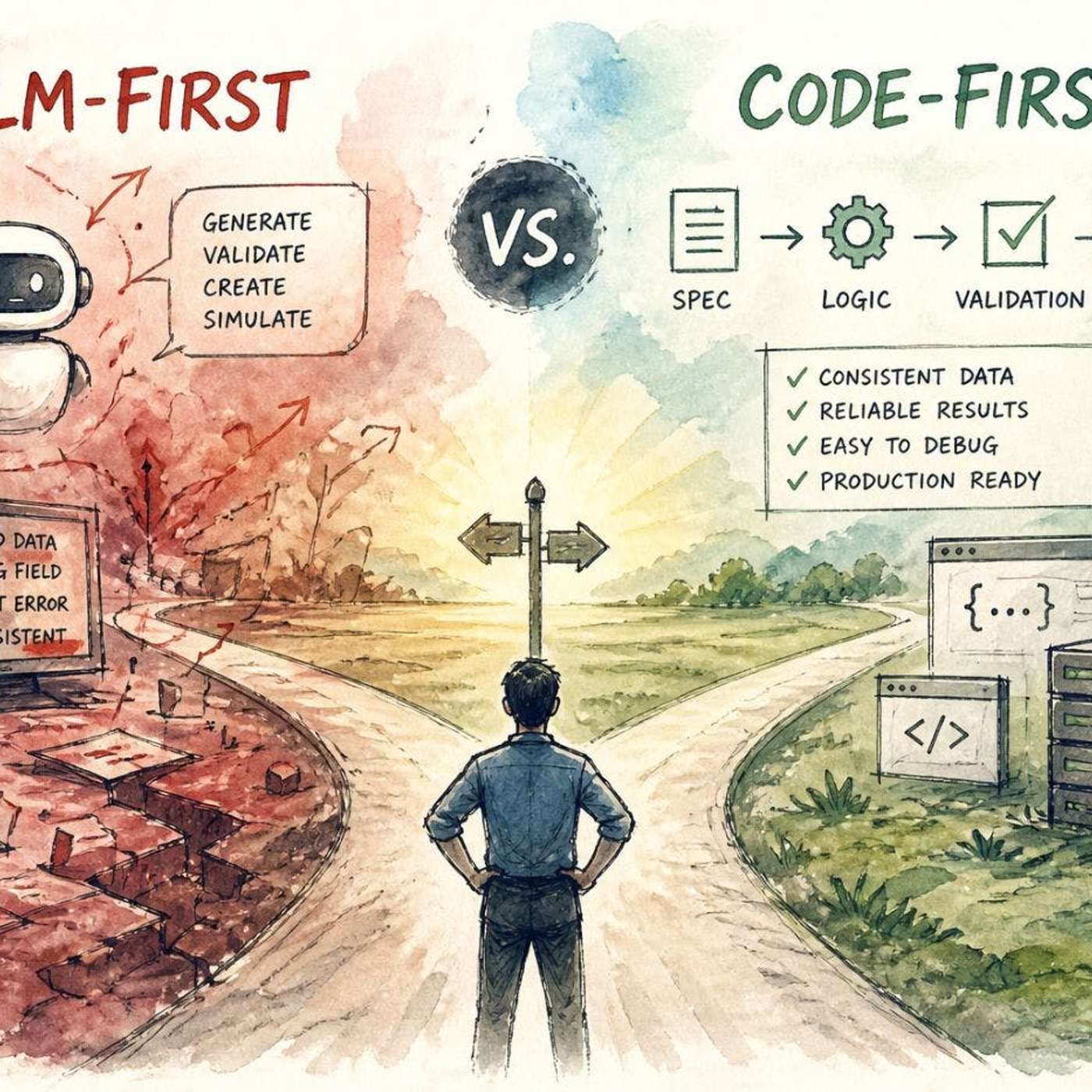
Don't give LLMs full control. Use deterministic code for core logic, validation, and enforcing rules. Delegate only tasks requiring flexibility or understanding of unstructured input to the LLM, treating it as a specialized component, not the entire system.
For 60 years, software digitized physical filing cabinets into databases, improving data retrieval but not the work itself. The current AI wave represents a paradigm shift where software (the "filing cabinet") can now autonomously perform tasks, evolving from a system of record to a system of action.
AI will not replace enterprise software because AI models are non-deterministic (probabilistic), while enterprise systems require deterministic (100% reliable) execution for critical functions. Enterprise software will act as the execution layer that harnesses AI's "thinking" capabilities within safe, predictable workflows.

The future of AI requires two distinct interaction models. One is the conversational "agent," akin to collaborating with a person. The other is the formally programmed "system." These are different paradigms for different needs, like a chair versus a table, not a single evolutionary path.
The next generation of enterprise AI software is not a fixed set of tools. Instead, it acts as an operating system that uses LLMs to write its own code on the fly, creating new capabilities like a data integration or an NPV analysis script the moment a user needs it.

The 'agents vs. applications' debate is a false dichotomy. Future applications will be sophisticated, orchestrated systems that embed agentic capabilities. They will feature multiple LLMs, deterministic logic, and robust permission models, representing an evolution of software, not a replacement of it.

Unlike traditional software, large language models are not programmed with specific instructions. They evolve through a process where different strategies are tried, and those that receive positive rewards are repeated, making their behaviors emergent and sometimes unpredictable.

Raw AI models are not useful on their own. A critical new software layer, dubbed a 'harness,' has emerged to make them effective. These harnesses (like OpenClaw or Codex) provide the structure for models to think in patterns and accomplish complex tasks, acting like an operating system for AI.
