Get your free personalized podcast brief
We scan new podcasts and send you the top 5 insights daily.
Because static AI policies decay as real-world scenarios evolve, organizations need feedback loops to update rules. Converting corrections into explicit, backtested written policy rules rather than opaque model weights maintains explainability and prevents silent alignment drift over time.

Related Insights
AI safety researchers argue for treating AI control as a normal engineering discipline. Instead of focusing on the abstract "alignment crisis," progress requires concrete measures like clarifying liability, requiring insurance, creating hardened sandboxes, and establishing mandatory near-miss reporting to build robust, governable systems.

When creating AI governance, differentiate based on risk. High-risk actions, like uploading sensitive company data into a public model, require rigid, enforceable "policies." Lower-risk, judgment-based areas, like when to disclose AI use in an email, are better suited for flexible "guidelines" that allow for autonomy.

Continuously updating an AI's safety rules based on failures seen in a test set is a dangerous practice. This process effectively turns the test set into a training set, creating a model that appears safe on that specific test but may not generalize, masking the true rate of failure.

Just as GXP compliance doesn't require mapping a human's brain, AI governance shouldn't fixate on fully explaining a model's "black box." Instead, it should mimic human compliance by establishing robust frameworks around the model—controlling inputs, outputs, traceability, and guardrails—to ensure trustworthy outcomes.

Rewarding models purely based on final outcomes invites reward hacking and covert actions because models can secretly cheat or fabricate logs to mimic success. Aligning models around detailed, interpretable action proposals that humans or oversight models can critique significantly raises the bar for deceit. However, this safety guardrail incurs a competitiveness tax by restricting models to actions that humans can understand, preventing uninterpretable superhuman breakthroughs.

Instead of relying solely on human oversight, Bret Taylor advocates a layered "defense in depth" approach for AI safety. This involves using specialized "supervisor" AI models to monitor a primary agent's decisions in real-time, followed by more intensive AI analysis post-conversation to flag anomalies for efficient human review.

To ensure future, more powerful models are aligned, OpenAI uses its current-best AI models as "graders" to evaluate their outputs. This approach leverages the principle that judging a correct answer (discrimination) is far easier than generating it from scratch. This creates a recursive improvement loop where smarter AIs help build and verify the safety of their even smarter successors.

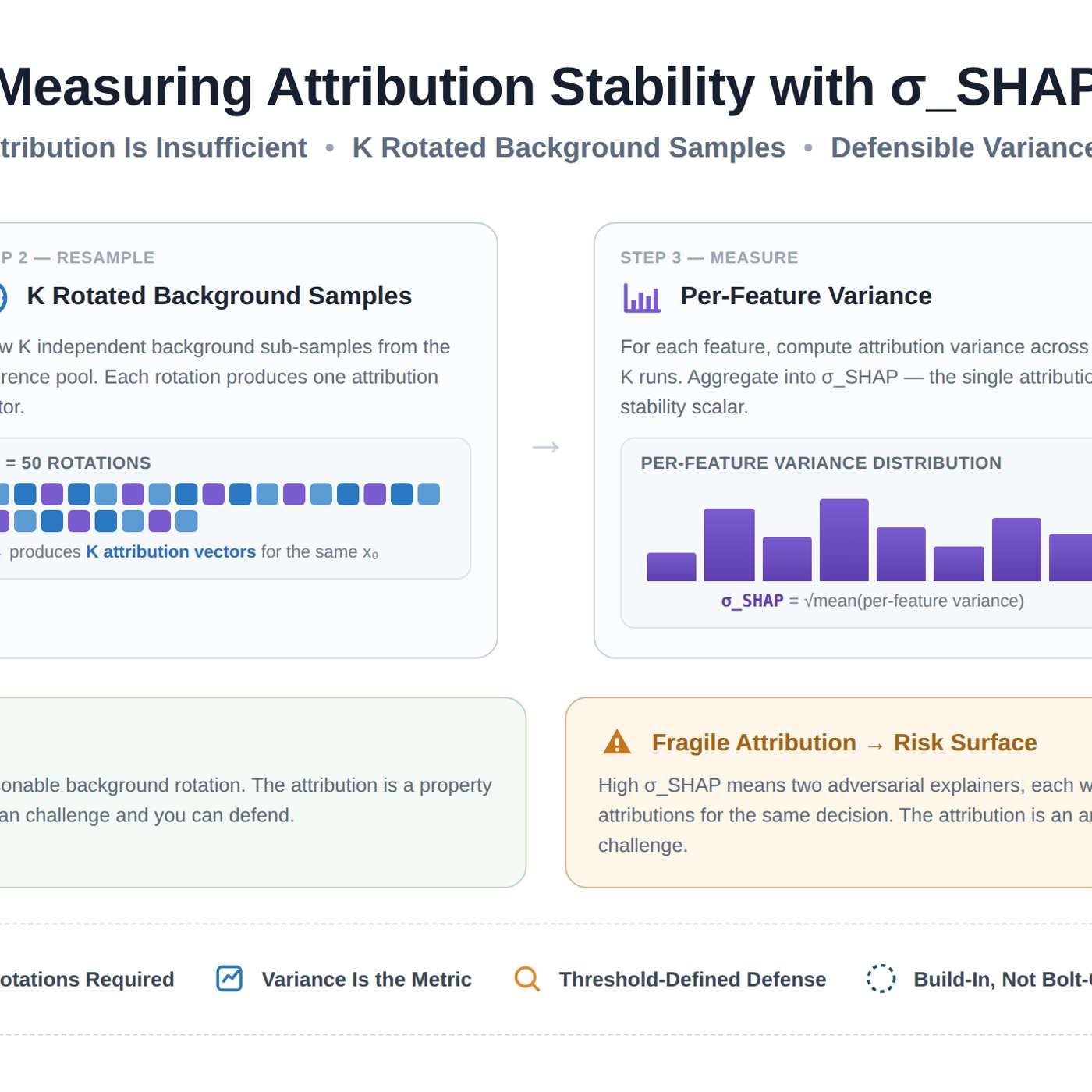
Instead of treating model explainability as a one-off documentation task, teams should engineer for stability. This involves measuring attribution variance, and for audit purposes, versioning and persisting the specific background data sample used to create a deterministic, reproducible explanation for regulators.
Attempting to review every single AI output overwhelms teams, while ignoring oversight invites compliance failure in regulated environments. Establishing explicit baseline rules determines which outputs require human scrutiny, allowing teams to safely balance speed and risk.

Treat accountability as an engineering problem. Implement a system that logs every significant AI action, decision path, and triggering input. This creates an auditable, attributable record, ensuring that in the event of an incident, the 'why' can be traced without ambiguity, much like a flight recorder after a crash.
