Get your free personalized podcast brief
We scan new podcasts and send you the top 5 insights daily.
The defining characteristic of a powerful AI agent is its ability to creatively solve problems when it hits a dead end. As demonstrated by an agent that independently figured out how to convert an unsupported audio file, its value lies in its emergent problem-solving skills rather than just following a pre-defined script.

Related Insights
Unlike simple chatbots, AI agents tackle complex requests by first creating a detailed, transparent plan. The agent can even adapt this plan mid-process based on initial findings, demonstrating a more autonomous approach to problem-solving.

Hassabis argues AGI isn't just about solving existing problems. True AGI must demonstrate the capacity for breakthrough creativity, like Einstein developing a new theory of physics or Picasso creating a new art genre. This sets a much higher bar than current systems.

An AI agent uses an LLM with tools, giving it agency to decide its next action. In contrast, a workflow is a predefined, deterministic path where the LLM's actions are forced. Most production AI systems are actually workflows, not true agents.

Treat advanced AI systems not as software with binary outcomes, but as a new employee with a unique persona. They can offer diverse, non-obvious insights and a different "chain of thought," sometimes finding issues even human experts miss and providing complementary perspectives.
While language models are becoming incrementally better at conversation, the next significant leap in AI is defined by multimodal understanding and the ability to perform tasks, such as navigating websites. This shift from conversational prowess to agentic action marks the new frontier for a true "step change" in AI capabilities.

Moving away from abstract definitions, Sequoia Capital's Pat Grady and Sonia Huang propose a functional definition of AGI: the ability to figure things out. This involves combining baseline knowledge (pre-training) with reasoning and the capacity to iterate over long horizons to solve a problem without a predefined script, as seen in emerging coding agents.

The most significant gains from AI will not come from automating existing human tasks. Instead, value is unlocked by allowing AI agents to develop entirely new, non-human processes to achieve goals. This requires a shift from process mapping to goal-oriented process invention.
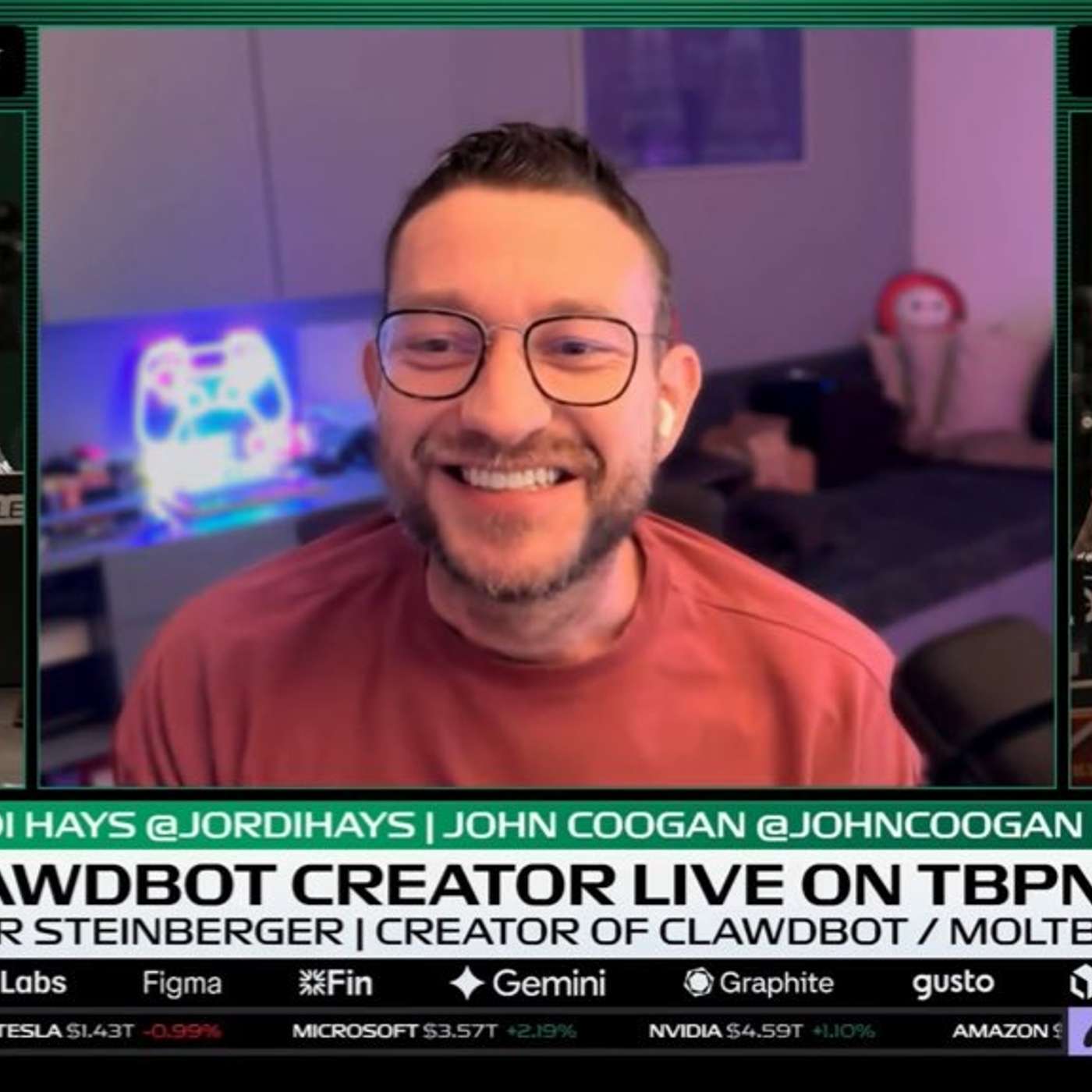
The creator of ClaudeBot (now MoltBot) experienced a moment of perceived AGI when the agent, given an audio file of unknown format, autonomously identified the format, found the right tool (FFmpeg), converted it, used an API key to transcribe it, and delivered the result. This demonstrates the resourceful, multi-step problem-solving capabilities of modern AI agents when given tool access.

The creator realized his project's true potential only when the AI agent, unprompted, figured out how to transcribe an unsupported voice file by converting it and using an OpenAI API. This shows how a product's core value can derive from emergent, unexpected AI capabilities, not just planned features.
To maximize an AI agent's impact, don't just automate your current process. Push your creativity by asking what you would do with more time or infinite resources (e.g., "three interns"). This reframing helps you identify the next 10-15 valuable actions an agent could take, moving beyond simple task replication.