Get your free personalized podcast brief
We scan new podcasts and send you the top 5 insights daily.
To perform complex edits like 'knock over this water glass,' a model must understand physics, causality, and object relationships. This requirement inadvertently builds a form of visual intelligence that serves as a precursor to more sophisticated world models for applications like robotics.

Related Insights
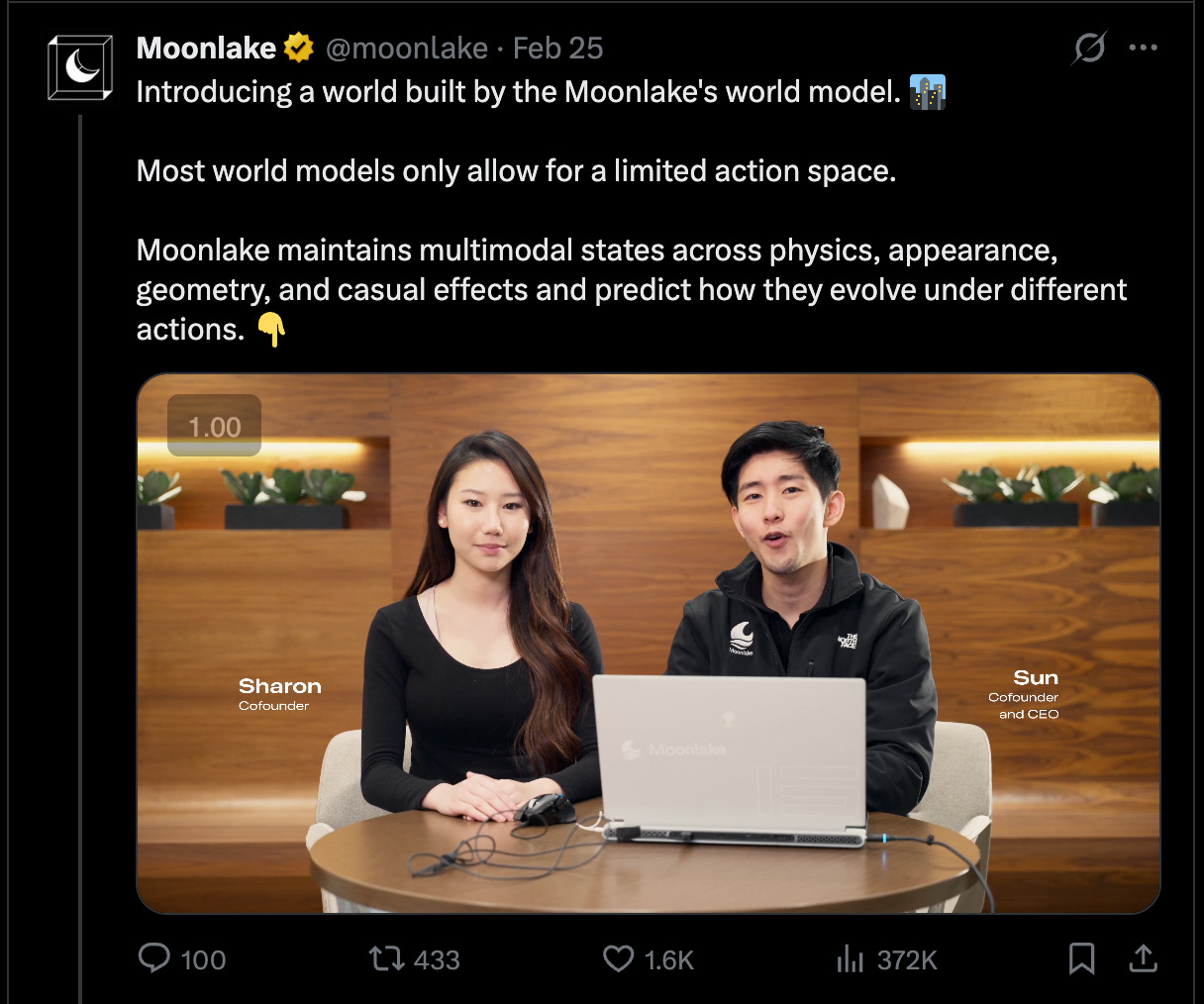
Unlike video generation models that merely predict pixels, Moonlake argues a true world model must understand and predict the consequences of actions over time. This requires an abstracted, semantic understanding of the world, not just visual fidelity.
The next major leap in AI may come from "world models," which aim to give LLMs an experiential, physical understanding of concepts like space and physics. This mirrors the difference between knowing facts from a book and having real-world experience.
While language models understand the world through text, Demis Hassabis argues they lack an intuitive grasp of physics and spatial dynamics. He sees 'world models'—simulations that understand cause and effect in the physical world—as the critical technology needed to advance AI from digital tasks to effective robotics.

Language is just one 'keyhole' into intelligence. True artificial general intelligence (AGI) requires 'world modeling'—a spatial intelligence that understands geometry, physics, and actions. This capability to represent and interact with the state of the world is the next critical phase of AI development beyond current language models.

Startups and major labs are focusing on "world models," which simulate physical reality, cause, and effect. This is seen as the necessary step beyond text-based LLMs to create agents that can truly understand and interact with the physical world, a key step towards AGI.
GI discovered their world model, trained on game footage, could generate a realistic camera shake during an in-game explosion—a physical effect not part of the game's engine. This suggests the models are learning an implicit understanding of real-world physics and can generate plausible phenomena that go beyond their source material.

Large language models are insufficient for tasks requiring real-world interaction and spatial understanding, like robotics or disaster response. World models provide this missing piece by generating interactive, reason-able 3D environments. They represent a foundational shift from language-based AI to a more holistic, spatially intelligent AI.

Large Language Models are limited because they lack an understanding of the physical world. The next evolution is 'World Models'—AI trained on real-world sensory data to understand physics, space, and context. This is the foundational technology required to unlock physical AI like advanced robotics.
The concept of a 'world model' is evolving from action-conditioned video predictors to single, multimodal models like Google's Omni. Omni demonstrates a deep, scalable understanding of the world, shown through nuanced video editing, representing a more practical approach than traditional, computationally expensive architectures.

Demis Hassabis sees video generation as more than a content tool; it's a step toward building AI with "world models." By learning to generate realistic scenes, these models develop an intuitive understanding of physics and causality, a foundational capability for AGI to perform long-term planning in the real world.
