Get your free personalized podcast brief
We scan new podcasts and send you the top 5 insights daily.
The concept of a 'world model' is evolving from action-conditioned video predictors to single, multimodal models like Google's Omni. Omni demonstrates a deep, scalable understanding of the world, shown through nuanced video editing, representing a more practical approach than traditional, computationally expensive architectures.

Related Insights
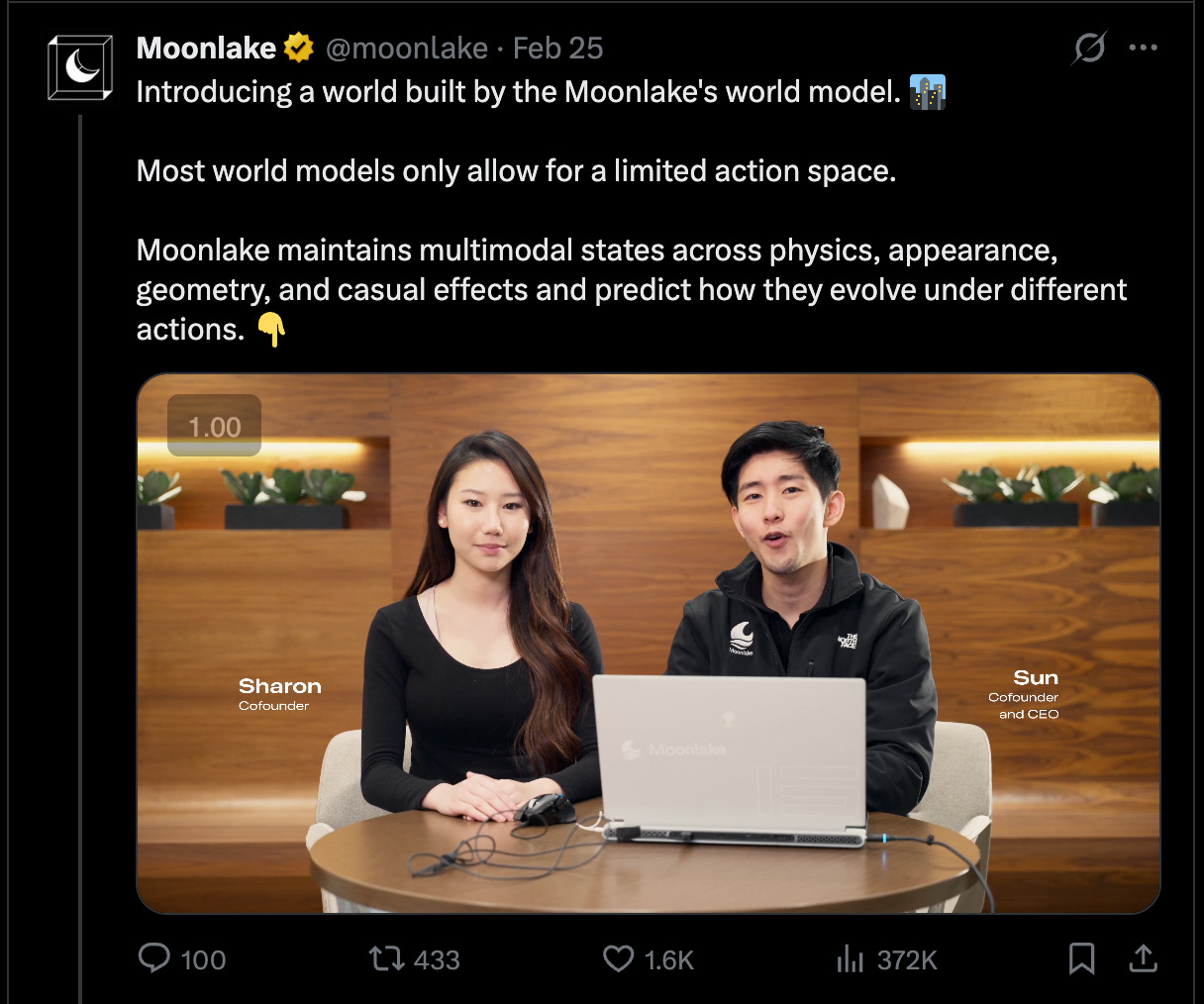
Unlike video generation models that merely predict pixels, Moonlake argues a true world model must understand and predict the consequences of actions over time. This requires an abstracted, semantic understanding of the world, not just visual fidelity.
Human understanding is the ability to connect new information to a global, unified model of the universe. Until recently, AI models were isolated (e.g., a chess model). The major advance with large multimodal models is their ability to create a single, cohesive reality model, enabling true, generalizable understanding.

Google's NotebookLM now generates "cinematic video overviews," a leap beyond simple slideshows. By orchestrating its Gemini models to act as a "creative director" for narrative and style, Google is strategically demonstrating its leadership in multimodal AI with a practical, high-value application that differentiates it from competitors.

Contrary to the narrative that AI tools will flood the internet with low-quality "slop," powerful multimodal models like Omni could have the opposite effect. By providing sophisticated VFX-level capabilities to the masses, they enable creators to tell stories with a higher degree of taste and production value than previously possible.

Large language models are insufficient for tasks requiring real-world interaction and spatial understanding, like robotics or disaster response. World models provide this missing piece by generating interactive, reason-able 3D environments. They represent a foundational shift from language-based AI to a more holistic, spatially intelligent AI.

Prof. Cho outlines two competing visions for world models. One camp believes in high-fidelity, step-by-step prediction (e.g., video generation). The other, which he and Yann LeCun favor, argues for abstract, high-level latent models that can plan without simulating every detail, akin to human thinking.

Google's Omni video model was initially dismissed for not being a leap in generation quality. However, its true innovation lies in fine-grained editing and control ("steerability"). The market consistently overestimates the importance of base model upgrades while underestimating the value unlocked by precise user control over outputs.
A "world model" transcends simple video generation. It is defined by three key capabilities: real-time responsiveness to user input (e.g., mouse clicks), long-horizon consistency over minutes or hours, and interactivity via multiple modalities like keyboard and voice.
Gemini Omni's multimodal capabilities are not just a technical feat; they are a fundamental accelerator for content creators. By simplifying complex tasks like video editing and ad creation, Omni will lower the barrier to entry, enabling individuals to produce high-quality content that previously required a full team and budget.
Demis Hassabis sees video generation as more than a content tool; it's a step toward building AI with "world models." By learning to generate realistic scenes, these models develop an intuitive understanding of physics and causality, a foundational capability for AGI to perform long-term planning in the real world.
