Get your free personalized podcast brief
We scan new podcasts and send you the top 5 insights daily.
As AI tools blur the lines between roles, Tubi now assesses engineers for "product sense"—a skill once reserved for PM interviews. The belief is that engineers with strong product intuition will be more effective builders in an AI-augmented world where coding is less of a constraint.

Related Insights
Candidates complete an exhaustive "friction logging" exercise, documenting pain points and user experience issues within a product. This practical test is a primary tool for evaluating a candidate's product sense and problem-identification skills, valued almost as much as the interview itself.

As AI handles routine coding, the most valuable engineers are either "dreamers" with strong product sense who can own features end-to-end, or deep subject matter experts who can verify and handle the complex, trust-critical parts of the system where human verification is still essential.

Companies like Anthropic and OpenAI are pioneering the "AI Builder" role, which combines product sense with hands-on coding. The traditional PM/engineer separation is dissolving as AI tools make building more accessible, shifting the focus to taste, problem-solving, and rapid prototyping.
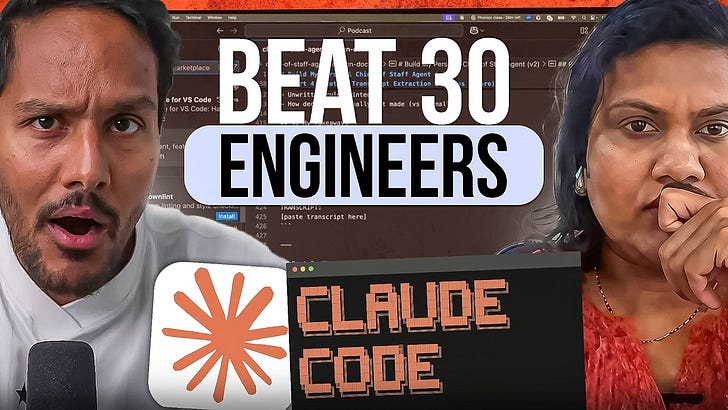
With AI tools enabling anyone to ship code, all team members directly impact the user experience. Floto.ai now includes traditional PM-style product thinking questions in interviews for engineers and growth roles to ensure everyone builds with strong user empathy and business context.

As AI agents automate code-writing, companies like WorkOS are hiring "product engineers" who possess taste, product sense, and strong communication. The stereotype of the purely technical, anti-social developer is becoming unemployable in modern tech companies.

In AI PM interviews, 'vibe coding' isn't a technical test. Interviewers evaluate your product thinking through how you structure prompts, the user insights you bring to iterations, and your ability to define feedback loops, not your ability to write code.

With AI making code generation cheap, product taste is the key differentiator. In top AI teams, PMs are increasingly technical, using tools like Claude Code to build and iterate, making their role nearly identical to an engineer's.

As AI tools accelerate engineering output, the limiting factor in product development is no longer coding speed but the quality of product discovery and strategy. This increases the demand for effective product managers who can feed the more efficient engineering pipeline.
With AI handling much of the coding, the most valuable engineers are no longer just prolific coders. Companies now prioritize platform engineers who can make deep architectural choices and product engineers who can embed with customers to excel at requirements gathering, which becomes the new bottleneck.
As AI tools commoditize writing code, the challenge shifts from 'can we build it?' to 'should we build it?'. The most valuable skill is now 'taste'—the nuanced understanding of user needs, market dynamics, and product quality that guides development toward an elegant solution.