Get your free personalized podcast brief
We scan new podcasts and send you the top 5 insights daily.
Astrocade's platform doesn't just use AI to generate a game; it also generates a custom editor with sliders and inputs for fine-tuning. This hybrid approach solves a key AI flaw: natural language is great for initial creation but inefficient for iterative refinement, where direct, deterministic controls are superior.

Related Insights
Even when AI generates game mechanics, human playtesting and fine-tuning are critical. A simple change, like increasing an upgrade from 25% to 50%, can make a game boring. This shows that the subjective 'feel' and balance of a game still require a human in the loop to iterate and perfect.
Creating custom "playground" tools for design exploration no longer requires advanced coding. You can simply describe the interface and the controls you want (e.g., "a grid with sliders for rows and opacity") in a natural language prompt to an AI, which will generate a functional tool.

AI models are already incredibly powerful, but their creative potential is limited by simple text prompts. The next breakthrough will be the development of sophisticated user interfaces that allow creators to edit scenes, control characters, and direct AI with precision, unlocking widespread adoption.

The handoff between AI generation and manual refinement is a major friction point. Tools like Subframe solve this by allowing users to seamlessly switch between an 'Ask AI' mode for generative tasks and a 'Design' mode for manual, Figma-like adjustments on the same canvas.

Instead of manually tweaking complex parameters like animation timing or color variables, designers can now ask an AI to build a custom visual editor for that specific task. This approach creates a hyper-efficient, temporary tool that provides precise control and can be discarded after use, a process that was previously unjustifiable.
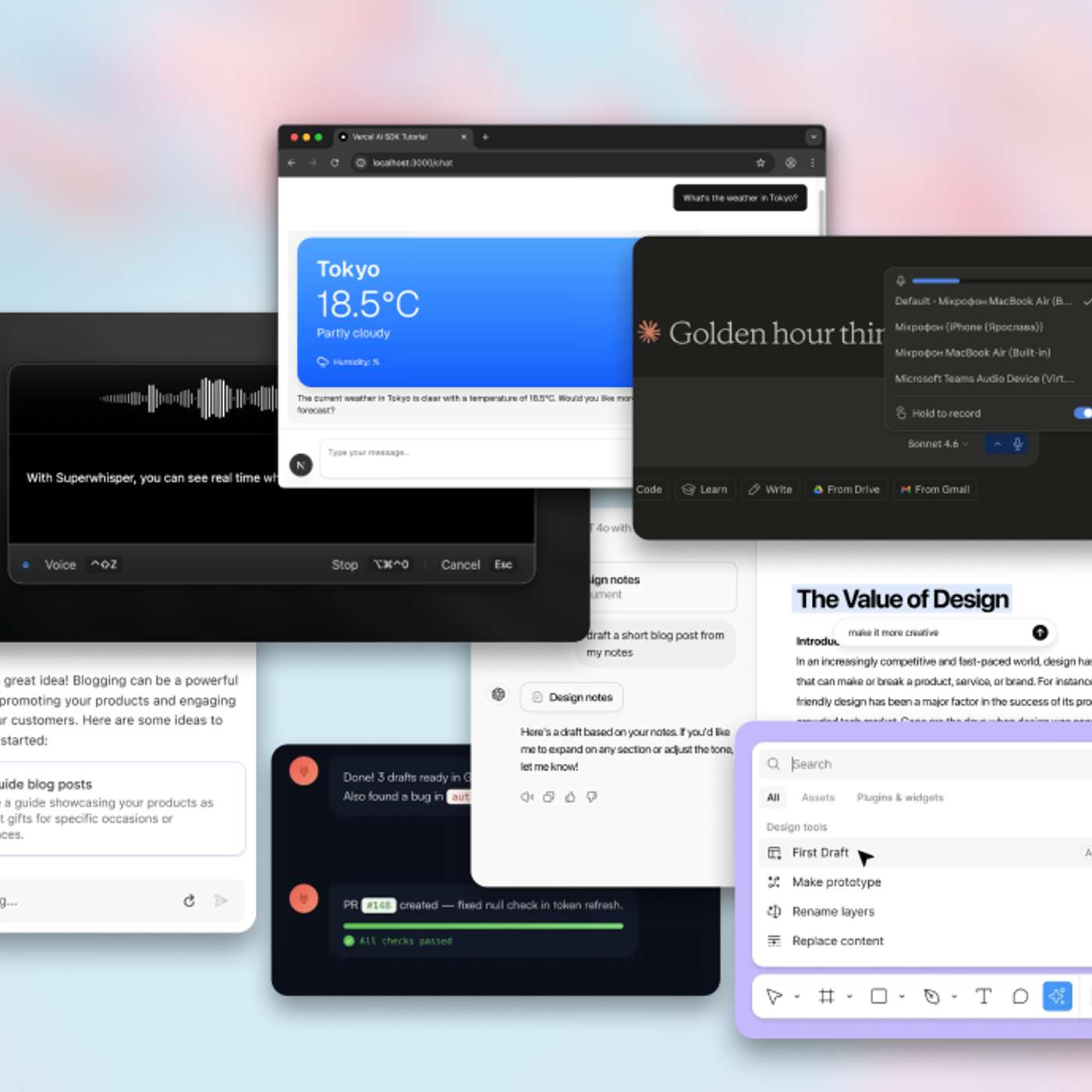
Early AI tools forced a frustrating 'regenerate' loop. Modern UX patterns succeed by making AI output interactive and editable within the same workflow. This shifts the user's expectation from a perfect final answer to a workable starting point, fostering a more collaborative process.
Instead of replacing entire systems with AI "world models," a superior approach is a hybrid model. Classical code should handle deterministic logic (like game physics), while AI provides a "differentiable" emergent layer for aesthetics and creativity (like real-time texturing). This leverages the unique strengths of both computational paradigms.

Instead of purely generative approaches, Moon Lake AI's strategy for creating interactive worlds involves using AI reasoning models to control and combine existing high-fidelity computer graphics tools. This is analogous to an LLM using a calculator, leveraging specialized tools for a more efficient and higher-quality outcome.

When AI handles the technical complexities of creation, the primary differentiator shifts from coding ability to aesthetic and design sense. Astrocade CEO Amir Sadeghian posits that a creator's 'taste'—their vision for a fun and engaging experience—is the most crucial input, effectively becoming the new high-level language.
While AI tools excel at generating initial drafts of code or designs, their editing capabilities are poor. The difficulty of making specific changes often forces creators to discard the AI output and start over, as editing is where the "magic" breaks down.
