Get your free personalized podcast brief
We scan new podcasts and send you the top 5 insights daily.
As AI use matures, the critical task is no longer just picking the best model. It's building a sophisticated internal architecture—including routers, monitors, and guardrails—to manage costs and route tasks effectively, treating AI as a system to be engineered.

Related Insights
Faced with rising costs from proprietary labs, sophisticated enterprise clients are building internal evaluation and routing systems. This allows them to use cheaper, open-source models for less complex tasks, optimizing for both cost and performance.

The focus in AI engineering has shifted from the agent itself to the surrounding system or 'harness.' This includes managing workflows, context, permissions, and tools. Engineering these reliable systems is now seen as more critical for delivering value than simply prompting a more powerful model.
Many engineering teams stall at "AI adoption"—simply providing tool licenses. The key to unlocking compounding value is "AI management"—designing a controlled, observable system where agents operate within the SDLC. Teams that get chaotic results often blame the model when the real failure is the process architecture around it.
As powerful AI models become commoditized, the sustainable competitive advantage will shift from model superiority to architectural robustness. Building systems with independent control planes, clear policy enforcement, and auditable execution paths will be the key long-term differentiator for agentic systems.

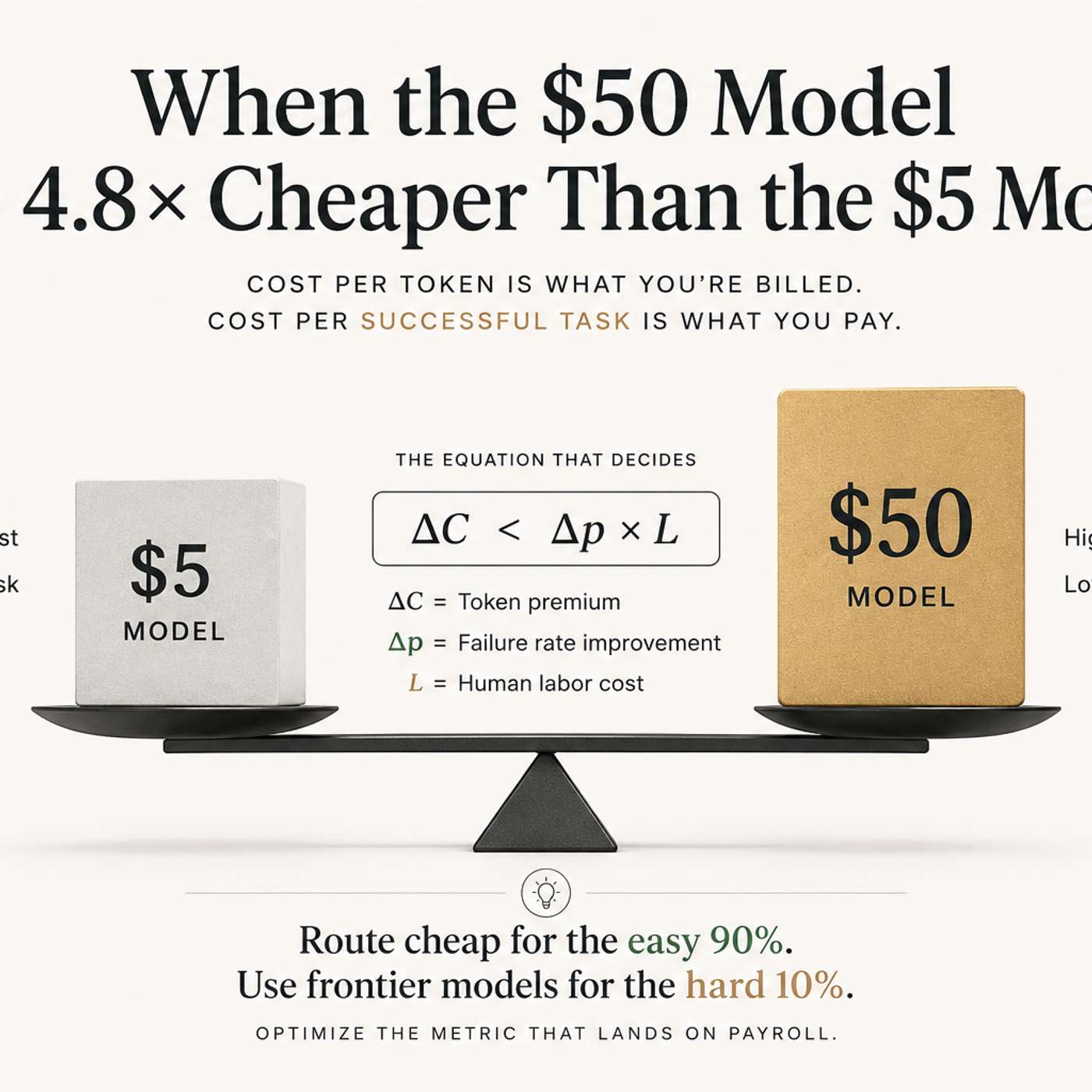
Instead of relying on a single large AI model, companies are adopting "model orchestration" to control costs. This involves using a router to send prompts to the most appropriate model based on the task, often cascading from cheap, small models to more expensive ones only when necessary.

Companies like Meta and Ramp are building AI routers to automatically send simple tasks to cheaper models. This trend shows the enterprise AI market is maturing past a 'one-model-fits-all' approach, focusing instead on cost management and operational efficiency by treating models as a commodity portfolio.
The recent focus on model routers signals a maturation of enterprise AI strategy. The initial "growth at all costs" phase, which encouraged rampant employee use ("token maxing"), is giving way to a new era of cost optimization and demonstrating clear ROI on AI investments.
Beyond a technical concept for coding agents, "harness engineering" provides a powerful mental model for enterprise AI adoption. It reframes the challenge from simply deploying models to redesigning the entire organizational system—processes, data access, and feedback loops—to create an environment where AI capabilities can truly succeed.
The excitement around AI capabilities often masks the real hurdle to enterprise adoption: infrastructure. Success is not determined by the model's sophistication, but by first solving foundational problems of security, cost control, and data integration. This requires a shift from an application-centric to an infrastructure-first mindset.

An optimal AI architecture routes tasks to different models based on complexity and risk. Simple, low-stakes work like data extraction should go to the cheapest models. Ambiguous, high-stakes work like system design warrants expensive frontier models, where preventing one engineering mistake justifies the premium token cost.