Get your free personalized podcast brief
We scan new podcasts and send you the top 5 insights daily.
The explosion of specialized AI models and routing harnesses makes development more complex. Engineers now face the 'exhausting' task of constantly running evaluations and tests to select the optimal model for each specific use case, creating a new DevOps-like challenge for AI teams.

Related Insights
As AI use matures, the critical task is no longer just picking the best model. It's building a sophisticated internal architecture—including routers, monitors, and guardrails—to manage costs and route tasks effectively, treating AI as a system to be engineered.

As frontier models from different labs constantly leapfrog each other, enterprises face 'analysis paralysis.' The most value will be created by an 'applied AI layer' that acts as a model router. This layer will abstract the complexity, select the best model for a given task, and prevent lock-in to a single provider like OpenAI or Google.

Treating AI evaluation as a single, pre-launch check is a mistake. Model behavior drifts due to fine-tuning, infrastructure changes, and shifts in user queries. Production AI systems demand a continuous evaluation pipeline integrated into the deployment lifecycle to catch regressions and ensure ongoing reliability.

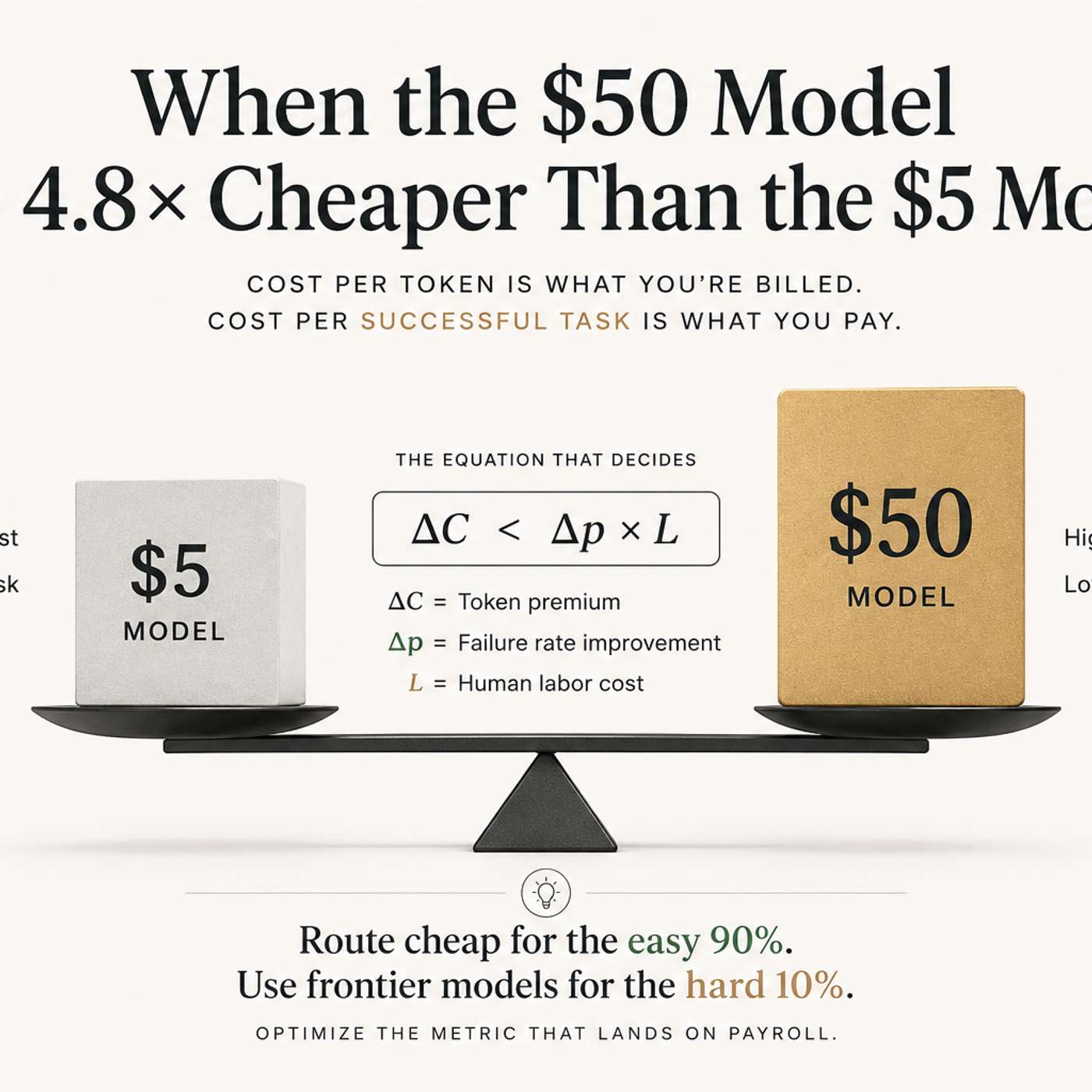
Companies like Meta and Ramp are building AI routers to automatically send simple tasks to cheaper models. This trend shows the enterprise AI market is maturing past a 'one-model-fits-all' approach, focusing instead on cost management and operational efficiency by treating models as a commodity portfolio.
The AI landscape is uniquely challenging due to the rapid depreciation of both models (new ones top leaderboards weekly) and hardware (Nvidia launched three new SKUs in one year). This creates a constant, complex management burden, justifying the need for platforms that abstract away these choices.

Companies no longer chase the single most powerful AI model. The new standard is creating a sophisticated architecture of multiple models, matching the right tool to the right task based on capability, efficiency, and cost, which allows for greater optimization across the enterprise.
Mature AI applications are not static calls to a single large model. They are complex systems of many models that require a continuous "AI loop": tracing performance, identifying areas for improvement (cost, speed, accuracy), and constantly iterating by swapping models, fine-tuning, or refining prompts.
As AI costs rise, using one powerful frontier model for every task is no longer financially viable. The solution is to create a dedicated "Model Sommelier" role responsible for curating a portfolio of models, continuously testing and selecting the most cost-effective option for each specific business use case.
The rapid release of new AI models makes it crucial for companies to move beyond industry benchmarks. Developing internal evaluation systems ("evals") is necessary to test and determine which model performs best for unique, high-value business use cases, as model choice is becoming extremely important.

An optimal AI architecture routes tasks to different models based on complexity and risk. Simple, low-stakes work like data extraction should go to the cheapest models. Ambiguous, high-stakes work like system design warrants expensive frontier models, where preventing one engineering mistake justifies the premium token cost.