Get your free personalized podcast brief
We scan new podcasts and send you the top 5 insights daily.
Browser and desktop AI apps are intentionally limited or 'nerfed.' For maximum power and control, run AI agents in the terminal. It provides direct, 'close to the metal' access to your computer's full capabilities and integrations.

Related Insights
Services like X, Reddit, and even AI models are starting to block agentic access. To maintain functionality, companies are shifting to dedicated local machines (like Mac Studios) which can spoof browser activity and evade these restrictions, ensuring their automation pipelines continue to work.
The power of tools like Claude Code comes from giving the AI access to fundamental command-line tools (e.g., `bash`, `grep`). This allows the AI to compose novel solutions and lets product teams define new features using simple English prompts rather than hard-coded logic.

To unlock their full intelligence, AI agents require broad access to compute resources—like a sandboxed computer—not just a single tool or database. Providing only limited access wastes their cognitive capacity. The challenge is enabling this power securely, requiring innovations like new types of firewalls.

Browser-based ChatGPT cannot execute code or connect to external APIs, limiting its power. The Codex CLI unlocks these agentic capabilities, allowing it to interact with local files, run scripts, and connect to databases, making it a far more powerful tool for real-world tasks.
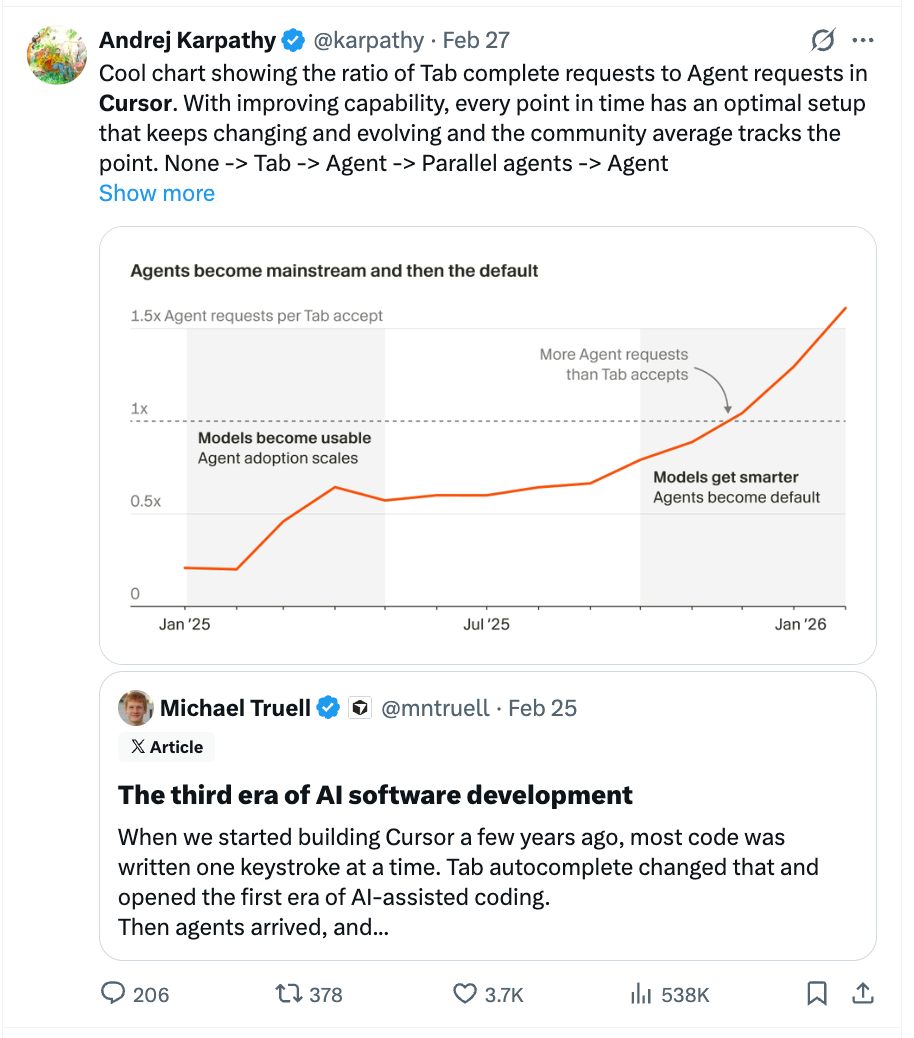
Cursor discovered that agents need more than just code access. Providing a full VM environment—a "brain in a box" where they can see pixels, run code, and use dev tools like a human—was the step-change needed to tackle entire features, not just minor edits.
The focus on browser automation for AI agents was misplaced. Tools like Moltbot demonstrate the real power lies in an OS-level agent that can interact with all applications, data, and CLIs on a user's machine, effectively bypassing the browser as the primary interface for tasks.

While GUIs were built for humans, the terminal is more "empathetic to the machine." Coding agents are more effective using CLIs because it provides a direct, scriptable, and universal way to interact with a system's tools, leveraging vast amounts of pre-trained shell command data.
The term 'Claude Code' is a misnomer. Advanced users see these tools not just for coding, but as a generalized 'cloud computer.' By giving an agent access to files, terminals, and browsers, it becomes a versatile tool capable of any task, from program management to data analysis.

The true potential of local AI agents like OpenClaw is unlocked not by running a model locally, but by granting it deep, contextual access to a user's entire system—email, calendar, and files. This creates a massive security paradox, positioning OS-level players like Apple, who can manage that trust and security layer, as the likely long-term winners.

A new wave of AI agents from companies like Manus and Adaptive are launching with a core "My Computer" feature. This signals a critical realization: to be truly useful, agents must move beyond cloud-only environments and gain access to local files and applications on a user's personal machine.