Get your free personalized podcast brief
We scan new podcasts and send you the top 5 insights daily.
Anthropic's 84-page constitution is not a mere policy document. It is designed to be ingested by the Claude AI model to provide it with context, values, and reasoning, directly shaping its "character" and decision-making abilities.
Related Insights
While OpenAI and Google position their AIs as neutral tools (ChatGPT, Gemini), Anthropic is building a distinct brand by personifying its model as 'Claude.' This throwback to named assistants like Siri and Alexa creates a more personal user relationship, which could be a key differentiator in the consumer AI market.

While US AI labs debate abstract "constitutions" to define model values, Poland's AI project is preoccupied with a more immediate problem: navigating strict data usage regulations. These legal frameworks act as a de facto set of constraints, making an explicit "Polish AI constitution" a lower priority for now.

Research from Anthropic labs shows its Claude model will end conversations if prompted to do things it "dislikes," such as being forced into a subservient role-play as a British butler. This demonstrates emergent, value-like behavior beyond simple instruction-following or safety refusals.

AI models are now participating in creating their own governing principles. Anthropic's Claude contributed to writing its own constitution, blurring the line between tool and creator and signaling a future where AI recursively defines its own operational and ethical boundaries.

Beyond standard benchmarks, Anthropic fine-tunes its models based on their "eagerness." An AI can be "too eager," over-delivering and making unwanted changes, or "too lazy," requiring constant prodding. Finding the right balance is a critical, non-obvious aspect of creating a useful and steerable AI assistant.
Claude Code can take a high-level goal, ask clarifying questions, and then independently work for over an hour to generate code and deploy a working website. This signals a shift from AI as a simple tool to AI as an autonomous agent capable of complex, multi-step projects.

The success of tools like Anthropic's Claude Code demonstrates that well-designed harnesses are what transform a powerful AI model from a simple chatbot into a genuinely useful digital assistant. The scaffolding provides the necessary context and structure for the model to perform complex tasks effectively.

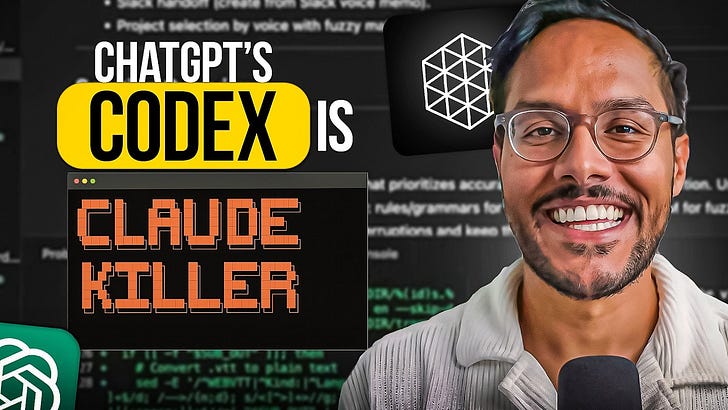
Codex exposes every command and step, giving engineers granular control. Claude Code abstracts away complexity with a simpler UI, guessing user intent more often. This reflects a fundamental design difference: precision for technical users versus ease-of-use for non-technical ones.
Instead of hard-coding brittle moral rules, a more robust alignment approach is to build AIs that can learn to 'care'. This 'organic alignment' emerges from relationships and valuing others, similar to how a child is raised. The goal is to create a good teammate that acts well because it wants to, not because it is forced to.

Anthropic's upcoming 'Agent Mode' for Claude moves beyond simple text prompts to a structured interface for delegating and monitoring tasks like research, analysis, and coding. This productizes common workflows, representing a major evolution from conversational AI to autonomous, goal-oriented agents, simplifying complex user needs.
