Get your free personalized podcast brief
We scan new podcasts and send you the top 5 insights daily.
Although the overall trial was negative, exploratory analysis of the AGO-OV-229 study suggested patients previously treated with Bevacizumab derived more benefit from Atezolizumab, hinting at a potential synergy worth further investigation.

Related Insights
The B96 trial's potential approval for platinum-resistant ovarian cancer introduces a new treatment sequencing challenge. Clinicians must decide between this immunotherapy combination and the ADC mervituximab, which has a clear biomarker (foliate receptor alpha). The lack of a reliable biomarker for the B96 regimen complicates this decision-making process for patients.

The traditional six-month timeframe for defining platinum sensitivity is being challenged. A growing theory suggests that tumors progressing while on a PARP inhibitor have a distinct biology that responds poorly to subsequent platinum, indicating a potential need to move directly to therapies like ADCs.

Real-world data suggests that using one antibody-drug conjugate (ADC) immediately after another is often ineffective. A potential strategy to overcome this resistance is to administer a different class of chemotherapy before starting the second ADC.

Despite multiple clinical trials, adding checkpoint inhibitors to frontline therapy for ovarian cancer has not demonstrated a proven survival benefit. The role of immunotherapy in this setting remains confined to rare subsets like DMMR or TMB-high tumors, and it is not standard practice for the general population.

The AGO-OV-229 trial confirmed that adding the PD-L1 inhibitor Atezolizumab to bevacizumab and chemotherapy did not improve overall or progression-free survival, reinforcing the challenge of applying immunotherapy in this setting.
Unlike early ADCs requiring high biomarker expression (e.g., mirvetuximab), next-generation agents show efficacy even in low-expressing tumors. This allows for broader, "all-comer" clinical trial inclusion criteria instead of biomarker-gated entry, potentially expanding patient access to these novel therapies.
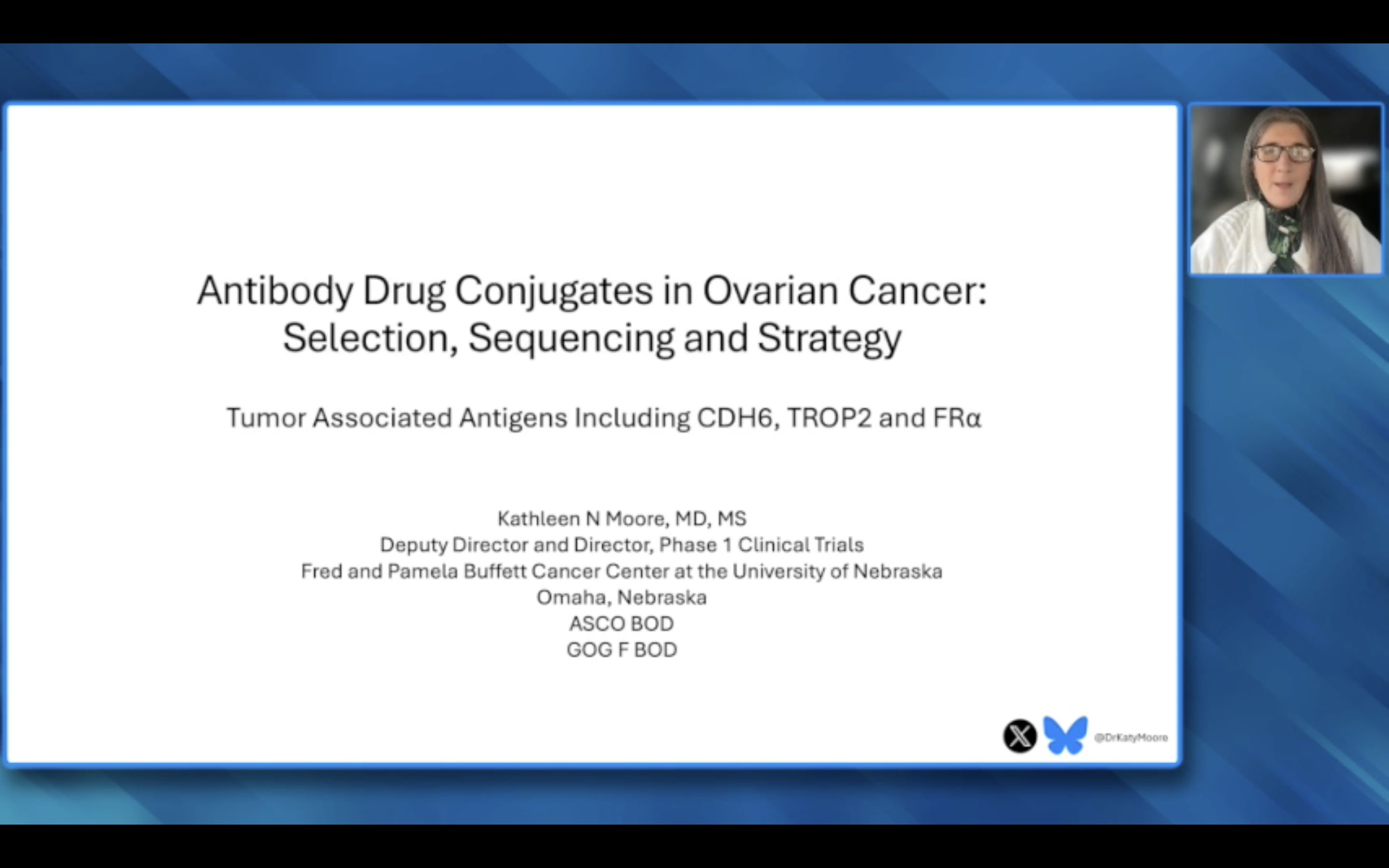
Patients whose ovarian cancer progresses on the folate-targeted ADC mirvetuximab may still respond to a subsequent folate-targeted ADC with a different cytotoxic payload. This suggests that the folate receptor alpha target remains viable and that resistance may be payload-specific, opening new sequencing strategies.
Despite stratifying patients by PD-L1 status, the AGO-OV-229 trial found it was not a predictive marker. Hazard ratios for survival were similar for both PD-L1 positive and negative tumors, challenging its utility for patient selection.
Disparate clinical trial results in endometrial cancer suggest a mechanistic difference between immunotherapy targets. PD-1 inhibitors (dostarlimab, pembrolizumab) have shown pronounced responses, whereas the PD-L1 inhibitor atezolizumab did not, indicating that targeting the PD-1 receptor may be a more robust strategy in GYN cancers.
Historically, therapies for platinum-resistant ovarian cancer were so ineffective that the order of administration was irrelevant. With the advent of multiple active ADCs, the concept of treatment sequencing and potential cross-resistance based on payloads or targets has become a critical, and entirely new, clinical consideration for this disease.