Get your free personalized podcast brief
We scan new podcasts and send you the top 5 insights daily.
AI loops and tools like `/goal` are effective for quickly building experimental prototypes where fine details are unimportant. For building a polished product where details and unique "sauce" matter, the human-in-the-loop approach remains superior and more cost-effective.

Related Insights
Instead of waiting for AI models to be perfect, design your application from the start to allow for human correction. This pragmatic approach acknowledges AI's inherent uncertainty and allows you to deliver value sooner by leveraging human oversight to handle edge cases.

The "vibe coding" trend, where non-technical staff use AI to rapidly build prototypes, is a legitimate accelerator for innovation. However, it's not yet a substitute for professional engineers when building scalable, mission-critical systems that are ready for deployment.
AI can rapidly execute the 'build' and 'measure' steps of a feedback loop, but true 'learning' is still done by the human founder. Offloading the entire process to AI without deep personal engagement will slow you down, as the machine cannot replicate the founder's capacity for insight.

For founders, AI tools are excellent for quickly building an MVP to validate an idea and acquire the first few customers—the hardest step. However, these tools are not yet equipped for the large-scale, big-picture thinking and edge-case handling required to scale a product from 100 to a million users. That stage still requires human expertise.
Agentic loops are not a universal solution. They are most effective in domains where success can be measured by a clear, objective score and where failed experiments are cheap and quick. This framework helps identify the best business processes to automate, starting with areas like code generation or ad testing, not subjective, slow-moving tasks like political negotiation.

Building a product too quickly with AI, without incremental user feedback, is like growing a tree indoors without wind. It appears fully formed but lacks the structural integrity and deep intuition gained from being exposed to real-world forces and user friction at each stage of growth.

Agentic loops excel in constrained tasks with clear feedback, like fixing code based on an AI-generated review score. They fail in open-ended creative tasks like building an application, where they make costly, incorrect assumptions about product details.
The panel suggests a best practice for AI prototyping tools: focus on pinpointed interactions or small, specific user flows. Once a prototype grows to encompass the entire product, it's more efficient to move directly into the codebase, as you're past the point of exploration.

Resist the temptation to treat AI-generated prototype code as production-ready. Its purpose is discovery—validating ideas and user experiences. The code is not built to be scalable, maintainable, or robust. Let your engineering team translate the validated prototype into production-level code.
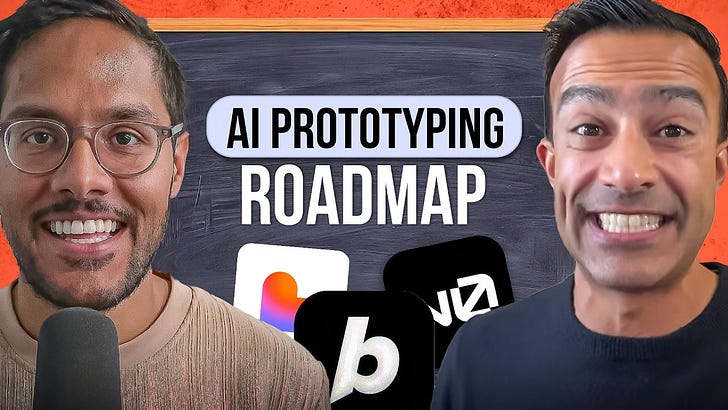
The most effective method for building apps with AI is still the iterative "human-in-the-loop" process. A human directs the AI with prompts, reviews the output, and provides corrections. This allows for creative control and avoids the costly, assumption-driven errors of fully autonomous loops.