Get your free personalized podcast brief
We scan new podcasts and send you the top 5 insights daily.
The new wave of entrepreneurship isn't about scaling large companies. It's about solopreneurs acting as "gig entrepreneurs" who master and customize a suite of AI tools to deliver bespoke, high-value outcomes for clients, effectively replacing the work of entire small agencies.

Related Insights
The democratization of technology via AI shifts the entrepreneurial goalpost. Instead of focusing on creating a handful of billion-dollar "unicorns," the more impactful ambition is to empower millions of people to each build a million-dollar "donkey corn" business, truly broadening economic opportunity.

As AI agents handle technical execution, the most valuable human skill becomes ideation. Replit CEO Amjad Massad predicts this will dissolve rigid corporate hierarchies in favor of adaptable teams of generalists who collaborate with autonomous AI tools to bring ideas to life.
Most successful SaaS companies weren't built on new core tech, but by packaging existing tech (like databases or CRMs) into solutions for specific industries. AI is no different. The opportunity lies in unbundling a general tool like ChatGPT and rebundling its capabilities into vertical-specific products.

Small firms can outmaneuver large corporations in the AI era by embracing rapid, low-cost experimentation. While enterprises spend millions on specialized PhDs for single use cases, agile companies constantly test new models, learn from failures, and deploy what works to dominate their market.

AI reverses the long-standing trend of professional hyper-specialization. By providing instant access to specialist knowledge (e.g., coding in an unfamiliar language), AI tools empower individuals to operate as effective generalists. This allows small, agile teams to achieve more without hiring a dedicated expert for every function.
The surprising success of Dia's custom "Skills" feature revealed a huge user demand for personalized tools. This suggests a key value of AI is enabling non-technical users to build "handmade software" for their specific, just-in-time needs, moving beyond one-size-fits-all applications.
The idea of a solo founder running a billion-dollar company is more a marketing gimmick than a future reality. While technologically feasible with AI, individuals won't want to handle all the associated operational burdens like bookkeeping and taxes. The logical endpoint of AI automation isn't a one-person company, but a zero-person, fully automated business.
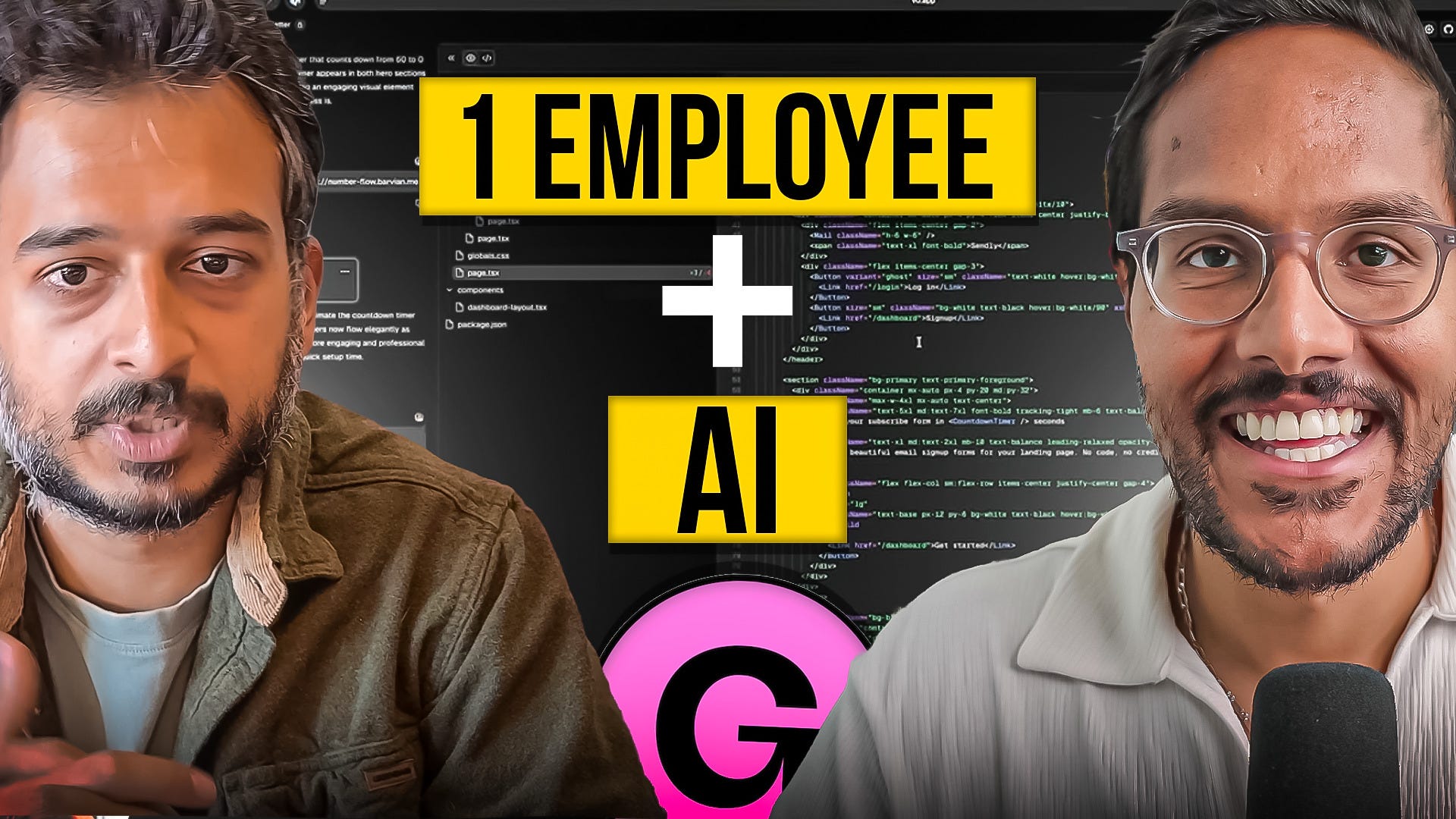
Previously, building 'just a feature' was a flawed strategy. Now, an AI feature that replaces a human role (e.g., a receptionist) can command a high enough price to be a viable company wedge, even before it becomes a full product.

In a world where AI makes software cheap or free, the primary value shifts to specialized human expertise. Companies can monetize by using their software as a low-cost distribution channel to sell high-margin, high-ticket services that customers cannot easily replicate, like specialized security analysis.

The barrier to entry for entrepreneurship has collapsed. Anyone, regardless of technical skill or capital, can now use tools like ChatGPT and Replit to create a formal business plan and a functional app, effectively democratizing innovation.
