Get your free personalized podcast brief
We scan new podcasts and send you the top 5 insights daily.
Modern cloud infrastructure allows teams to spin up hundreds of GPUs within seconds. Because these resources run in parallel, engineers can evaluate entire test matrices—spanning diverse stirring speeds, aeration rates, and fluid viscosities—in the exact same elapsed time that a single simulation would take, removing historical throughput bottlenecks.

Related Insights
Because CFD operates strictly on physical parameters rather than biological mechanisms, a vessel needs to be fully characterized only once across 100 to 200 operational points. When switching to a new molecule, media, or cell line, the scale-up software only needs updated fluid properties such as viscosity, density, surface tension, and salt concentration, eliminating the need to re-run simulations from scratch.
Running multiple, complex AI coding agents simultaneously is computationally prohibitive on local machines. Stripe's success relies on their ability to spin up numerous isolated cloud development environments in parallel, a crucial investment for any team serious about agentic engineering.

Characterizing a bioreactor requires careful boundary setting because every additional variable exponentially increases the required simulation count. Adding wide continuum ranges for parameters like working volume or fluid viscosities creates an enormous operational space. Teams must strategically limit variables to discrete, sensible operating increments rather than attempting to model extreme spectrums from empty vessels to honey-like viscosities.
The most significant breakthroughs will no longer come from traditional wet lab experiments alone. Instead, progress will be driven by the smarter application of AI and simulations, with future bioreactors being as much digital as they are physical.
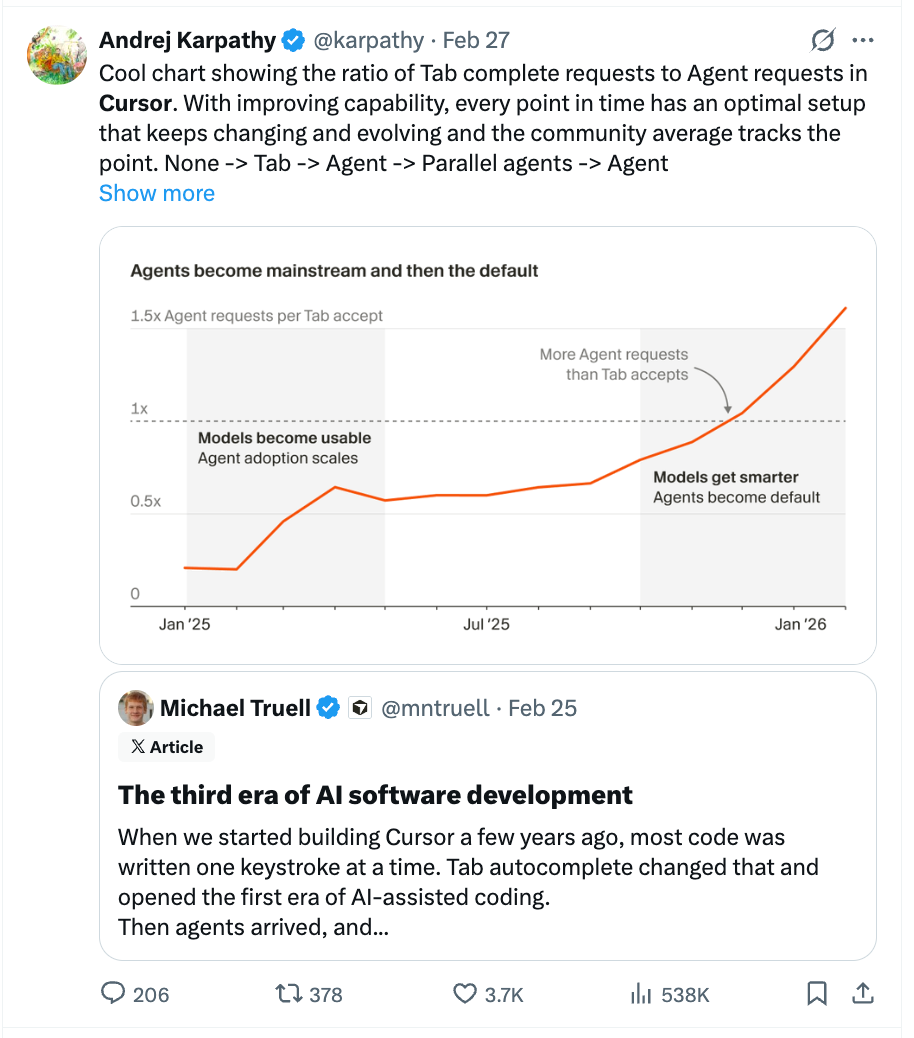
The focus in AI engineering is shifting from making a single agent faster (latency) to running many agents in parallel (throughput). This "wider pipe" approach gets more total work done but will stress-test existing infrastructure like CI/CD, which wasn't built for this volume.
Instead of one massive experiment, split numerous factors into smaller, biologically-themed groups. Running these focused experiments in parallel is superior to both one-factor-at-a-time and large DOE approaches, as it maintains the breadth of a large screen while providing the high-quality signal of a small one.
The key advantage of larger GPU clusters is their ability to use the memory bandwidth of all GPUs in parallel to load model weights. This massive aggregate bandwidth dramatically reduces memory fetch times, which is a primary latency bottleneck, especially for very large, sparse models.

When splitting jobs across thousands of GPUs, inconsistent communication times (jitter) create bottlenecks, forcing the use of fewer GPUs. A network with predictable, uniform latency enables far greater parallelization and overall cluster efficiency, making it more important than raw 'hero number' bandwidth.

Instead of running hundreds of brute-force experiments, machine learning models analyze historical data to predict which parameter combinations will succeed. This allows teams to focus on a few dozen targeted experiments to achieve the same process confidence, compressing months of work into weeks.
By deploying multiple AI agents that work in parallel, a developer measured 48 "agent-hours" of productive work completed in a single 24-hour day. This illustrates a fundamental shift from sequential human work to parallelized AI execution, effectively compressing project timelines.
