Get your free personalized podcast brief
We scan new podcasts and send you the top 5 insights daily.
While the race for AI supremacy in language models is fierce with many well-funded competitors, the autonomous driving sector remains starkly different. Legacy automakers are still perceived as being a decade behind Tesla's Full Self-Driving capabilities, failing to close the gap in a way that companies have in the LLM space.

Related Insights
Major AI breakthroughs like Transformers accelerate initial progress but are not silver bullets for the safety-critical long tail. The nature of the problem is that getting a prototype working is relatively easy, but achieving the final "nines" of reliability is incredibly difficult, justifying Google's early, multi-decade investment.

A breakdown of Tesla's market cap suggests its autonomous driving business, which has minimal commercial revenue, is valued at roughly $500B. In contrast, Waymo, a functioning and revenue-generating competitor, is valued at a fraction of that, making it a compelling investment by comparison.
Autonomous vehicle technology will likely become a commodity layer, with most manufacturers providing their cars to existing ride-sharing networks like Uber and Lyft. Only a few companies like Tesla have the brand and scale to pursue a vertically-integrated, closed-network strategy.
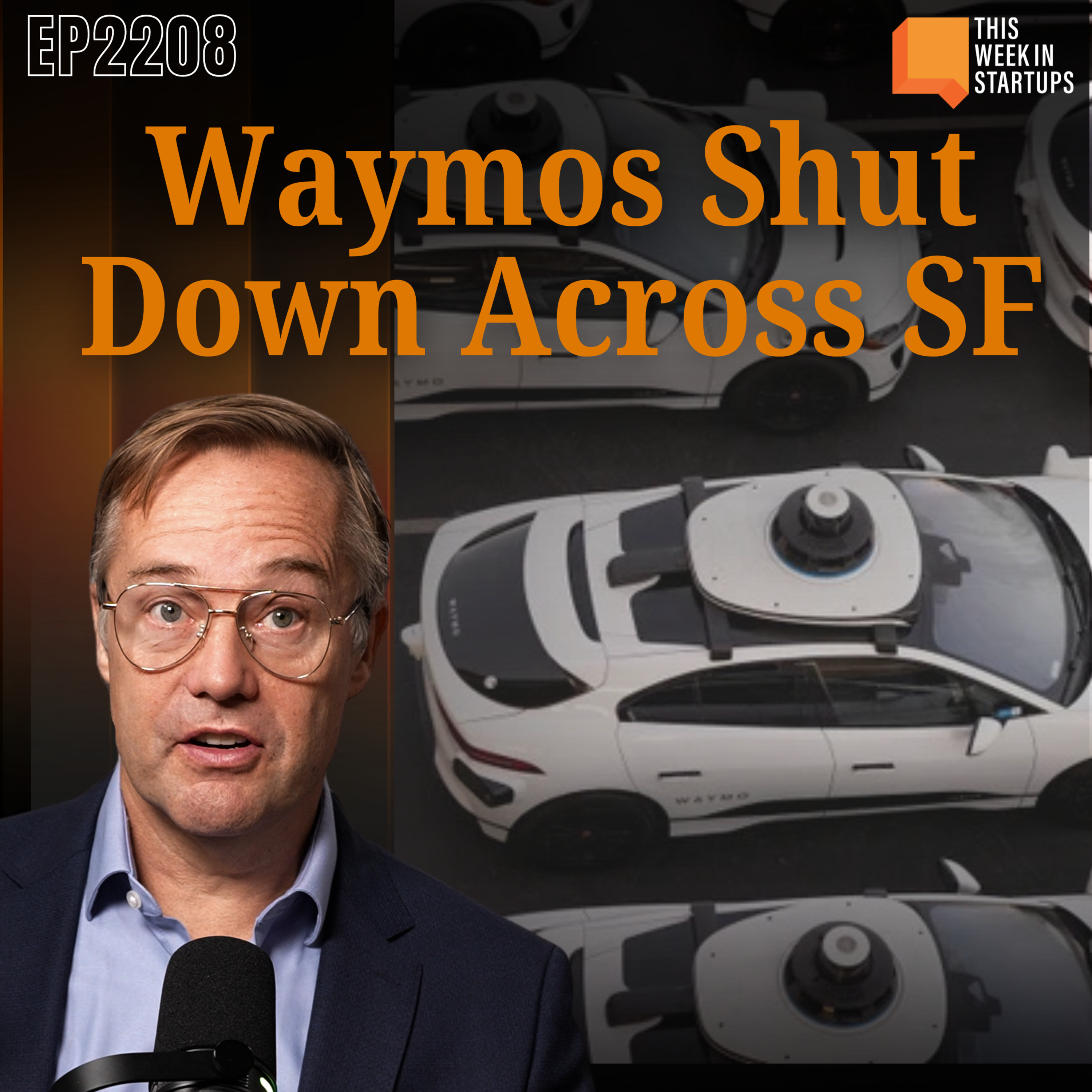
While large language models (LLMs) converge by training on the same public internet data, autonomous driving models will remain distinct. Each company must build its own proprietary dataset from its unique sensor stack and vehicle fleet. This lack of a shared data foundation means different automakers' AI driving behaviors and capabilities will likely diverge over time.

RJ Scaringe argues that successful, neural net-based autonomy requires a rare combination of ingredients: full control of the perception stack, a large vehicle fleet for data collection, massive capital, and GPU access. He believes only a handful of companies, including Rivian, Tesla, and Waymo, possess all the necessary components to compete.
By eschewing expensive LiDAR, Tesla lowers production costs, enabling massive fleet deployment. This scale generates exponentially more real-world driving data than competitors like Waymo, creating a data advantage that will likely lead to market dominance in autonomous intelligence.

Drawing from his Tesla experience, Karpathy warns of a massive "demo-to-product gap" in AI. Getting a demo to work 90% of the time is easy. But achieving the reliability needed for a real product is a "march of nines," where each additional 9 of accuracy requires a constant, enormous effort, explaining long development timelines.

As tech giants like Google and Amazon assemble the key components of the autonomy stack (compute, software, connectivity), the real differentiator becomes the ability to manufacture cars at scale. Tesla's established manufacturing prowess is a massive advantage that others must acquire or build to compete.
Initially criticized for forgoing expensive LIDAR, Tesla's vision-based self-driving system compelled it to solve the harder, more scalable problem of AI-based reasoning. This long-term bet on foundation models for driving is now converging with the direction competitors are also taking.

Travis Kalanick argues that Tesla has become the new benchmark for investors evaluating physical AI companies. Similar to how Web 2.0 startups were asked "Why won't Google kill you?", today's robotics and automation founders must now justify their existence against the perceived dominance of Tesla.
