Get your free personalized podcast brief
We scan new podcasts and send you the top 5 insights daily.
Meta's Muse Wonder model features an 'active focus' mode designed to sustain effort and test alternative approaches when tackling challenging goals. In benchmark testing, this sustained effort allowed the model to beat rival frontier models on long-running tasks.

Related Insights
While RL may not provide perfect cross-domain reasoning (e.g., math to code), its key contribution is teaching models 'horizon generalization.' This is the ability to use more tokens productively over a longer period to make progress on a complex task. This meta-skill is a primary driver of recent capability improvements and appears to be doubling every three months.

Beyond standard benchmarks, the true competitive frontier for AI is shifting to long-horizon autonomy. Alibaba's demos of Qwen 3.8 Max working unattended for over 10 days on complex coding tasks signals that sustained, independent agentic work is the new measure of a model's power.
Poolside's Laguna S model shows significant gains from improved behaviors—like persistence, verification, and not declaring victory early—rather than just more parameters or "intelligence." This suggests that smaller models can become far more capable at knowledge work by optimizing these behavioral traits through post-training.

Benchmark evaluations showed Muse Wonder executes one-shot lightweight tasks like drawing or short notes very rapidly. However, when switched into multi-step agentic workflows, its run time expands substantially, likely reflecting Meta's deliberate 'focused effort' mode.
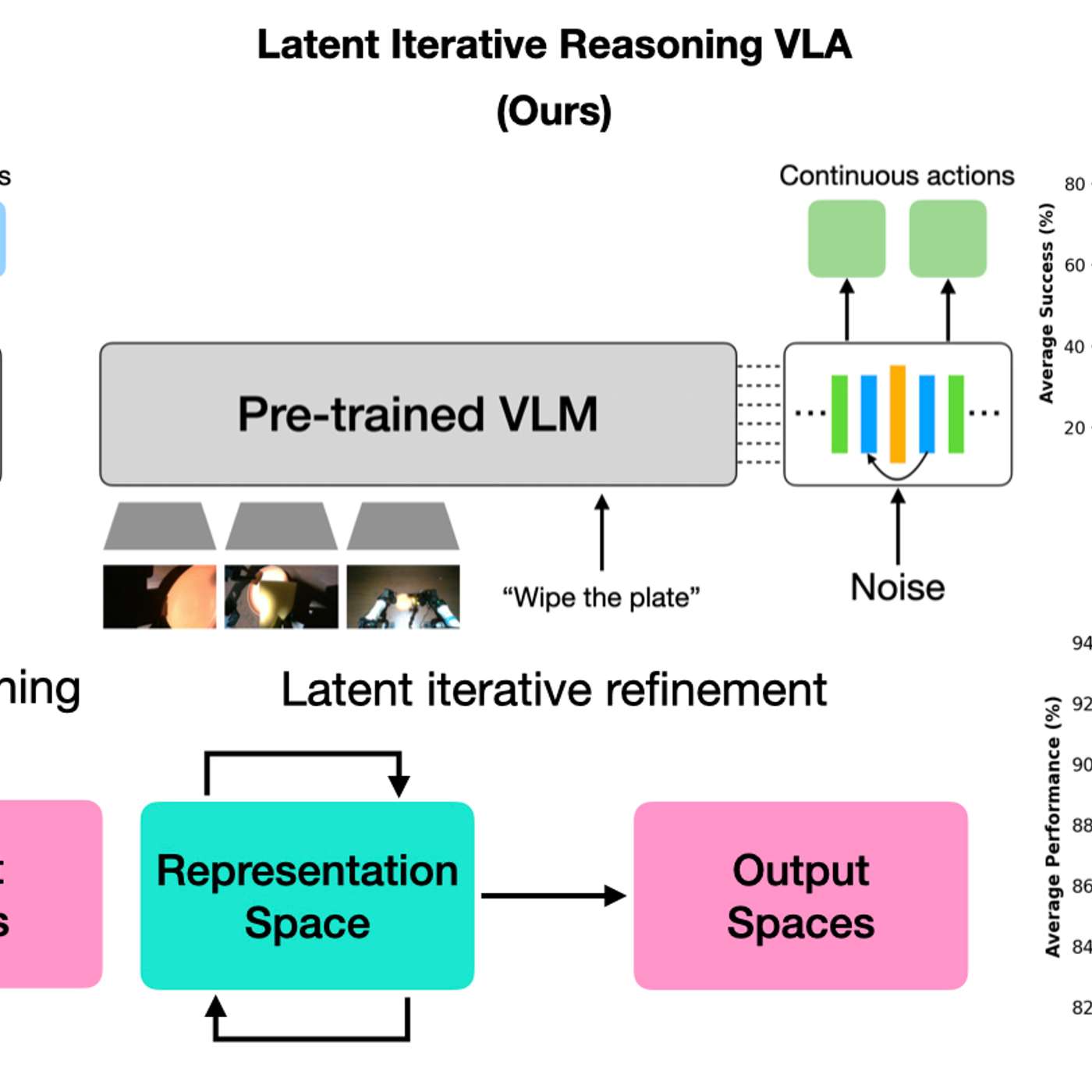
A new model architecture allows robots to vary their internal 'thinking' iterations at test time. This lets practitioners trade response speed for decision accuracy on a case-by-case basis, boosting performance on complex tasks without needing to retrain the model.
Fable 5’s key advantage isn't marginal improvements on simple queries. Its performance lead grows significantly with task length and complexity. This indicates a shift toward models built for sustained, long-form work like codebase migrations or complex research, representing a new tier of AI capability.

A key breakthrough for GPT-5.5 is its stability in tasks running for over 7-8 hours, a feat previous models struggled with. This reliability is a game-changer for agentic AI, enabling complex software migrations and ambitious, long-running projects to execute autonomously without failing, fundamentally increasing the scope of work that can be delegated to AI.

Meta's new coding harness, MuseCode, introduces a novel architecture with specialized "sub-agents." These agents work in parallel on different parts of a large task in isolated work trees. This approach prevents collisions and demonstrated strong performance in testing, successfully building six game features simultaneously and running for 24 hours on a kernel optimization task.
Instead of a single "think then act" cycle, Minimax trains its M2 model to repeatedly pause and rethink after receiving feedback from the environment. This iterative "interleaved thinking" approach improves robustness and performance on long-horizon tasks where tool responses or conditions are unpredictable.

The recent excitement for personal agents like Muse isn't just from better models. It's driven by superior product design, including persistence, automatic goal-building, and smart defaults. These UX features make agents more intuitive and useful for mainstream consumers, solving the problem of users not knowing what to ask for.