Get your free personalized podcast brief
We scan new podcasts and send you the top 5 insights daily.
A significant and persistent challenge for deploying AI coding agents is 'repo setup': ensuring the agent’s sandboxed environment perfectly mirrors a human developer's setup, including all dependencies, secrets, and configurations. Solving the local developer environment story is key to solving the agent setup.

Related Insights
The core needs of AI agents—version control, testing, observability—mirror those of human developers. However, the sheer scale and speed of agentic workflows mean existing tools like Kubernetes are insufficient, requiring a fundamental reimagining of the entire infrastructure stack.

Instead of placing agents inside a pre-set environment, a more powerful approach for reasoning models is to start with just the agent. Then, give it the tools and skills to boot its own development stack as needed, granting it more autonomy and control over its workspace.
Tools like Git were designed for human-paced development. AI agents, which can make thousands of changes in parallel, require a new infrastructure layer—real-time repositories, coordination mechanisms, and shared memory—that traditional systems cannot support.

Running multiple, complex AI coding agents simultaneously is computationally prohibitive on local machines. Stripe's success relies on their ability to spin up numerous isolated cloud development environments in parallel, a crucial investment for any team serious about agentic engineering.

The biggest barrier for designers entering the codebase isn't writing code, but the complex, brittle setup of a local development environment. Tools that abstract this away into one-click, sandboxed environments are critical for unlocking designer participation.

As AI generates more code than humans can review, the validation bottleneck emerges. The solution is providing agents with dedicated, sandboxed environments to run tests and verify functionality before a human sees the code, shifting review from process to outcome.
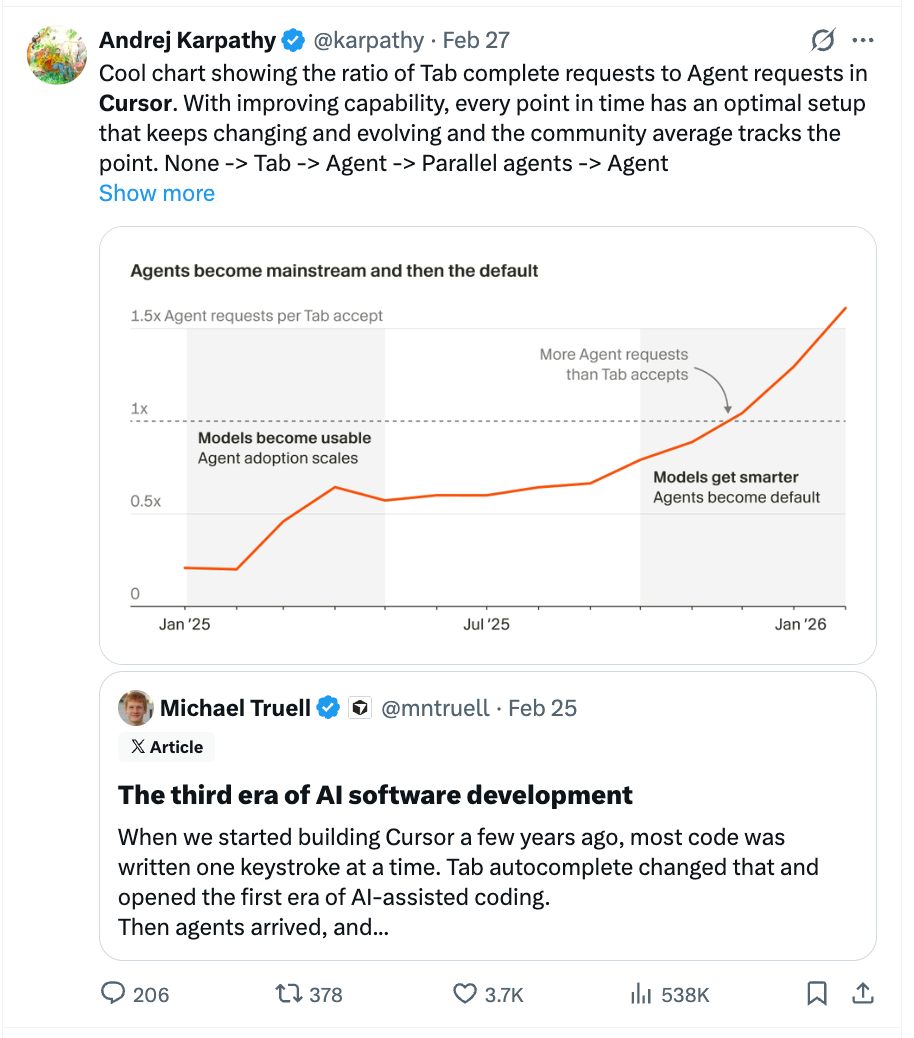
Cursor discovered that agents need more than just code access. Providing a full VM environment—a "brain in a box" where they can see pixels, run code, and use dev tools like a human—was the step-change needed to tackle entire features, not just minor edits.
The 'out of the box' architecture, where an agent's logic runs separately from its sandboxed execution environment, is more complex but offers superior security and reusability. This prevents agent secrets from being exposed in the execution environment and allows leveraging existing developer setups.
A critical, non-obvious requirement for enterprise adoption of AI agents is the ability to contain their 'blast radius.' Platforms must offer sandboxed environments where agents can work without the risk of making catastrophic errors, such as deleting entire datasets—a problem that has reportedly already caused outages at Amazon.

When multiple AI agents work on the same codebase, they overwrite each other's changes. Superset solves this by giving each agent its own cloned environment using Git work trees. This mimics how human developers work on separate branches before merging, preventing conflicts and enabling parallel work.
