Get your free personalized podcast brief
We scan new podcasts and send you the top 5 insights daily.
The core needs of AI agents—version control, testing, observability—mirror those of human developers. However, the sheer scale and speed of agentic workflows mean existing tools like Kubernetes are insufficient, requiring a fundamental reimagining of the entire infrastructure stack.

Related Insights
As individuals and companies deploy numerous specialized AI agents, managing them via simple interfaces like Telegram becomes untenable. This creates a demand for sophisticated "Mission Control" dashboards to monitor agent health (e.g., heartbeats, cron jobs), track persistent information, and manage the entire agent fleet effectively.

The developer's role is evolving from a linear workflow (code, submit PR, get review) to a parallel one. At Block, developers now manage multiple AI agents building numerous pull requests simultaneously, acting as an editor and context-switcher rather than the sole creator.

Tools like Git were designed for human-paced development. AI agents, which can make thousands of changes in parallel, require a new infrastructure layer—real-time repositories, coordination mechanisms, and shared memory—that traditional systems cannot support.
AI agents operate on a tight feedback loop. A slow CI/CD pipeline becomes the primary bottleneck, negating the speed benefits of AI-generated code. Fast CI is now a strategic necessity for any engineering team serious about leveraging AI.

The focus in AI engineering is shifting from making a single agent faster (latency) to running many agents in parallel (throughput). This "wider pipe" approach gets more total work done but will stress-test existing infrastructure like CI/CD, which wasn't built for this volume.
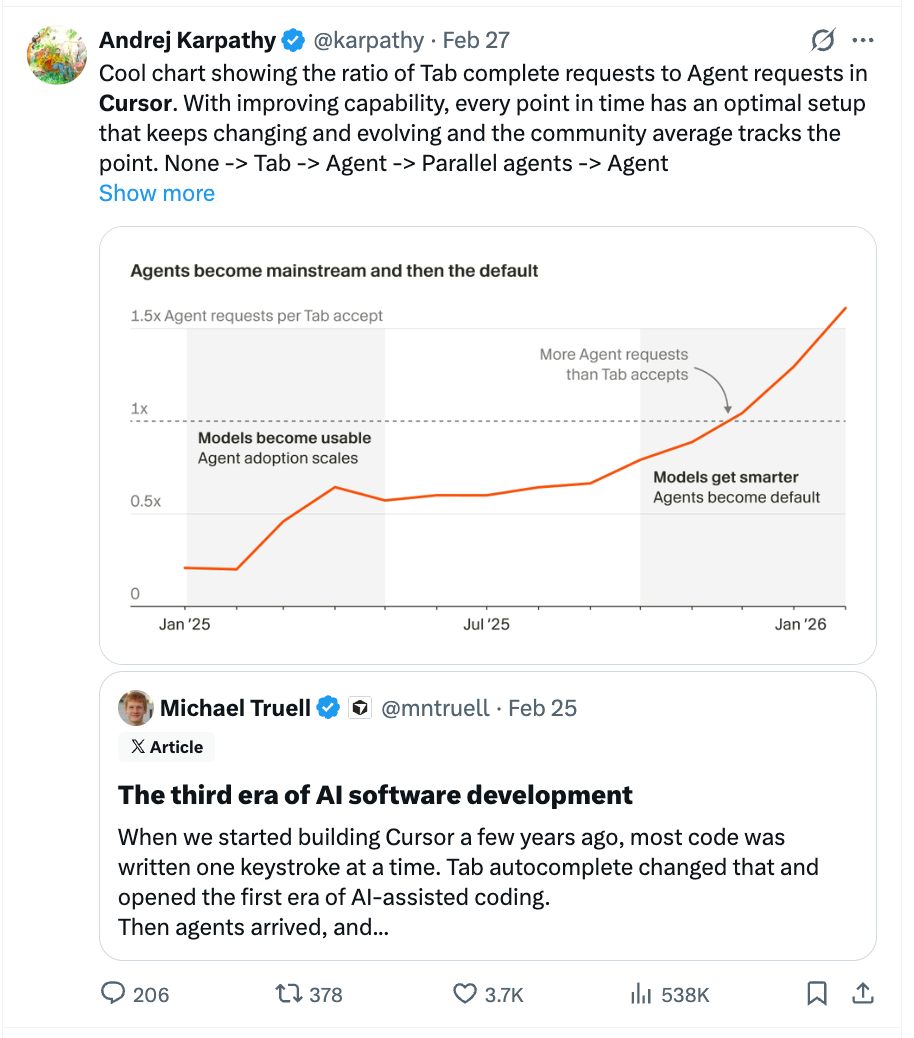
The next evolution of agentic work involves massive, collaborative swarms of AIs working together. Current tools like GitHub, designed for human workflows with a single master branch, are ill-suited for this paradigm. The future will require new, agent-native platforms, possibly resembling social networks, to manage thousands of parallel experiments and collaborative branches.
The number of AI agents will soon vastly exceed human employees. This requires a fundamental shift in software development, prioritizing API-first design, reliability, and machine-to-machine interaction over traditional human-centric user interfaces.
The durable investment opportunities in agentic AI tooling fall into three categories that will persist across model generations. These are: 1) connecting agents to data for better context, 2) orchestrating and coordinating parallel agents, and 3) providing observability and monitoring to debug inevitable failures.
As AI generates more code, the bottleneck is no longer writing but managing parallel streams of work from AI agents. This shift is making single-threaded editing tools like Cursor obsolete in favor of multi-agent management platforms like Superset, which orchestrate cloned codebases for each agent.

Historically, developer tools adapted to a company's codebase. The productivity gains from AI agents are so significant that the dynamic has flipped: for the first time, companies are proactively changing their code, logging, and tooling to be more 'agent-friendly,' rather than the other way around.
