Get your free personalized podcast brief
We scan new podcasts and send you the top 5 insights daily.
Kun Chen doesn't just use off-the-shelf agents; he builds his own tools like Lavish (visual planning) and 'no mistakes' (validation). This highlights a key trait of power users: identifying and solving personal workflow frictions with custom software instead of waiting for public solutions.

Related Insights
For its Custom Agents feature, Notion rejected the goal of making it "as easy as possible to use." They realized simplifying the interface would abstract away critical interpretability and diminish the tool's power, so they aligned on building a deep, sophisticated product for "the top of the class."
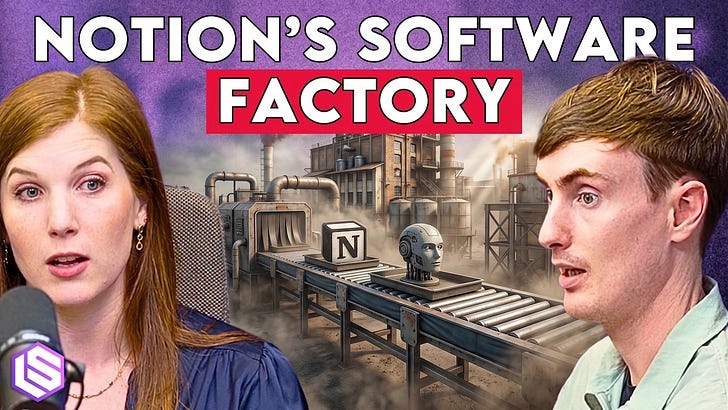
The most significant productivity gains come from applying AI to every stage of development, including research, planning, product marketing, and status updates. Limiting AI to just code generation misses the larger opportunity to automate the entire engineering process.

You don't need technical skills to build custom AI tools. Frame your needs as problem statements to a capable AI agent. The AI then acts as a product manager, asking clarifying questions to understand the requirements before generating the necessary scripts and workflows to solve your problem automatically.

Instead of relying on one-off prompts, professionals can now rapidly build a collection of interconnected internal AI applications. This "personal software stack" can manage everything from investments and content creation to data analysis, creating a bespoke productivity system.

Establish a powerful feedback loop where the AI agent analyzes your notes to find inefficiencies, proposes a solution as a new custom command, and then immediately writes the code for that command upon your approval. The system becomes self-improving, building its own upgrades.

The surprising success of Dia's custom "Skills" feature revealed a huge user demand for personalized tools. This suggests a key value of AI is enabling non-technical users to build "handmade software" for their specific, just-in-time needs, moving beyond one-size-fits-all applications.
Most AI power users focus on creating agentic "skills" or "verbs" (e.g., summarize this). Steve Newman's personal toolkit highlights the power of building custom UIs or "nouns"—like a dashboard for agent status. This visual layer makes interacting with AI-processed information far more efficient and is an underexplored frontier.

Treat your personal software as malleable. Instead of enduring friction, describe your pain point to an AI and have it build a solution, like a custom web UI or Kanban board, in hours. This shifts the paradigm from using to co-creating tools.

The excitement around tools like OpenClaw stems from their ability to empower non-programmers to create custom software and workflows. This replicates the feeling of creative power previously exclusive to developers, unlocking a long tail of niche, personalized applications for small businesses and individuals who could never build them before.
The highest level of AI coding proficiency involves creating a "machine that builds the machine." This means developing a custom system of agents (e.g., PM, Engineer), skills, and a central `Claude.md` config that automates your unique workflow and values.