Get your free personalized podcast brief
We scan new podcasts and send you the top 5 insights daily.
The submarine production crisis is not just a headcount problem; it is a deep operational inefficiency problem. A Navy Admiral reveals that in some areas, worker productivity is less than 50%, meaning simply hiring more people is insufficient without fundamentally new technology and processes.

Related Insights
A critical challenge for the military is maintaining aging equipment when original suppliers no longer exist. Advanced, flexible factories can reverse-engineer and produce these 'obsolete parts' on demand, solving a critical maintenance bottleneck for in-service submarines and other legacy systems.
The nearly trillion-dollar US defense budget is misleading. The vast majority is locked into fixed costs like salaries, facilities, and sustaining legacy systems. The actual procurement budget for new technology is at a historic low as a percentage of GDP, constraining modernization.

Modern factories like Hadrian's use software not just for automation but for agility. This allows them to quickly reconfigure production lines for small batches of highly varied parts ('high mix, low volume'), a necessity for complex systems like submarines where components are not mass-produced.
The US defense industry's error was creating a separate, "exquisite" industrial base. The solution is designing weapons that can be built using existing, scalable commercial manufacturing techniques, mirroring the successful approach used during World War II.
According to the 'dark side' of Metcalfe's Law, each new team member exponentially increases the number of communication channels. This hidden cost of complexity often outweighs the added capacity, leading to more miscommunication and lost information. Improving operational efficiency is often a better first step than hiring.

Palantir is applying AI software to US shipyards to dramatically accelerate production. The technology has reduced planning processes that previously took hundreds of man-hours per week to just 10 minutes, and manufacturing bill of materials generation from 200 hours to 12 seconds, aiming to overcome production bottlenecks.

After the Cold War, the US de-emphasized manufacturing, creating a massive skills gap. Today, the money exists to build more submarines, but the trained welders, machinists, and engineers do not. This human capital deficit, not budget, is the primary obstacle to scaling production.
In the near future, companies will leverage AI to demand exponentially higher productivity. Individuals unable to produce the output currently done by a team of ten will struggle to find or keep jobs. This is the real meaning of 'productivity gains'.

The decisive advantage in future conflicts will not be just technological superiority, but the ability to mass-produce weapons efficiently. After decades of offshoring manufacturing, re-industrializing the US to produce hardware at scale is Anduril's core strategic focus, viewing the factory itself as the ultimate weapon.
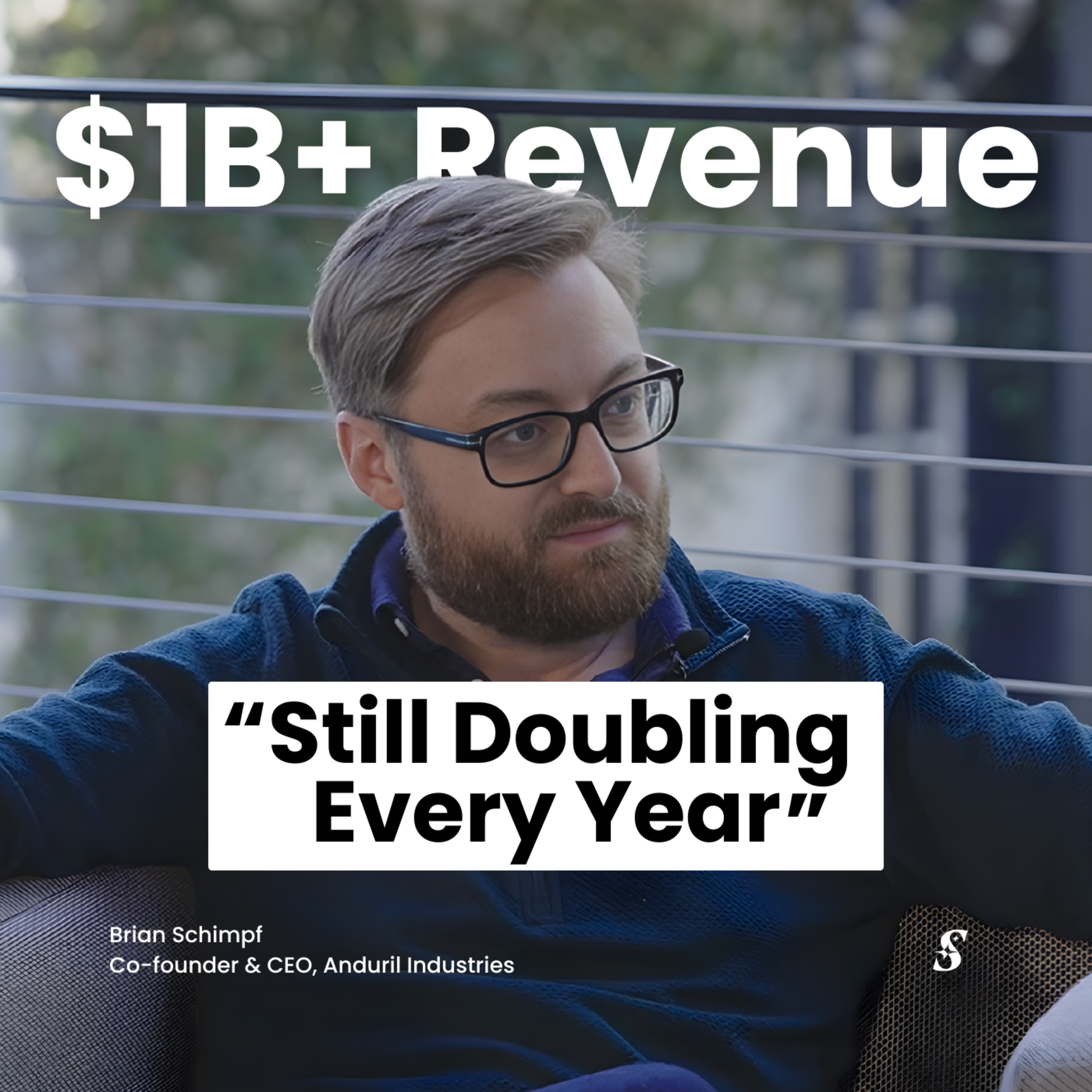
Anduril's co-founder argues America's atrophied manufacturing base is a critical national security vulnerability. The ultimate strategic advantage isn't a single advanced weapon, but the ability to mass-produce "tens of thousands of things" efficiently. Re-industrializing is therefore a core pillar of modern defense strategy.