Get your free personalized podcast brief
We scan new podcasts and send you the top 5 insights daily.
The discovery of low-grade, asymptomatic interstitial lung disease (ILD) on scans for patients on certain ADCs does not mandate permanent discontinuation. By holding the drug, initiating steroids, and involving pulmonology, the inflammation can resolve, often allowing the patient to safely resume a highly effective therapy.
Related Insights
Unlike immunotherapy, where re-challenge after progression is dubious, there is an emerging clinical practice of re-challenging patients with the same antibody-drug conjugate (ADC), such as enfortumab vedotin (EV), after a treatment break forced by toxicity. Anecdotally, patients are showing great responses, highlighting a key area for prospective data generation.

Trastuzumab deruxtecan (TDXD) and datopotamab deruxtecan (Dato-DXd) share the same cytotoxic payload, yet Dato-DXd has a much lower rate of interstitial lung disease (ILD). This indicates the toxicity is driven by the antibody-antigen interaction, not the payload itself.
ITP caused by immune checkpoint inhibitors (ICIs) is rare (0.25% incidence) but generally has a good prognosis. Most patients respond to standard first-line ITP therapies, and approximately 70% of those re-challenged with the ICI can continue treatment without a recurrence of ITP.
To manage the risk of interstitial lung disease (ILD) with TDXD, experts now recommend routine screening with high-resolution chest CT scans every 6-12 weeks. This practice aims to catch asymptomatic, grade 1 ILD early, allowing for treatment holds and steroid intervention, which may preserve the option to rechallenge.
An ADC may show better response rates than chemotherapy, but its true benefit is compromised if toxicities lead to treatment discontinuation. As seen with failed PARP/IO combinations, if patients cannot tolerate a drug long enough, the regimen's overall effectiveness can become inferior to standard therapy.
As multiple effective Antibody-Drug Conjugates (ADCs) become available, the primary clinical challenge is no longer *if* they work, but *how* to use them best. Key unanswered questions involve optimal sequencing, dosing for treatment versus maintenance, and overall length of therapy, mirroring issues already seen in breast cancer.
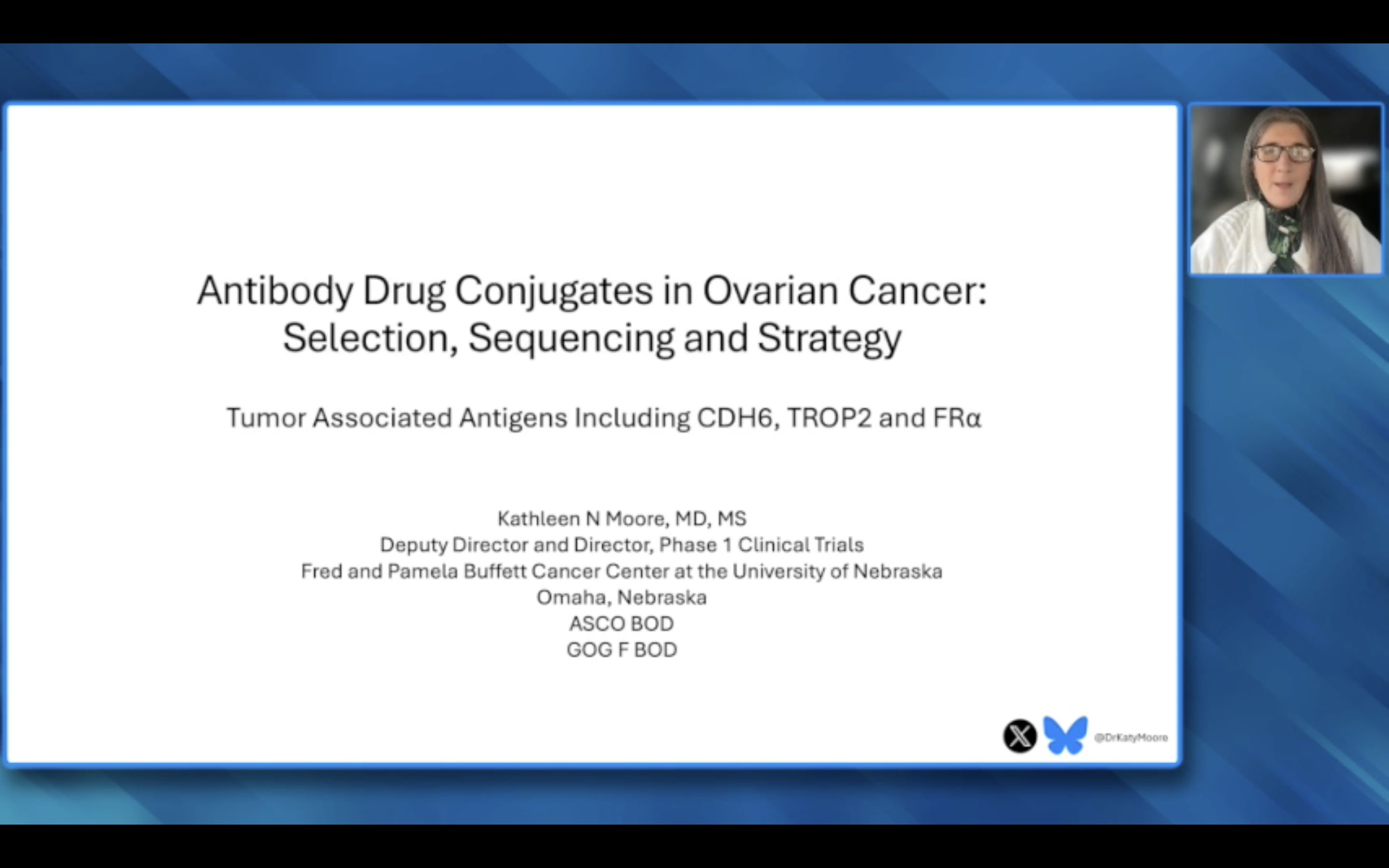
The REJOICE trial for an ADC in ovarian cancer exemplifies a critical trend: embedding multi-arm dose optimization studies. This approach identified a dose that maintained high response rates (57%) while significantly lowering rates of serious adverse events like ILD (from 6% to 3%), prioritizing patient safety.
For the ADC belantamab mafodotin, clinicians should not feel rigidly bound to the initial every-three-week schedule. Data shows that spreading doses out to every 8 or 12 weeks is a viable strategy, as most patients stabilize or even improve their depth of response despite holding the drug, allowing for better toxicity management.
While oncologists focus on the low 4% rate of Interstitial Lung Disease (ILD) from neoadjuvant TDXD, surgeons worry this complication could prevent patients from reaching potentially curative surgery, drawing parallels to issues seen with neoadjuvant immunotherapy.
Clinical trial data shows that despite specific toxicities, antibody-drug conjugates (ADCs) can be better tolerated overall than standard chemotherapy. For example, trials for both sacituzumab govitecan and dato-DXd reported fewer patients discontinuing treatment in the ADC arm compared to the chemotherapy arm.