Get your free personalized podcast brief
We scan new podcasts and send you the top 5 insights daily.
LLMs can generate functional, structured files, not just text. A simple, natural language prompt can be used to find unstructured information online (like a sports team's schedule) and create a ready-to-use .ICS calendar file, turning web data into a practical tool without coding.

Related Insights
Browser-based ChatGPT cannot execute code or connect to external APIs, limiting its power. The Codex CLI unlocks these agentic capabilities, allowing it to interact with local files, run scripts, and connect to databases, making it a far more powerful tool for real-world tasks.

Advanced management techniques, like using AI to suggest team improvements, no longer require specialized software or data science teams. A manager can use an off-the-shelf tool like ChatGPT, feed it a simple spreadsheet of performance data, and ask it to run the analysis, democratizing access to managerial 'superpowers'.

A powerful, non-obvious use for LLMs is information restructuring. By feeding a standard online recipe to ChatGPT, you can ask it to reformat the instructions so that ingredient measurements appear directly within each step. This eliminates scrolling back and forth, making recipes easier to follow.

The 'calendar' content format is highly flexible and not limited to B2B event tracking. Consumer brands can create wellness or challenge calendars, while nonprofits can map out their annual impact and volunteering opportunities. The key is providing a year-long planning tool relevant to your specific audience.

Use Claude's "Artifacts" feature to generate interactive, LLM-powered application prototypes directly from a prompt. This allows product managers to test the feel and flow of a conversational AI, including latency and response length, without needing API keys or engineering support, bridging the gap between a static mock and a coded MVP.
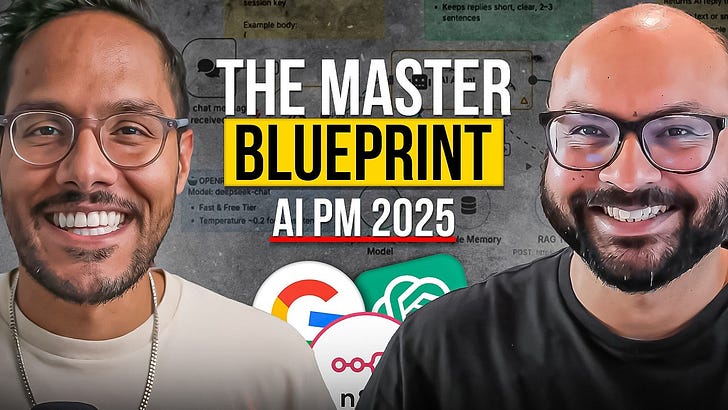
Prototyping and even shipping complex AI applications is now possible without writing code. By combining a no-code front-end (Lovable), a workflow automation back-end (N8N), and LLM APIs, non-technical builders can create functional AI products quickly.
Instead of manual survey design, provide an AI with a list of hypotheses and context documents. It can generate a complete questionnaire, the platform-specific code file for deployment (e.g., for Qualtrics), and an analysis plan, compressing the user research setup process from days to minutes.
A simple but effective method to feed context into an AI project is to use the "Print to PDF" function on websites. This works well for company marketing pages, support articles, or competitor pricing, instantly turning structured web data into a usable file for the AI's knowledge base.
A standout feature of the Claude LLM is "artifacts," which allows a user to convert a chat-based creation into a simple, deployed application that can be shared with others directly within the Claude interface. This is a powerful way for PMs to quickly prototype and share ideas.
Instead of creating mock data from scratch, provide an LLM with your existing production data schema as a JSON file. You can then prompt the AI to augment this schema with new fields and realistic data needed to prototype a new feature, seamlessly extending your current data model.