Get your free personalized podcast brief
We scan new podcasts and send you the top 5 insights daily.
As AI agents and copilots accelerate code creation from numerous sources, the primary challenge for engineering teams becomes validating this massive influx of pull requests. This makes the code review process the new critical choke point in the software development lifecycle.

Related Insights
As AI coding agents generate vast amounts of code, the most tedious part of a developer's job shifts from writing code to reviewing it. This creates a new product opportunity: building tools that help developers validate and build confidence in AI-written code, making the review process less of a chore.

The ease of creating PRs with AI agents shifts the developer bottleneck from code generation to code validation. The new challenge is not writing the code, but gaining the confidence to merge it, elevating the importance of review, testing, and CI/CD pipelines.
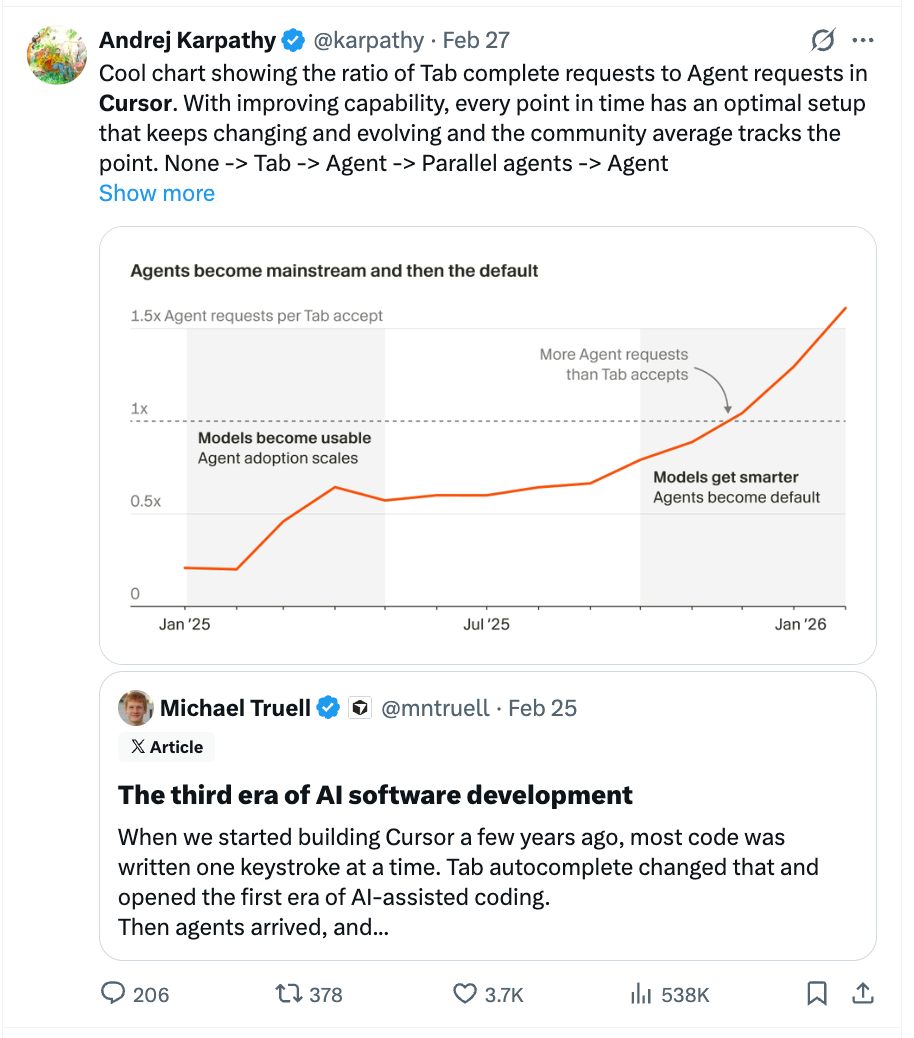
Traditional software development processes, like peer code reviews, were built for a cadence of 10-15 PRs per month. When AI agents enable a 10x increase in output, the human team becomes the bottleneck, forcing a shift towards AI-driven review and validation.

As AI accelerates content and code generation, the primary challenge is no longer creation but the overwhelming volume of work that needs review. Loredana Crisan notes that teams are becoming bottlenecked by review cycles, highlighting a need for new collaborative and automated review workflows.

With AI agents capable of generating code and designs at an unprecedented rate, the new chokepoint in workflows is human review. The primary challenge is no longer production but scaling the evaluation process to ensure AI-generated output aligns with quality standards and company values.

With AI generating 1,300 pull requests weekly at Stripe, the critical path is shifting. When coding becomes a commodity, the bottleneck moves to human review and validation. Engineering teams must refocus from pure creation to oversight and quality assurance at scale.

Simply deploying AI to write code faster doesn't increase end-to-end velocity. It creates a new bottleneck where human engineers are overwhelmed with reviewing a flood of AI-generated code. To truly benefit, companies must also automate verification and validation processes.

AI agents can generate plausible-looking code contributions instantly, flooding maintainers with pull requests. Since the human cost to review and validate the code remains high, this creates a significant imbalance and a new bottleneck in open source development.

With AI agents autonomously generating pull requests, the primary constraint in software development is no longer writing code but the human capacity to review it. Companies like Block are seeing PRs per engineer increase massively, creating a new challenge for engineering managers to solve.

As AI generates more code, the core engineering task evolves from writing to reviewing. Developers will spend significantly more time evaluating AI-generated code for correctness, style, and reliability, fundamentally changing daily workflows and skill requirements.