Get your free personalized podcast brief
We scan new podcasts and send you the top 5 insights daily.
For older or frail DLBCL patients who are not candidates for CAR-T cell therapy, the combination of mosunetuzumab and polatuzumab offers a potent and significantly more tolerable alternative to other bispecifics. This regimen is logistically simpler for community practice and can be used successfully even in very elderly patients.

Related Insights
When choosing a bispecific antibody for follicular lymphoma, a major practical difference is the treatment duration. Mosunetuzumab is a time-limited therapy stopped after achieving a complete response, while Epcoritamab is given indefinitely until progression. This distinction heavily influences selection, especially for elderly patients.

Provocative data from a German study showed an 81% complete response rate in untreated, elderly DLBCL patients using a chemotherapy-free regimen of polatuzumab (an ADC), glofitamab (a bispecific), and rituximab. This challenges the decades-long R-CHOP chemotherapy backbone and points to a future of targeted frontline therapies.
Combining the ADC Loncastuximab before a bispecific antibody may lower the bispecific's toxicity, potentially through a debulking effect. This surprising finding suggests a strategy to improve the tolerability and delivery of bispecifics, especially in community settings.

In follicular lymphoma, the treatment goal is durable remission with manageable toxicity, not necessarily a cure. Therefore, clinicians frequently prefer using a bispecific antibody first, reserving the more complex and toxic CAR-T cell therapy for transformed disease or after a bispecific fails.
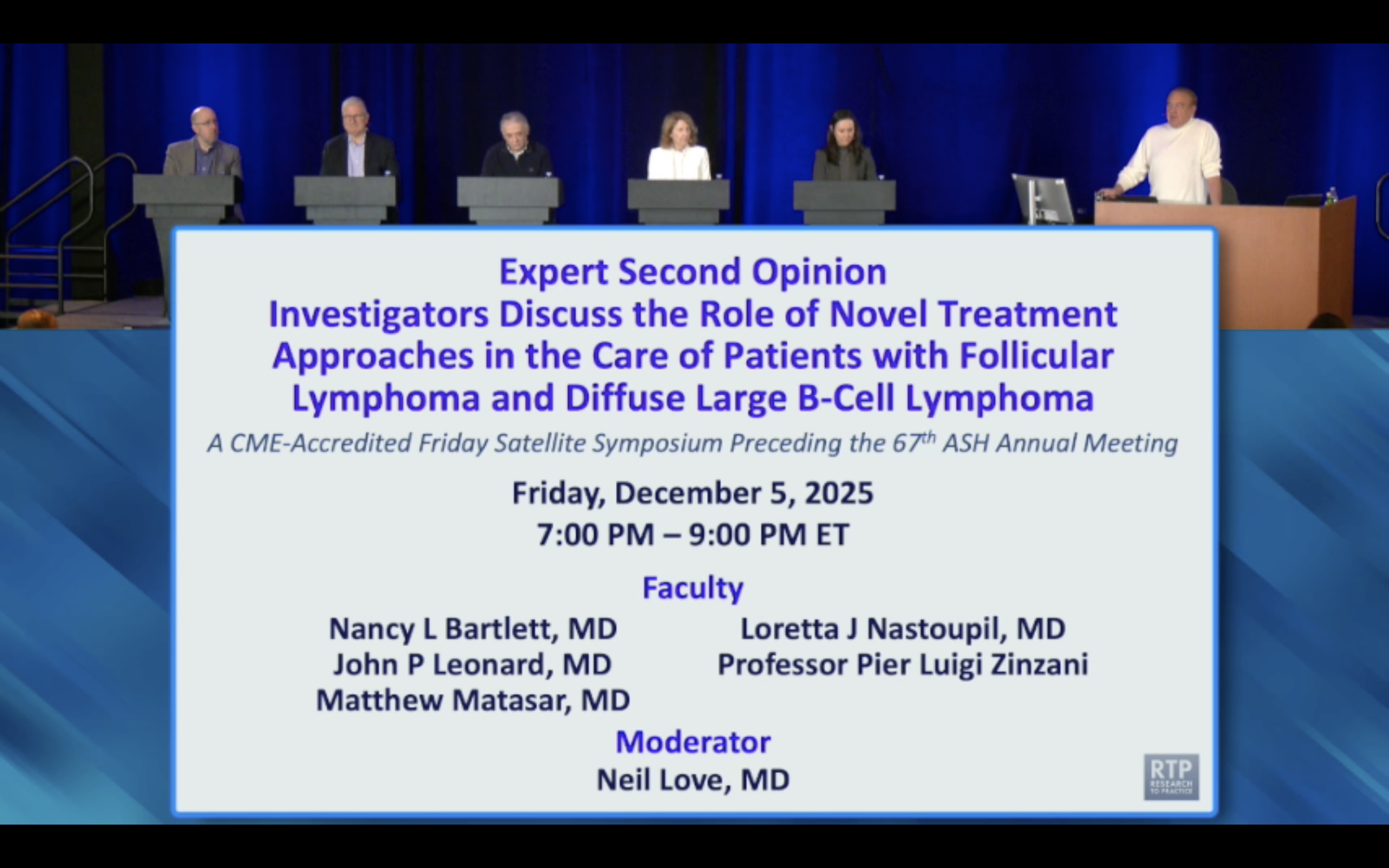
Experts view R-mini-CHOP, the standard for older/unfit DLBCL patients, as a poor benchmark that urgently needs to be replaced. Promising chemo-free or chemo-light regimens, like the R-Polo-Glofitamab combination, are seen as the future, aiming to improve outcomes in this vulnerable population without harsh toxicities.

For DLBCL patients awaiting CAR-T cell therapy, particularly those with aggressive disease, bispecific antibodies are the preferred bridging strategy. This approach effectively controls disease and reduces tumor burden for better CAR-T outcomes, while avoiding the T-cell depleting effects of traditional chemotherapy.
While the first-line Polarix trial suggested Polatuzumab's benefit was greater in ABC-subtype DLBCL, the Polargo trial in relapsed patients found no such difference. Both ABC and GCB subtypes benefited significantly from Polatuzumab's addition. This suggests that in the higher-risk relapse setting, overall disease risk trumps cell of origin as the key determinant of treatment benefit.
For relapsed mantle cell lymphoma, the mosunetuzumab-polatuzumab (MOSEN-POLA) combination shows efficacy comparable to single-agent glofitumab. However, MOSEN-POLA has a significantly better safety profile with much lower rates of severe cytokine release syndrome (CRS), making it an attractive and more manageable option.
An expert treating DLBCL states they no longer use bispecific antibodies as monotherapy. Combining them with partners like chemotherapy (GemOx) or ADCs (Polatuzumab) raises the complete response rate by 15-20%, offering a better chance of benefit for patients.
Early trial data for single-agent bispecific antibodies in elderly or frail patients with large cell lymphoma reveals surprisingly high efficacy. This success is prompting discussions about a chemotherapy-free future for this population, with combinations like glofitumab-polatuzumab potentially replacing traditional regimens.