Get your free personalized podcast brief
We scan new podcasts and send you the top 5 insights daily.
While the first-line Polarix trial suggested Polatuzumab's benefit was greater in ABC-subtype DLBCL, the Polargo trial in relapsed patients found no such difference. Both ABC and GCB subtypes benefited significantly from Polatuzumab's addition. This suggests that in the higher-risk relapse setting, overall disease risk trumps cell of origin as the key determinant of treatment benefit.

Related Insights
Despite the POLARIX trial showing greater benefit for Pola-R-CHP in non-GCB DLBCL, experts don't use this biomarker for treatment decisions. The community's IHC-based testing is considered too discordant with the trial's GEP method to be clinically reliable.

In relapsed/refractory DLBCL, the timing of relapse is a critical factor in determining the next line of therapy. Patients who relapse within 12 months are preferred candidates for CAR-T therapy. Those relapsing after 12 months may first undergo salvage chemotherapy followed by an autologous stem cell transplant if they respond.

The 5-year follow-up of the Polarix trial revealed an unexpected overall survival benefit for patients with the activated B-cell (ABC) subtype of diffuse large B-cell lymphoma. This post-hoc finding suggests the drug's efficacy is not uniform and is most pronounced in this historically harder-to-treat patient group, challenging initial interpretations of the data.
Combining polatuzumab vedotin with bispecific antibodies appears particularly effective for patients with double-hit lymphoma. This is significant because these high-risk patients, who have poor prognoses, were notably excluded from pivotal trials like STAR GLOW, suggesting a potential new standard for this specific subgroup.

Provocative data from a German study showed an 81% complete response rate in untreated, elderly DLBCL patients using a chemotherapy-free regimen of polatuzumab (an ADC), glofitamab (a bispecific), and rituximab. This challenges the decades-long R-CHOP chemotherapy backbone and points to a future of targeted frontline therapies.

The traditional "germinal center" (GC) classification for DLBCL is overly simplistic. Molecular analysis reveals distinct subtypes within GC, such as "dark zone" and "light zone" signatures, which have different prognoses and responses to targeted therapies like polatuzumab.
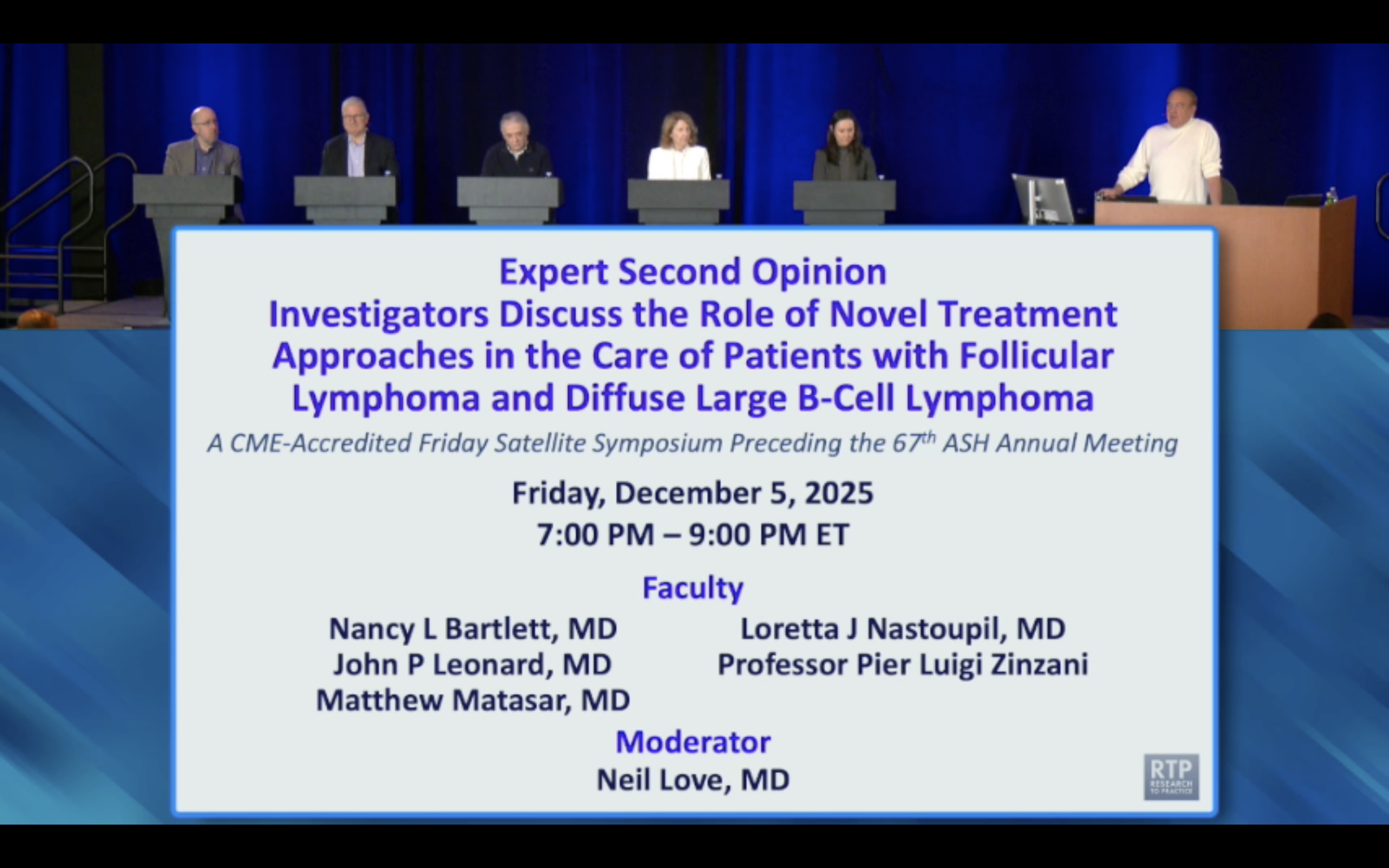
The traditional ABC/GCB classification for DLBCL is flawed. Single-cell sequencing reveals that tumors classified as one type via bulk analysis contain malignant cells of the other subtype. This underlying heterogeneity explains why the distinction is an imperfect predictor and will be replaced by more sophisticated biomarkers like T-cell exhaustion signatures.

Due to a 20% misclassification rate with the Hans algorithm for determining cell of origin, clinicians use an IPI score of 2 or greater as the primary criterion for selecting Polatuzumab-R-CHOP. This avoids potentially giving 1 in 5 patients the wrong therapy based on an imperfect biomarker.
An expert treating DLBCL states they no longer use bispecific antibodies as monotherapy. Combining them with partners like chemotherapy (GemOx) or ADCs (Polatuzumab) raises the complete response rate by 15-20%, offering a better chance of benefit for patients.
Emerging data reveals significant synergy when combining antibody-drug conjugates (ADCs) like polatuzumab vedotin with bispecific antibodies like glofitumab. These combinations show impressive results in relapsed/refractory non-Hodgkin lymphoma, signaling a major future direction for developing more potent therapies.