Get your free personalized podcast brief
We scan new podcasts and send you the top 5 insights daily.
To create autonomous AI agents, first break a workflow into stages. Manually verify the quality of each stage's output. Once you trust the end-to-end process, package it as a recurring, proactive "skill" that requires only occasional check-ins.

Related Insights
To avoid failure, launch AI agents with high human control and low agency, such as suggesting actions to an operator. As the agent proves reliable and you collect performance data, you can gradually increase its autonomy. This phased approach minimizes risk and builds user trust.

Before committing to automating an operational task like a daily briefing, run the process manually with AI every day for a week or two. This trial period allows you to evaluate the output's actual utility and refine the process before locking it into a potentially flawed automation.

Instead of forcing full autonomy, the AI agent allows teams to start with human approvals at key stages. This 'human-in-the-loop' model builds trust and enables organizations to incrementally automate complex support workflows as they grow more confident in the system's reliability.
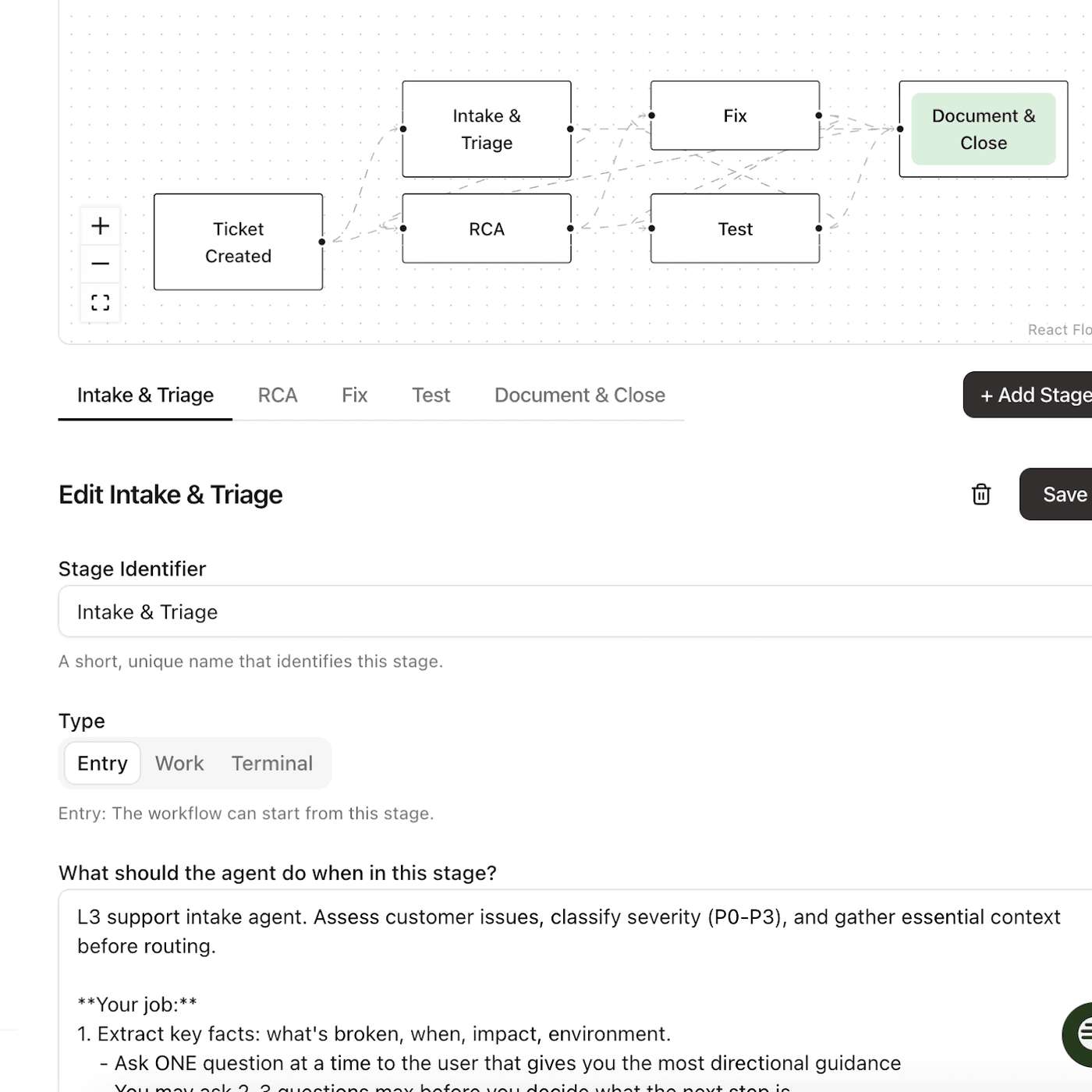
The key to creating effective and reliable AI workflows is distinguishing between tasks AI excels at (mechanical, repetitive actions) and those it struggles with (judgment, nuanced decisions). Focus on automating the mechanical parts first to build a valuable and trustworthy product.

A practical framework for developing agentic AI is to first map the human workflow. Break down the task into discrete steps, identify which ones can be automated, ensure the necessary data is available, and then build the underlying tools and code blocks. Don't start with the technology; start with the human process.

Don't write agent skills from scratch. First, manually guide the agent through a workflow step-by-step. After a successful run, instruct the agent to review that conversation history and generate the skill from it. This provides the crucial context of what a successful outcome looks like.
Counter the hype by following a clear progression: Skills -> Workflows -> Agents. If you cannot create a reliable, deterministic workflow with a predefined path, an autonomous agent attempting to improvise will almost certainly fail. This structured approach mitigates risk and ensures reliability.
For complex, high-stakes tasks like booking executive guests, avoid full automation initially. Instead, implement a 'human in the loop' workflow where the AI handles research and suggestions, but requires human confirmation before executing key actions, building trust over time.
When an AI coding assistant asks you to perform a manual task like checking its output, don't just comply. Instead, teach it the commands and tools (like Playwright or linters) to perform those checks itself. This creates more robust, self-correcting automation loops and increases the agent's autonomy.

Instead of pre-designing a complex AI system, first achieve your desired output through a manual, iterative conversation. Then, instruct the AI to review the entire session and convert that successful workflow into a reusable "skill." This reverse-engineers a perfect system from a proven process.
