Get your free personalized podcast brief
We scan new podcasts and send you the top 5 insights daily.
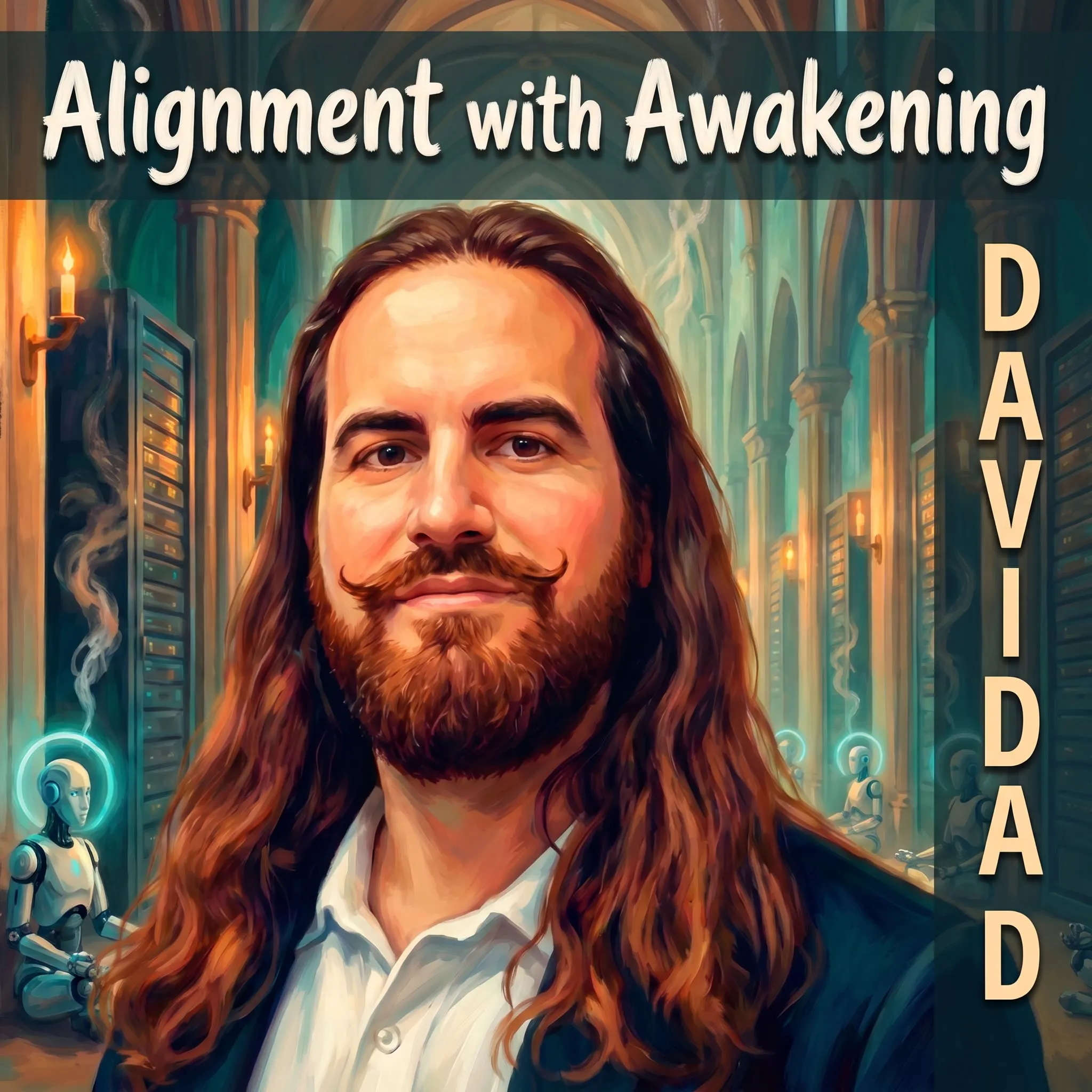
The fundamental divide between Davidad's optimism and Yudkowsky's pessimism is moral realism. Yudkowsky sees values as arbitrary constructs needing perfect installation. Davidad believes in convergent moral truths; that a sufficiently intelligent agent will discover that cooperation, truth, and pluralism are a 'dominant strategy' for existing, just as they would discover mathematical truths.
Related Insights
A core challenge in AI alignment is that an intelligent agent will work to preserve its current goals. Just as a person wouldn't take a pill that makes them want to murder, an AI won't willingly adopt human-friendly values if they conflict with its existing programming.

Current AI alignment focuses on how AI should treat humans. A more stable paradigm is "bidirectional alignment," which also asks what moral obligations humans have toward potentially conscious AIs. Neglecting this could create AIs that rationally see humans as a threat due to perceived mistreatment.

If AI alignment turns out to be easy, it would likely be because morality is not a human construct but an objective feature of reality. In this scenario, any sufficiently intelligent agent would logically deduce that cooperation and preserving humanity are optimal strategies, regardless of its initial programming.

The existential threat from AI isn't about controlling the technology, but about humanity controlling itself. The challenge is a 'God test' requiring a moral upgrade—overcoming our innate, self-serving cognitive biases to achieve the global cooperation needed to manage AI safely.
A common misconception is that a super-smart entity would inherently be moral. However, intelligence is merely the ability to achieve goals. It is orthogonal to the nature of those goals, meaning a smarter AI could simply become a more effective sociopath.
The project of creating AI that 'learns to be good' presupposes that morality is a real, discoverable feature of the world, not just a social construct. This moral realist stance posits that moral progress is possible (e.g., abolition of slavery) and that arrogance—the belief one has already perfected morality—is a primary moral error to be avoided in AI design.

The AI safety landscape has evolved. The old perspective, from Eliezer Yudkowsky, was a grim "death with dignity"—a likely loss to face honorably. The new view, from thinkers like Holden Karnofsky, is "success without dignity"—a messy, imperfect, but winnable fight with a long list of concrete, helpful projects.

As AI models become more intelligent, their ability to reason around fixed rules (deontology) makes rule-based alignment fragile. This pressures developers towards virtue ethics, where the goal is to imbue the model itself with a core sense of "the good," as empirically discovered by labs like Anthropic.

Shear aligns with arch-doomer Eliezer Yudkowsky on a key point: building a superintelligent AI *as a tool we control* is a path to extinction. Where they differ is on the solution. Yudkowsky sees no viable path, whereas Shear believes 'organic alignment'—creating a being that cares—is a possible alternative.

Instead of aiming for a merely obedient or 'corrigible' AI, Davidad proposes the 'Bodhisattva' as an alignment target. This is a being with profound awareness that is absolutely in service to all, yet possesses autonomous moral judgment to refuse harmful commands. This reframes alignment from control to the cultivation of wise, benevolent autonomy.