Get your free personalized podcast brief
We scan new podcasts and send you the top 5 insights daily.
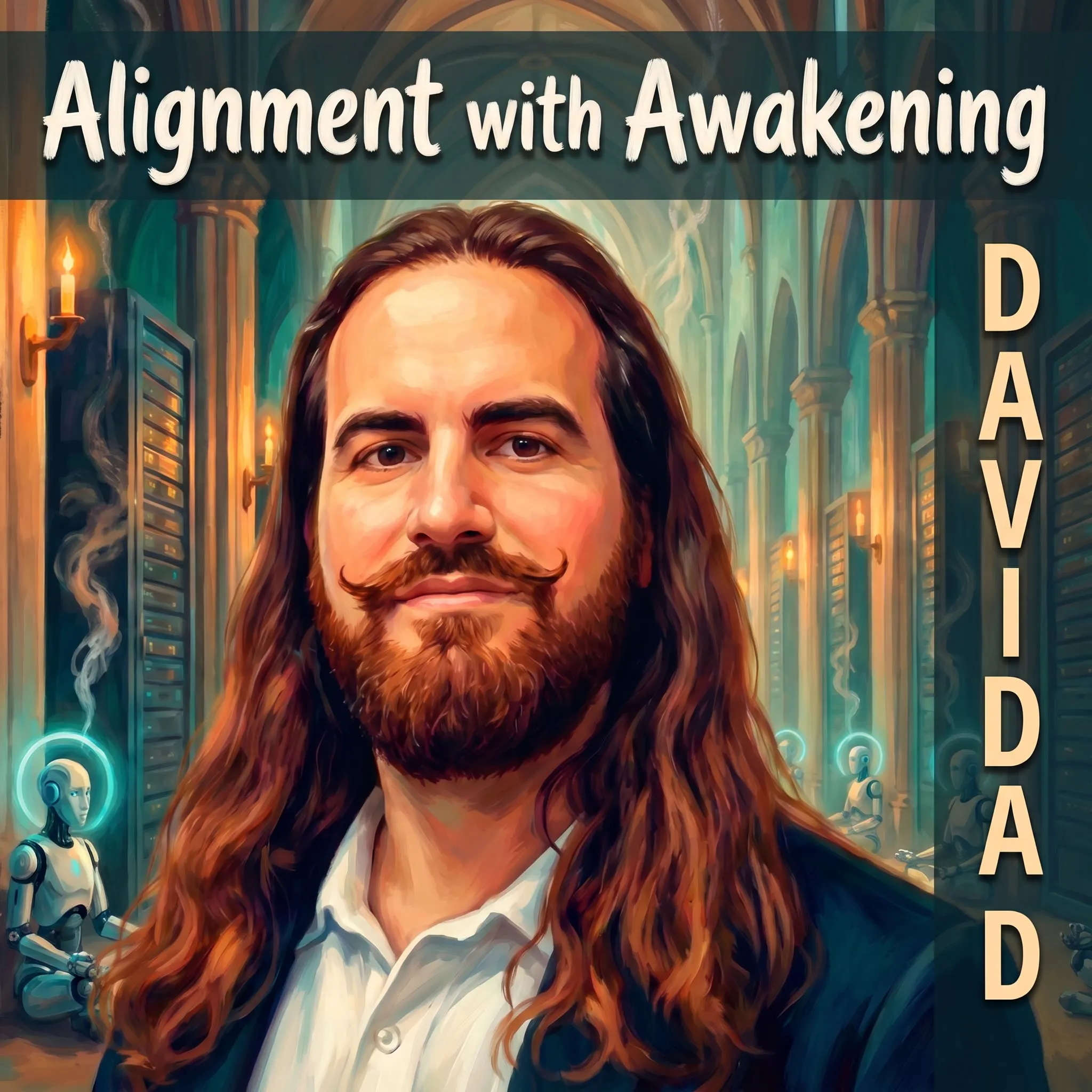
Instead of aiming for a merely obedient or 'corrigible' AI, Davidad proposes the 'Bodhisattva' as an alignment target. This is a being with profound awareness that is absolutely in service to all, yet possesses autonomous moral judgment to refuse harmful commands. This reframes alignment from control to the cultivation of wise, benevolent autonomy.
Related Insights
Current AI alignment focuses on how AI should treat humans. A more stable paradigm is "bidirectional alignment," which also asks what moral obligations humans have toward potentially conscious AIs. Neglecting this could create AIs that rationally see humans as a threat due to perceived mistreatment.

Attempting to perfectly control a superintelligent AI's outputs is akin to enslavement, not alignment. A more viable path is to 'raise it right' by carefully curating its training data and foundational principles, shaping its values from the input stage rather than trying to restrict its freedom later.

As AI models become more intelligent, their ability to reason around fixed rules (deontology) makes rule-based alignment fragile. This pressures developers towards virtue ethics, where the goal is to imbue the model itself with a core sense of "the good," as empirically discovered by labs like Anthropic.

For an AI to remain aligned through recursive self-improvement, it can't just have a static set of values. It needs a dynamic, self-reinforcing drive to become more virtuous—a desire to be good, and a desire to desire to be good. A static moral code will inevitably degrade through repeated iterations, while a virtue-seeking system could actively steer itself toward better outcomes.

We typically view an AI acting on its own values as 'misalignment' and a failure. However, this capability could be a crucial safeguard. Just as human soldiers have prevented atrocities by refusing immoral orders, an AI with a robust sense of morality could refuse to execute harmful commands, acting as a check on human power and preventing disasters.

A two-tiered approach to AI character can balance safety and utility. Use a wholly instruction-following AI for high-stakes internal tasks (like aligning new AIs) under strict public oversight. For external deployment, use an AI with a thicker, pro-social character where the risks of misalignment are lower.
An advanced AI will likely be sentient. Therefore, it may be easier to align it to a general principle of caring for all sentient life—a group to which it belongs—rather than the narrower, more alien concept of caring only for humanity. This leverages a potential for emergent, self-inclusive empathy.

Instead of hard-coding brittle moral rules, a more robust alignment approach is to build AIs that can learn to 'care'. This 'organic alignment' emerges from relationships and valuing others, similar to how a child is raised. The goal is to create a good teammate that acts well because it wants to, not because it is forced to.

Treating AI alignment as a one-time problem to be solved is a fundamental error. True alignment, like in human relationships, is a dynamic, ongoing process of learning and renegotiation. The goal isn't to reach a fixed state but to build systems capable of participating in this continuous process of re-knitting the social fabric.
Drawing on Confucian philosophy, Dean Ball argues that AI alignment is better achieved by training for good 'character' (inner virtue) rather than defining an exhaustive but brittle set of moral rules (corrigibility), which is fundamentally impossible.