Get your free personalized podcast brief
We scan new podcasts and send you the top 5 insights daily.
The reason high-quality photos of UAPs are rare is not a lack of sightings. The physics allowing for their travel—a "warp bubble"—distorts spacetime around them. Filming through this barrier is like taking a picture of a fish through water, resulting in distorted images.

Related Insights
Loeb warns against the scientific heuristic that 'if it looks like a duck, it's a duck.' He argues that an advanced technological object could mimic natural phenomena, like a car creating a dust cloud similar to an animal. Relying on superficial resemblance could cause us to miss signs of intelligence.

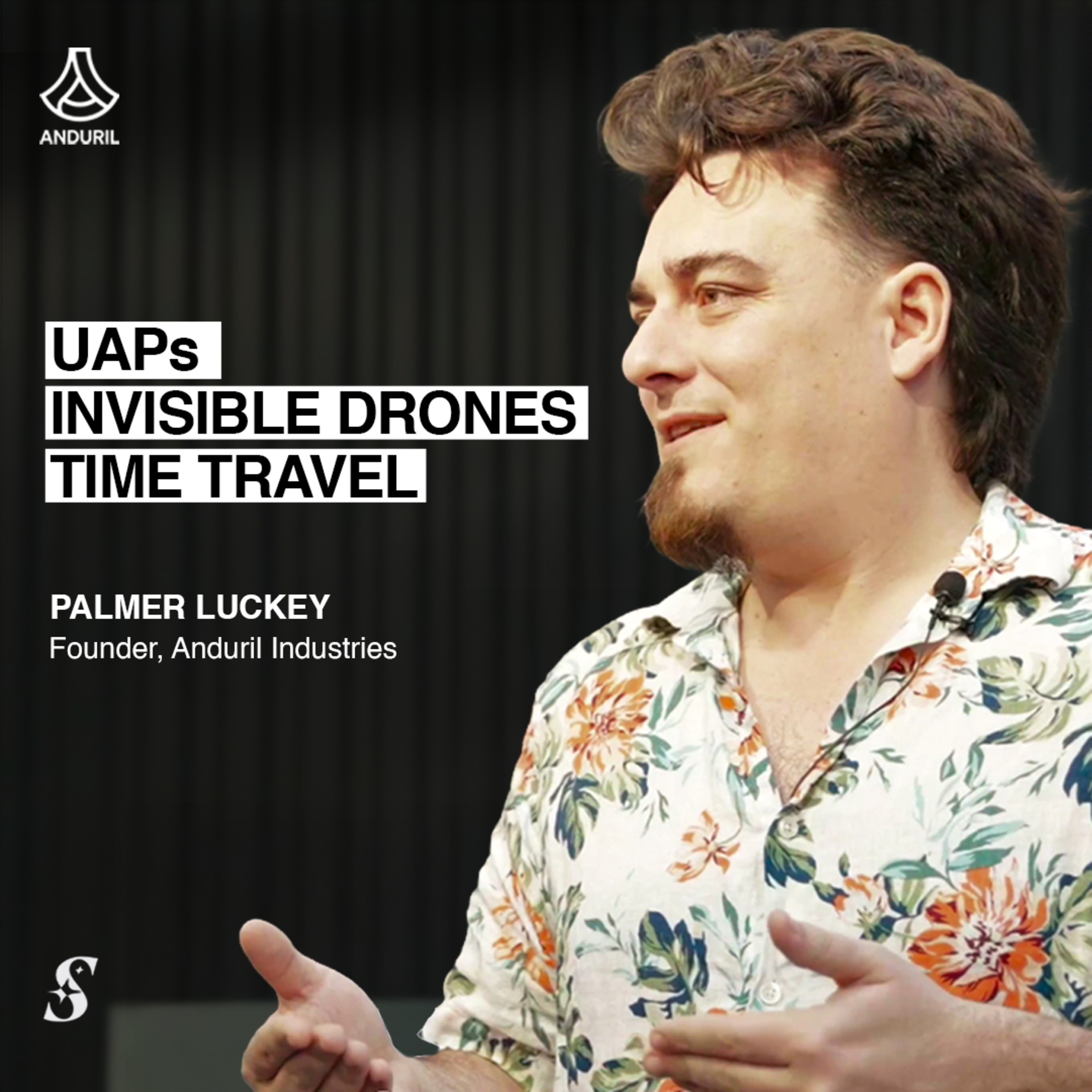
Palmer Luckey states that if UAP technology is real and can be understood, it will obsolete all current defense systems. Therefore, until that breakthrough occurs, military development must proceed on a completely independent track, treating the UAP phenomenon as a separate universe that cannot influence current strategy.
According to physicist Hal Puthoff, UAPs operate within Einstein's theory of general relativity. They don't travel faster than light but create a "warp bubble" by engineering the spacetime metric. This localized bubble separates the craft from the external environment, enabling trans-medium travel.
To protect its secret UAP programs, the U.S. government allegedly created a cultural stigma in the 1940s and 50s. This campaign, which included funding movies depicting aliens as silly, effectively discouraged serious inquiry and ruined the careers of those who spoke up.
The energy required for the "Tic Tac" UAP's maneuvers is so immense that if a human group had it, they would have leapfrogged humanity by thousands of years. The idea such a group exists but hasn't used this power is considered even more far-fetched than the non-human hypothesis.
Instead of subscribing to Hollywood's vision of aliens, Avi Loeb’s Galileo Project takes a data-driven approach. It uses AI to first catalog familiar objects (birds, planes, satellites) to create a baseline, then systematically searches for outliers in appearance, speed, or acceleration that defy known physics.
A key detail from those allegedly involved in crash retrievals is that many recovered craft are empty besides seats. The absence of traditional control panels suggests the craft are operated via a direct consciousness or mind-machine interface.
Contrary to classical physics, space and time are not infinitely divisible. They break down at the "Planck length" and "Planck time," a smallest possible unit. This mirrors the necessary resolution limit of any finite computational system, like pixels on a screen or voxels in a game, suggesting reality is fundamentally digital.

The 'government cover-up' around UFOs may not be about aliens, but about hiding top-secret military projects like stealth aircraft. Allowing UFO narratives to flourish is an effective counter-intelligence strategy, as it provides a fantastical explanation for sightings and discredits credible witnesses.

The reason we don't see aliens (the Fermi Paradox) is not because they are distant, but because our spacetime interface is designed to filter out the overwhelming reality of other conscious agents. The "headset" hides most of reality to make it manageable, meaning the search for physical extraterrestrial life is fundamentally limited.
