Get your free personalized podcast brief
We scan new podcasts and send you the top 5 insights daily.
According to Replit's CEO, AI agents are more effective when interacting with file systems than with SQL. Their underlying models are heavily trained on Unix command-line tools like 'grep', making them naturally better at searching and manipulating text-based files.

Related Insights
The power of tools like Claude Code comes from giving the AI access to fundamental command-line tools (e.g., `bash`, `grep`). This allows the AI to compose novel solutions and lets product teams define new features using simple English prompts rather than hard-coded logic.

Initially an add-on, computer use (running shell commands, interacting with file systems and databases) is now the absolute core of Tasklet's platform. This architectural shift reflects a move towards more fundamental, general-purpose agent capabilities over relying on pre-built API integrations.

While GUIs were built for humans, the terminal is more "empathetic to the machine." Coding agents are more effective using CLIs because it provides a direct, scriptable, and universal way to interact with a system's tools, leveraging vast amounts of pre-trained shell command data.
Claude Code's terminal-based interaction within a specific folder allows it to automatically read and reference local files. This makes "context engineering" drastically faster and more powerful than manually pasting information into a traditional chat interface, as the context is implicitly understood.

Instead of designing tools for human usability, the creator built command-line interfaces (CLIs) that align with how AI models process information. This "agentic-driven" approach allows an AI to easily understand and scale its capabilities across numerous small, single-purpose programs on a user's machine.
The architectural breakthrough of AI agents is the fusion of LLMs with the classic UNIX mindset. It uses a shell, file system, and cron jobs, making the agent's state (its files) independent of the specific LLM. This allows for model-swapping, migration, and self-modification.
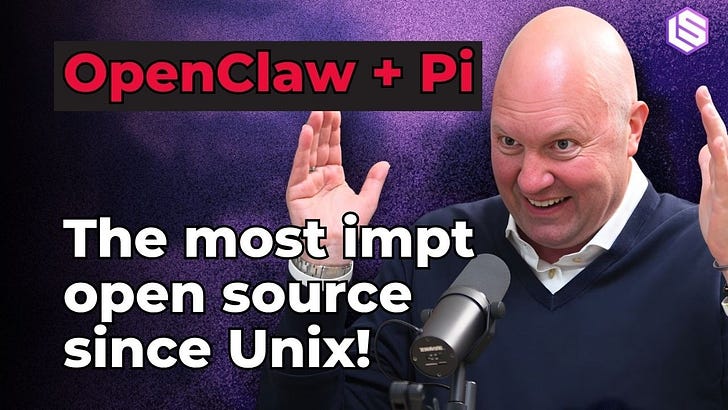
Andreessen presents the modern AI agent's architecture—a language model combined with a Unix shell and file system—as a major software breakthrough. This modular, extensible design mirrors the powerful Unix mindset, enabling agents that are independent of specific models and can modify themselves.

Despite the availability of machine-readable JSON output, coding agents often perform better with standard human-readable text. They can parse it effectively, and it often contains more contextual hints, challenging the assumption that machines always need structured data.
Tools like Claude Code offer superior capabilities beyond standard chatbots. They can access local file systems, enabling them to read and write files, maintain persistent memory, and execute complex, multi-step "recipes" autonomously, acting as a true virtual assistant rather than a simple text generator.

Early AI agents like OpenClaw use simple markdown files for memory. This 'janky' approach is effective because it mirrors a code repository, providing a rich mix of context and random access that agents, trained on code, can efficiently navigate using familiar tools like GREP.