Get your free personalized podcast brief
We scan new podcasts and send you the top 5 insights daily.
The mental effort required to actively conceal your true self and project a false persona is one of the most draining activities for the human brain. This constant self-monitoring and suppression of authentic emotion creates a cognitive load even greater than solving complex mathematical problems.

Related Insights
People lack self-candor not out of delusion, but to project a false image to others. This strategy only deceives other insecure people. Emotionally intelligent 'winners' see through it, causing you to lose credibility with the very people you want to impress.

The persona you consider 'you'—like being the life of the party—might be an ingrained behavior adopted in childhood to compensate for a perceived deficit. True authenticity lies beneath this constructed, and often smaller, version of yourself.

From a young age, we learn to suppress authentic behaviors to gain acceptance from caregivers, a subconscious survival mechanism. This creates a lifelong pattern of choosing acceptance over authenticity, which must be consciously unlearned in adulthood to reconnect with our true selves.
Secrecy is not a passive act but an active process of constant mental monitoring. This cognitive burden increases stress hormones like cortisol and consumes significant mental bandwidth. Studies show this preoccupation can literally take away brain space, resulting in temporarily lower performance on IQ tests.
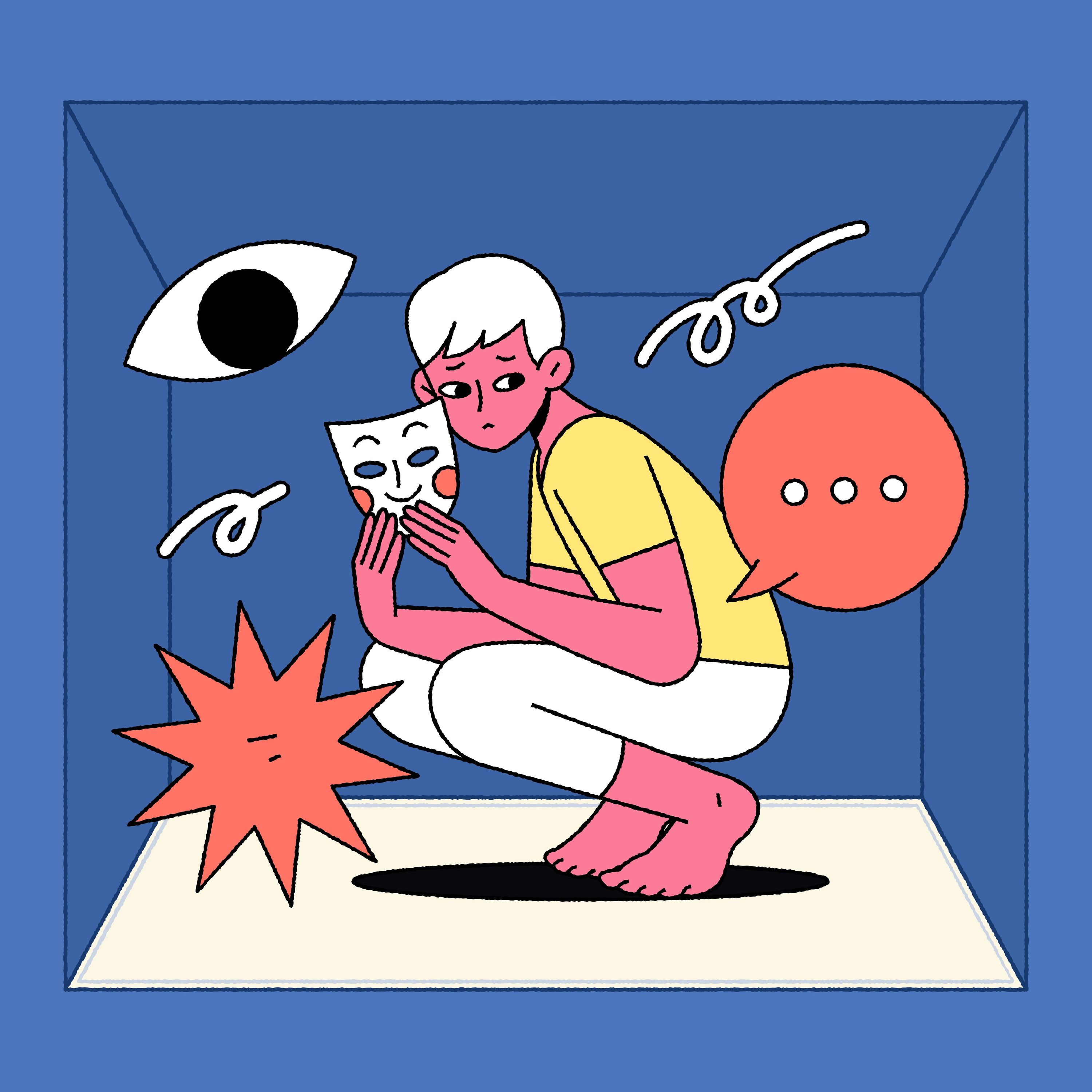
Modern society increasingly selects for traits like low aggression and risk-taking, which are less common on average in men. This requires men to exert a greater degree of effortful 'emotional containment' to adhere to social norms, representing a cognitive and emotional cost that is rarely acknowledged.
The Default Mode Network (DMN) activates during self-referential thought when the mind is idle. Counterintuitively, this "idling" state uses more energy than active concentration on external tasks, indicating that constructing and maintaining our narrative of self is a demanding neurological process.

According to "Truth Default Theory," telling the truth is our natural, low-effort state. Lying is cognitively demanding as it requires inventing and tracking a false narrative, which violates the human tendency toward cognitive ease.

Many highly proficient individuals are driven by a deep-seated fear of being the opposite of what they project. An exceptionally beautiful person may feel ugly, a highly successful person may feel like a failure, and a very competent person may feel useless. Their public persona is a massive compensatory mechanism for this internal lack.
People are more effective at deceiving others about their true motivations when they first deceive themselves. Genuinely believing your own pro-social justification for a self-interested act makes the act more compelling and convincing to others.
Portraying a persona you are not requires constant mental calculation and energy to maintain. Genuine authenticity eliminates this cognitive load, freeing up mental space for faster, more intuitive decision-making. It's an operational advantage disguised as a personal trait.