Get your free personalized podcast brief
We scan new podcasts and send you the top 5 insights daily.
Clements relentlessly championed index funds in hundreds of columns, making him a pivotal figure in shifting American investors from high-fee active management to passive strategies, saving them billions of dollars in fees.

Related Insights
To repeatedly advocate for the 'aggressively boring' strategy of indexing without losing readers, journalist Jonathan Clements mastered the listicle format. He framed consistent advice in novel, often humorous ways to keep it fresh and engaging.
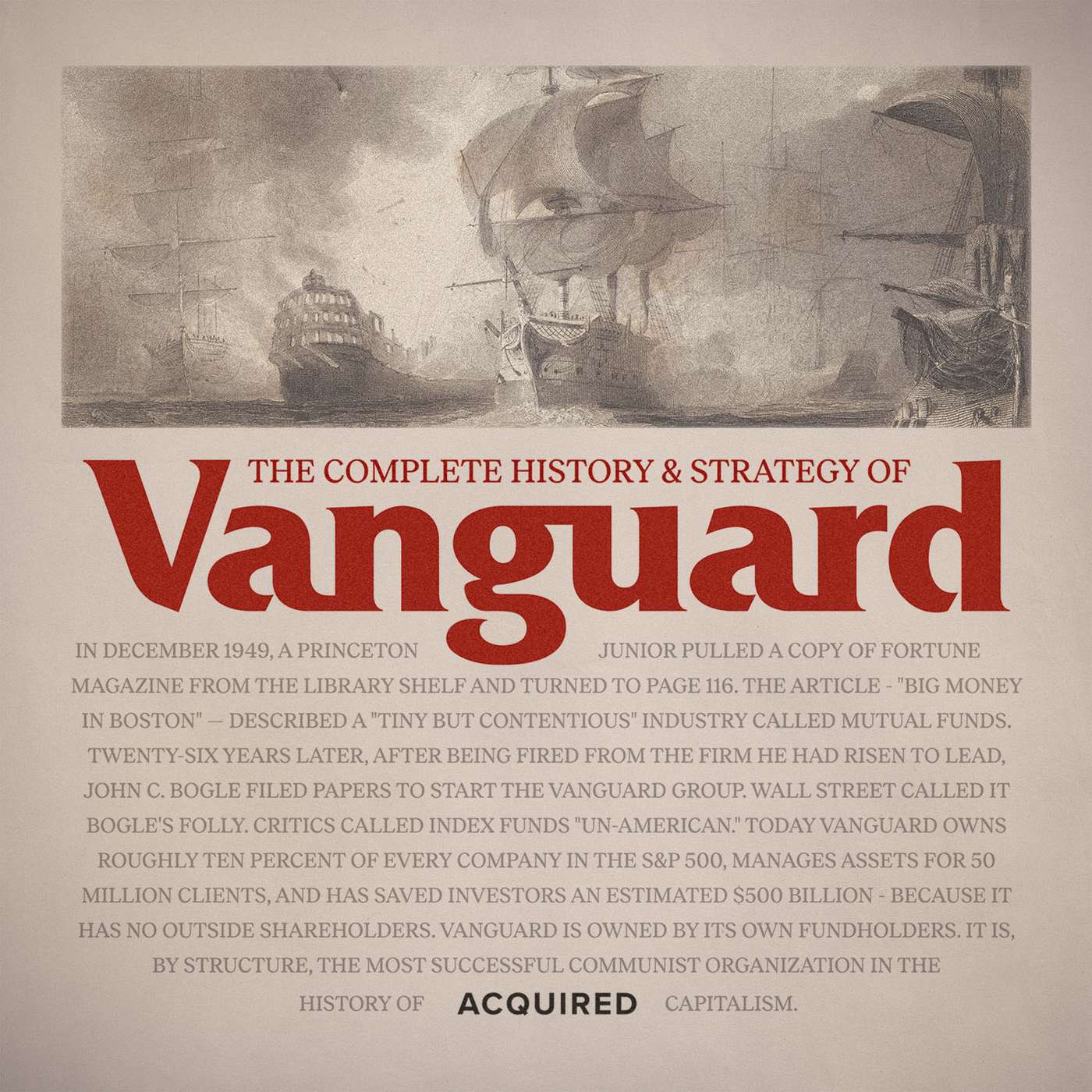
Beyond compounding returns, Jack Bogle's core insight was the destructive power of compounding costs. He showed that a 1% annual fee could consume one-third of an investor's long-term gains (e.g., reducing a $1.5M nest egg to $1M over 40 years), making low fees paramount.
Marks argues that the massive shift to indexation is less a testament to its brilliance and more a direct consequence of the widespread failure of active managers. They consistently underperformed while charging high fees, making the low-cost, average-return option of index funds far more attractive.

Data over the last decade shows that 97% of professional stock pickers, despite their resources, fail to beat a basic market index. Ambitious individuals often fall into the trap of thinking they're the exception. The most reliable path to market wealth is patient, consistent investing in low-cost index funds.

Vanguard's first index fund had a ~2% expense ratio (180 bps), far from today's near-zero fees. This historical fact shows that for innovative financial products, low costs are an outcome of achieving massive scale, not a viable starting point. Early fees must be high enough to build a sustainable business.

Contrary to the belief that indexing creates market inefficiencies, Michael Mauboussin argues the opposite. Indexing removes the weakest, 'closet indexing' players from the active pool, increasing the average skill level of the remaining competition and making it harder to find an edge.
Despite building his fortune on active stock picking, Buffett's will instructs that 90% of his wife's inheritance be invested in a low-cost S&P 500 index fund. This is a powerful admission that for most individuals, even his own family, passive investing is the superior and safer long-term strategy.

Jack Bogle's indexing assumed efficient markets where passive funds accept prices. Now, with passive strategies dominating capital flows, they collectively set prices. This ironically creates the market inefficiencies and price distortions that the original theory assumed didn't exist on such a large scale.

Created to help ordinary Americans invest cheaply, index funds became so successful that the top four now own over 25% of most large U.S. companies. According to Harvard's John Coates, this runaway success has given them massive, unintended power over corporate governance without a mandate to wield it.

Counterintuitively, the case for indexing strengthened as markets became dominated by professionals. In the 1970s, active managers could easily beat unsophisticated retail investors. By the 1990s, with professionals on both sides of every trade, outperformance became much harder, making low-cost indexing superior.